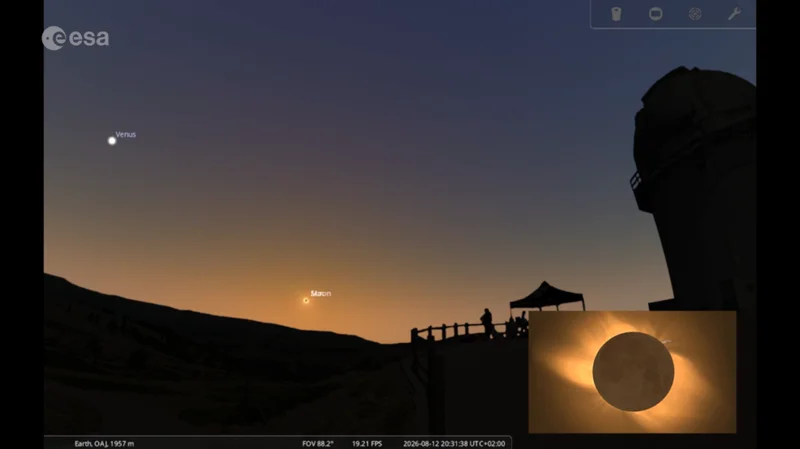
[English] Experience a musical simulation of the 12 August 2026 total solar eclipse as seen from the Observatorio Astrofísico de Javalambre (Spain). Click here for information about ESA’s live broadcast from this observatory, or visit esa.int/solareclipse for an overview of all ESA eclipse activities & resources.
This is a ‘musification’ – an artistic interpretation of a set of data. In this case, the eclipse determines when and how much of each sound is heard. The music is simply the way those data are presented.
This musification is a collaboration ESA’s CESAR team and Rubén García Benito from the Instituto de Astrofísica de Andalucía (IAA-CSIC). It uses nine parameters extracted from a Stellarium simulation of the total solar eclipse:
Arpeggio (the rapid succession of notes): Visible sunlight. Its rhythm, range (spanning almost four octaves), and volume are determined by the light itself; the chord follows the colour of the sky. It fades out as the Sun sets. (The data determine the behaviour; the scale and pattern are artistic choices.)
Pad (background chord): The colour of the light; the redder and warmer the light becomes, the darker the chord. (The colour is the data.)
Bass (sub): The weight of the darkness; deepest during totality. (Data-driven.)
Heartbeat: The tension, reflecting how quickly the light is falling; it comes to rest during totality. (Data: rate of change.)
Bells: The actual contacts C1, C2, maximum eclipse and C3 (there is no C4, as the Sun sets before the eclipse ends). (Sonification: marking a real moment in time.)
Shimmering sound during totality: The solar corona. (A musical element placed at the real event.)
Descending whoosh: The exact moment when the Sun disappears behind the horizon. (An icon of the event; not measured wind.)
Low night drone: The onset of night (entering when the Sun passes below the horizon). (Data: when it happens and to what extent.)
Stars (soft sparkling tones): The stars that become visible at night (but not during totality). (Data: when they appear and how many are visible.)
[Spanish] Vive una simulación musical del eclipse solar total del 12 de agosto de 2026 tal como se verá desde el Observatorio Astrofísico de Javalambre (España). Visita esa.int/solareclipse para consultar un resumen de todas las actividades y recursos de la ESA relacionados con el eclipse.
Se trata de una musificación, es decir, una interpretación artística de un conjunto de datos. En este caso, el eclipse determina cuándo se escucha cada sonido y con qué intensidad. La música es simplemente la forma en que se presentan esos datos.
Esta musificación es fruto de una colaboración entre el equipo CESAR de la ESA y Rubén García Benito, del Instituto de Astrofísica de Andalucía (IAA-CSIC). Utiliza nueve parámetros extraídos de una simulación del eclipse solar total realizada con Stellarium:
• Arpegio (rápida sucesión de notas): La luz solar visible. Su ritmo, extensión (que abarca casi cuatro octavas) y volumen están determinados por la propia luz; el acorde sigue el color del cielo. Se desvanece a medida que el Sol se pone. (Los datos determinan el comportamiento; la escala y el patrón son elecciones artísticas).
• Pad (acorde de fondo): El color de la luz. Cuanto más rojiza y cálida se vuelve la luz, más oscuro es el acorde. (El color es el dato).
• Grave (subgrave): El peso de la oscuridad, que alcanza su máxima intensidad durante la totalidad. (Basado en datos).
• Latido: La tensión, que refleja la rapidez con la que disminuye la luz; se calma durante la totalidad. (Dato: tasa de cambio).
• Campanas: Los contactos reales C1, C2, máximo eclipse y C3 (no hay C4 porque el Sol se pone antes de que termine el eclipse). (Sonificación: marca un instante real en el tiempo).
• Brillo suspendido durante la totalidad: La corona solar. (Elemento musical situado en el momento real del acontecimiento).
• Soplo descendente: El instante exacto en que el Sol desaparece tras el horizonte. (Un recurso sonoro que representa el evento; no se trata de viento medido).
• Zumbido (dron) nocturno grave: El inicio de la noche (cuando el Sol desciende por debajo del horizonte). (Datos: cuándo ocurre y en qué grado).
• Estrellas (suaves tonos centelleantes): Las estrellas que se hacen visibles durante la noche (pero no durante la totalidad). (Datos: cuándo aparecen y cuántas son visibles).