- Published
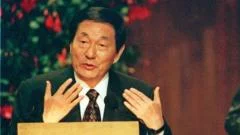
Former Chinese Premier Zhu Rongji, who spearheaded China's entry into global trade and laid the foundation for its explosive growth, has died at the age of 97.
He served in the country's second-highest office from 1998-2003 and played a leading role in securing its entry into the World Trade Organization, opening Chinese factories to the international market and drawing foreign investment.
He was one of the most important economic reformers who moved local tax powers to the central government, closed or privatised failing state firms and promoted home ownership.
Many in China remember him as a tough and pragmatic leader who delivered double-digit growth and wa rarely afraid to speak his mind.
In 1998, he said China was facing "many potential crises that could erupt at any time...
"Ordinary people are discontent about us in many ways. Especially, there is corruption among officials, the gulf between rich and poor and the way some local officials act like tyrants."
He labelled rogue bankers as "half-wits" and said the dams and flood dykes lining the Yangtze River were as "flimsy and porous as tofu dregs".
Under his leadership, which helped stabilise the economy and tackle corruption, China began transforming into a manufacturing powerhouse, leaving behind its status as a Communist outsider.
Though he faced criticism because those reforms also led to 30 million lay-offs over five years, and with huge growth came more inequality.
Chinese state media describe Zhu Rongji's life as one of "revolution, struggle and brilliance".
He was born in the central province of Hunan in 1928 and earned a degree in electrical engineering before joining the civil service.
He joined the Communist Party in 1949, but was purged twice - first after criticising Mao Zedong's economic policies as "irrational" and being labelled a "rightist", and again during the Cultural Revolution.
Zhu was brought back into the fold after Mao's death, and by 1991 had risen to the role of vice-premier in charge of China's economy.
He took the role of premier seven years later.
Zhu led China through difficult negotiations to enter the World Trade Organization in 2002.
In state media his obituary described him as an "outstanding member of the Communist Party of China and loyal Commnist fighter... an outstanding leader of the Party and state".