From launchpads to low Earth orbit and beyond, space companies and their affiliates are deploying a familiar marketing tactic – with a new twist. In a space economy projected to reach US$1.8 trillion by 2035, they sell space exploration narratives by appealing to a desire to expand humankind beyond Earth – while downplaying or omitting the negative repercussions for Earth and the space environment. Welcome to the age of starwashing.
You may have heard the term greenwashing, which describes when companies falsely claim that their practices or products are more environmentally friendly than they are, or when their green efforts are insignificant compared to their harmful environmental practices.
Some examples range from auto companies claiming that dumping cars into oceans benefits fish to plastics companies asserting that their products are more easily recycled than they are.
Today, greenwashing often disguises the true nature of corporate activity by appealing to the increasing number of people who care about environmental sustainability.
But greenwashing practices don’t end with those who care about the Earth. As a social work researcher interested in the consequences of commercialism both on and off Earth, I’ve studied how space companies are using similar strategies. Instead of appealing only to a sense of environmental responsibility, however, they also appeal to your sense of cosmic wonder. I call this practice starwashing.
Starwashing can also appeal to an interest in learning about life’s origins, Earth’s place in the universe, or the desire for humans to explore places beyond our planet. For example, positioning a space-related idea, activity, product or policy as a benefit to “all humankind,” even if it could damage Earth or the larger cosmic environment, would be starwashing.
For the benefit of Earth?
Blue Origin is a leading space technology company. Its mission states that it aims both to colonize space and “restore and sustain Earth.”
The company’s founder, Jeff Bezos, envisions building space habitats that could house billions as a solution to environmental catastrophes on Earth. He’s also outlined a vision for moving industry off Earth, most immediately to the Moon.
Bezos’ other company, Amazon, has a carbon footprint larger than dozens of nations, including Ireland, Bolivia and Norway. At face value, moving some of Amazon’s activities into space to lessen its carbon footprint may seem environmentally desirable.
But even if having a fraction of the human population live and work in space one day far in the future were possible, it would not fix pressing environmental crises such as wildfires or climate change in the near term.
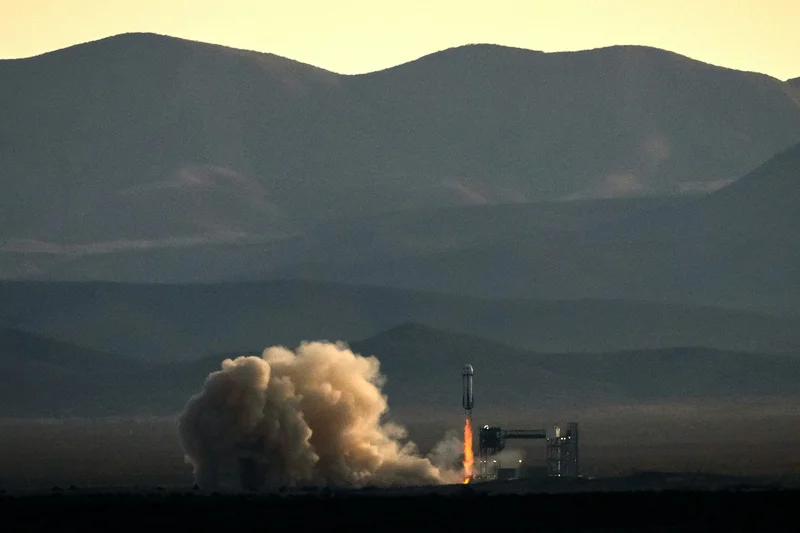
Blue Origin also makes misleading claims about its rocket fuel. Its New Shepard rocket, it says, is “for the benefit of Earth,” with the company claiming that nearly all the rocket fuel’s dry mass is reused. Its engine’s combustion results only in water vapor, with no carbon emissions. But water vapor can amplify atmospheric warming that other greenhouse gases such as carbon dioxide cause, which the statement omits, and on which Blue Origin did not respond to a request for comment.
Mining the Moon
Companies are also racing to extract resources from the Moon for what some, including Blue Origin, say will enable lunar development by reducing trips to and from the Moon. Other companies aim to harvest valuable resources such as helium-3.
These activities will require more frequent rocket launches, which will increase demand for launch sites that use more coastal land and, potentially, ocean waters.
Such ventures will also affect the environment of the Moon. The lunar surface area is less than the combined surface area of North America and South America, and desirable resources are restricted to certain locations – far from limitless. Prime landing locations are also priceless scientific sites that human ventures could endanger.
At an annual Space Resources Week event in Luxembourg, businesses have publicly discussed how to make mining other celestial bodies, including the Moon, more palatable for the public. While the host has suggested coming up with a word that sounds “more beneficial,” venture capitalists have proposed a marketing campaign to divert the focus from environmental damage off-Earth by espousing space’s promises for pharmaceutical research and wireless connectivity.
A crowded low Earth orbit
Artificial intelligence, referred to by financial experts as a “key” ingredient for space economy growth, is also relevant.
Bezos and Elon Musk both have companies that build and rely on resource-intensive data centers based on land. They’ve espoused plans to construct solar-powered orbital data centers and to help other companies such as Google do the same. They frame these plans as environmentally beneficial because an orbital data center wouldn’t require the same amount of water or electricity as a data center on Earth.
But orbital data centers, made up of satellite clusters, would add to an already-crowded space environment.
Blue Origin has already launched thousands of new internet satellites to keep pace with Musk’s company SpaceX, which has launched tens of thousands of satellites and plans to launch 1 million to power AI data centers. These satellites can threaten Earth-based astronomy, pollute Earth’s orbit with debris and damage the ozone layer when they burn up in the atmosphere.
In February 2026, Musk admitted that terrestrial AI data centers impose unsustainable “hardship on communities and the environment.” But his company continues to build them, and analysts suggest that he took SpaceX public to fund AI ambitions, not space travel. While the SpaceX brand relies on exciting notions of sending people into space, the company leases unused computing power to AI competitors at its Colossus data complex in Memphis, Tennessee, where environmental groups have alleged the center’s emissions violate the Clean Air Act.
Star appeal
Companies sometimes use “stars” – as in celebrities – in these starwashing practices. In 2021, SpaceX partnered with businessman Jared Isaacman, who is now the NASA administrator, to advertise seats on the first all-civilian flight to orbit, Inspiration4. They ran a Super Bowl commercial that showed the Earth reflected in an astronaut’s helmet, accompanied by singer Celeste’s soulful rendition of “Twinkle Twinkle Little Star.”
Blue Origin transformed celebrities into space tourists to display its launch capabilities. On April 14, 2025, it helped an all-female crew, including pop star Katy Perry, fly to suborbital space for four minutes. While Blue Origin showed off its New Shepard rocket, Perry promoted her upcoming tour.
Benefiting ‘all humankind’
The Outer Space Treaty of 1967 obligates nations to explore space for the benefit of all countries as the “province of all mankind.”
SpaceX, for instance, purportedly aims to save humanity from future environmental catastrophes, like the asteroid that killed the dinosaurs, by colonizing the Moon and Mars.
This philosophy bypasses intersecting environmental crises such as climate change and biodiversity loss that are more probable near-term threats to Earth’s inhabitability than the kind of catastrophic asteroid impact estimated to occur once every few million years.
As U.S.-based space companies, principal among them SpaceX, receive billions in taxpayer-funded contracts, their environmental effects both on and beyond Earth will grow. An open question is whether all of humankind will reap the benefits of space, as the Outer Space Treaty asks.
A new movement?
In 1968, the Apollo 8 crew captured the first color photograph of Earth from space: “Earthrise.” It helped inspire the environmental movement of the last century, which included holding companies accountable for greenwashing.
This past April, the Artemis II crew captured the earlier photo’s counterpart, “Earthset.” This image of our blue marble setting behind the Moon captivated people across the world.
Whether it will motivate an off-Earth environmental movement – one that holds space companies accountable for starwashing practices – is yet to be seen.