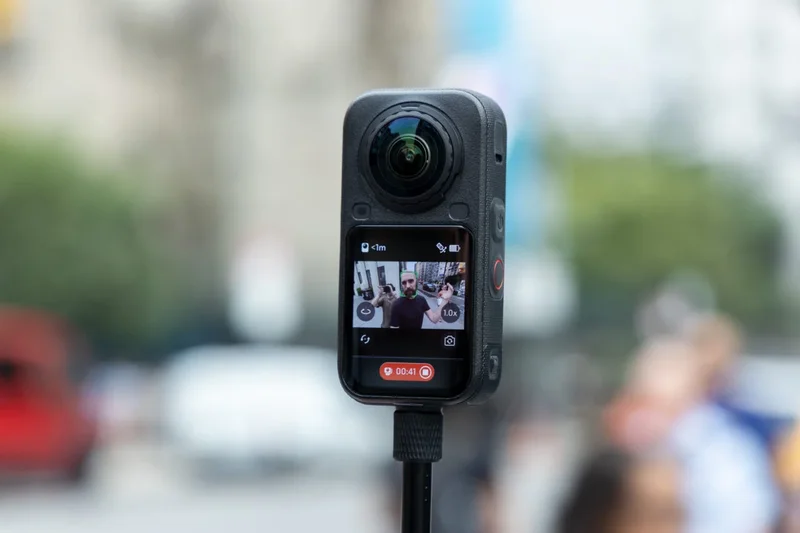
Insta360âs new X6 360 camera is not breaking new ground in 360 cameras. Itâs just doing everything better than anybody else.
Itâs video quality beyond anything else that sets the X6 apart. But does that mean it can be your one and only action shooter, as Insta360 keeps droning on about? Letâs imagine youâre a budget videographer, a starter influencer, a ragtag street sports star, or youâre just an average Joe or Jane who would like some video of their weekend getaway to post to friends on Instagram. If you only wanted one single camera and nothing more, the Insta360 X6 may be your best answer. Just know that the X6 is still not straightforward, and no 360 will ever be.
Insta360 X6
This 360 camera offers some excellent quality shots in either 360 or linear formats. Just don't think of it as your only camera.
Pros
- Excellent low-light shooting
- Plenty of 360 and gimbal modes
- New haptic touchscreen
- 47GB built-in storage
- Excellent battery life
Cons
- Gimbal mode isn't all it's cracked up to be
- Still a bit heavy
- Slo-mo mode on the fritz
- $150 more than the X5
For what it’s worth, Insta360 has made the 360 camera space what it is today. Even with companies like DJI and GoPro nipping at its heels, the new $700 X6 once again claims the top spot for fish-eye action shooters. Itâs thanks to three things: the improved 1/1.1-inch sensor, the excellent 360-video processing inside the camera, and a few new software features that will turn your X6 into a pseudo gimbal vlogging camera, kind of like the recent Luna Ultra that Insta360 is simultaneously determined to sell you on.
Itâs an absolutely stacked camera, in any case. It features a great battery life and more shooting options than ever. Which is to say, for $700, youâre spending $150 more than the $550 X5 cost at launch last April. Thatâs a fish-eye-sized pill to swallow for what is certainly the most feature-packed 360 camera available today. The footage alone may be worth it. At the price, it probably should be the only camera you buy for a good while.
Shorter, but with a better lens
Insta360 has really honed its capabilities over the last few generations of 360 cameras. The companyâs X4 Air may be its starting camera. The X6 is certainly its most premium package. Itâs still making use of two large lenses that capture 180 degrees in front; the two images are then stitched together to help the footage appear like it was captured as one continuous orb of media.
The difference is down to the sensor size. Insta360 calls its new sensors co-developed by Sony â1-inch equivalent,” though in reality the X6 is built around dual 1/1.1-inch sensors. The company still claims its new lenses capture more with a 33% boost in sensor area compared to the 1/1.28-inch sensors on the X5. But thatâs only the start. The X6 includes a 2.44um pixel size at 8K with 14.5 stops of dynamic range. With its larger lenses, this thing is built for arenas with minimal light.
If youâve tried more than one of Insta360’s previous-gen cameras, you’ve likely seen them lengthen over time. Most barely fit in your pants pocket anymore. The X6 shrinks things a bit and now measures about 2 x 3 inches while still maintaining the thin stick-like design. Competitors like the DJI Osmo 360 and the GoPro Max 2 are more square-shaped. In the end, it makes little difference, since the X6 weighs more than DJI’s camera at 6.9 ounches (0.43 pounds). To add to the premium feel, Insta360 also coupled its new camera with an OLED display. Will a prettier 2.32-inch screen matter much when performing hands-free shooting? Probably not.
Besides the size, the other big upgrades to the camera body are the inclusion of 360-degree microphones that capture the audio no matter where your subject is. Thereâs even an extra, specially designed mic built to handle engine noise when riding a dirt bike or off-road quad scenario. Insta360 also claims they upgraded the durability of their dual lenses, but in either case you can remove and replace them if need be.
Insta360 says it put extra effort into its camera’s internals as well. The X6 relies on an 8-core 3.3 GHz 4nm processor made by Qualcomm as its main chip, but it includes two other imaging chips. This extra processing is built to allow the camera to identify ambient light and adjust settings on the fly. It’s a big reason this camera does so well in what would normally be terrible lighting conditions.
Low-light 360 footage has never been better
Increasingly, Insta360 imagines its 360 cameras as a set-it-and-forget-it device. With all its automatic shooting modes, the X6 is more hands-free than ever.
I was surprised that, even in the darkest areas with such poor lighting, the resulting footage looked so damn detailed. The camera’s PureView low-light modeâwhich activates automatically in dim settingsâhelps boost the high ISO, but it also offers enough denoising to remove much of the graininess I would see on competing cameras like the DJI Osmo 360.
I have multiple uses for a 360 camera. As I do for all my action camera reviews, I take these devices to my historical sword fighting classes. Normally, the dim fluorescent lights make my fencing footage look muddied and marred with annoying blown-out highlights whenever the overhead lights come into frame. I also use these kinds of cameras for my day job, taking video of consumer products in various lighting conditions. You would be amazed how many massive tech firms with multi-billion budgets keep showing off gadgets in the absolute worst places to film.
In a dim basement gym and recording in a product showcase that could best be described as â80s arcade levels of dark, the X6 still managed to capture some details I usually expect would get lost completely in these settings. Without any need to adjust ISO or aperture, the X6 did all the hard work for me, allowing me to only think about where I was standing so I didn’t get smacked with any rogue length of steel.
While I shot the above footage without any extra settings enabled, the X6 now supports native shooting with I-Log color and Dolby Vision for high-dynamic range content. You can only use one of those settings at a time, up to 8K and 30 fps.
Just know that when shooting in either Dolby Vision or I-Log modes, you won’t receive nearly as clean a picture as you would in standard without adjusting other camera settings first. Videographers can tune the color mode as well as shutter, ISO, white balance, and exposure value. It’s just enough control for professionals to get the right shot before editing in post, but I-Log will be more beneficial for those creative types than Dolby Vision. You’ll also want an external microphone to boost speakers’ audio quality. The built-in 360-degree mics are better tuned to crowds than they are for a stand-up or even a personal vlog.
So, what about non-360 footage?
One of the big upgrades for the X6 was the introduction of a faux-gimbal mode that enables a kind of face-tracking. You can shoot in this “InstaFrame 2.0” mode with a stable linear video at 4K up to 30 fps. If youâre taking regular linear footage, you can push the frame rate up to 60. Just like a gimbal camera, you can wave your wand wherever, and the software will center you in the middle of the frame.
In the abstract, this mode could be even better than a mechanical gimbal camera like the DJI Osmo Pocket 4, whose range of motion is limited by the speed and degree of rotation of its gimbal function. The footage I caught with the X6 came out perfectly workable for the average video blogger. The face tracking was so effective that I could literally flip the entire X6 along with its telescoping handle in the air, and the camera still managed to stay centered on my face.
Insta360 even promotes a special magnetic Mini Remote you can use to add pan or rotation effects to your shots. The one thing missing from this function is an option to recenter the tracking to various corners of the frame. If I want to keep my face on the bottom left of each shot so I can force more subjects into view, I would have to turn off face tracking altogether and film in 360 mode. Itâs a simple software solution that I imagine could be ripped out of the $770 Luna Ultra without much fuss.
It’s a working alternative to a gimbal camera, though if you were looking for a dedicated vlogging shooter, the X6 wouldnât be your best option. The other variants for linear shooting involve more of the same 4K, PureView, and flat photo options. The Luna Ultra or DJI Osmo Pocket 4 Pro costs more, but they’re still going to offer you better results.
The same can be said for a few other modes, like its âBullet Timeâ slow-motion recording capabilities. This mode takes video at 8K in 360 degrees at a promised 100 fps or 4K at a whopping 240 fps. I couldnât actually gather any usable footage in this mode during my testing, as the frame remained locked at the stitching line between the two lenses. This may be a feature that could get better at release when not using early beta software. For now, the GoPro Mission 1 Pro is still your best option for small-sized slo-mo.
Found footage in every shot
The other shooting modes are more niche. Thereâs “Loop Recording” and “Road Mode” built for long stretches of recording with the camera on the back of your bike. Thereâs also a standard static “Timelapse” setting and a “Starlapse” for when you can actually get to a place without the light pollution to witness a sea of stars. Either way, the vast majority of your time with the X6 will be spent shooting in either standard 8K 360 or 4K in linear modes.
When you want to rip your footage off the camera, you can either do it the old-fashioned way, by either connecting the camera or SD card to your computer or by relying on Insta360âs app. The new addition to this ecosystem is called the âAI Frameâ feature. Essentially, the company promises you donât have to do any extra work to rejigger your 360 footage into something that looks good enough to post to Instagram in the regular 9:16 format. Indeed, some of the preset looks for these videos are as obnoxious as the worst TikToks that crawl into your feed.
It works, up to a point. Sure, it will keep people in frame, but what if I donât want to focus on my face and instead focus on some object that is my true subject? I shoot enough product video that I would want the option to tell the AI to look at the computer mouse rather than my bored mug. You can indeed go into the AI-edited video to further fine-tune the chip. You just wonât have the option to dewarp the AI clips.
So, inevitably, I turned to Insta360 Studio on PC and Mac and had to suffer through the annoyances of keyframes. You canât expect a 360 camera to be as simple as a standard fixed lens setup. This camera makes gathering footage easier, but not editing it.
The AI Frame feature further exacerbated common problems with these sorts of cameras. I noticed a few instances in my footage where the stitching effectâcaused by the camera bringing together footage from the two lensesâwould look warped. In my testing, the footage can also be prone to shudders even if you accidentally shake or bump it. This is a common issue with most 360 cameras, though I experienced it too many times in my editing efforts.
Extra storage and extra battery
The finer upgrades from the X5 to the X6 deserve some mention as well, some of which I didnât have the opportunity to actually test. Insta360 upgraded the waterproofing to IP68, and now it promises you can go 20 meters (65 feet) below the surface without needing the diving case. The case accessory pushes the depth up to 60 meters, or 196 feet.
The other features will help many more users. The camera now includes 47GB of on-device backup storage, just in case you accidentally max out your microSD card. The upgrade to Wi-Fi 6 and USB 3.0 will increase data transfer speeds with or without a cable. Thereâs even a handy NFC (near-field communication) feature that will let you instantly connect your camera to the app by tapping your phone to the X6.
The X6 is simply more tactile than other competing 360 cameras. You can now tap the screen to start recording, and the X6 features small haptic feedback when you’re surfing through menus. But of all the upgrades over the X5, the most significant is the battery life. Insta360 went with a 2600mAh âXtremeâ battery for the X6. During my testing, I was regularly recording at 8K and 30 fps, and despite taking nearly an hour of video in a single session, I was only down to about 56%. I could easily get more than two hours of recording time before needing to swap out the battery.
No, this isnât your only camera
Beyond any other 360 camera I used, the X6 slides into my recording life with the kind of elegance that has entirely relegated my iPhone camera to what it always should have been: taking pictures of my cat.
Itâs just not my one and only shooter for every scenario. There are some situations where I prefer the X6 above any GoPro-sized camera. Then there are times when I still need a straightforward recorder. Because despite the need to spend $700, it still takes more effort to edit your footage after the fact than if you were to merely pump clips from your phone straight to your TikTok account in machine gun fashion.
And does the footage really appear the equivalent of $150 better than an X5 or more than $230 over a DJI Osmo 360? If I had to hazard a guess, not for the vast majority of people who consider buying a camera. For the best 360 camera video quality, youâll have to spend more. At least youâre netting yourself a good camera in the process.