Your support helps us to tell the story
From reproductive rights to climate change to Big Tech, The Independent is on the ground when the story is developing. Whether it's investigating the financials of Elon Musk's pro-Trump PAC or producing our latest documentary, 'The A Word', which shines a light on the American women fighting for reproductive rights, we know how important it is to parse out the facts from the messaging.
At such a critical moment in US history, we need reporters on the ground. Your donation allows us to keep sending journalists to speak to both sides of the story.
The Independent is trusted by Americans across the entire political spectrum. And unlike many other quality news outlets, we choose not to lock Americans out of our reporting and analysis with paywalls. We believe quality journalism should be available to everyone, paid for by those who can afford it.
Your support makes all the difference.
Read more
Astronomers are perplexed to find signs of the same as-yet-undiscovered molecule on the surfaces of both Pluto and Saturn’s moon Titan, pointing to a unique shared chemistry between the two worlds billions of miles apart.
Titan is Saturn’s biggest moon, and one of the only worlds with clear evidence of stable surface liquid in the Solar System.
In complete contrast, Pluto is a frozen dwarf planet at the edge of the solar system, far colder and about half the size of Titan.
Now, researchers analysing data from Titan and Pluto recorded by Nasa’s James Webb Space Telescope (JWST) have found that the atmospheres of both these worlds share a unique common feature.
“We have found an unidentified absorption feature in JWST spectra of Titan and of Pluto,” scientists wrote in the yet-to-be-published study posted on arXiv.
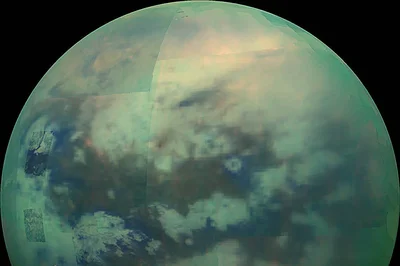
Composite image shows an infrared view of Saturn's moon Titan (Nasa)
In both data sets, scientists have identified a common light absorption feature, which is known to be caused by certain molecules.
But what exactly this molecule is remains a mystery.
Researchers assessed past studies on light absorption bands by molecules, and could not find a match for the feature found on Pluto and Titan anywhere else, they say.
"We did not find any band referenced in these publications that corresponds to the location of the observed absorption in Titan and Pluto,” scientists wrote.
"It's rather mysterious...We cannot say what it is,” said study co-author Bruno Bézard told Space.com.
Experts theorised that acetylene ice and benzene mixed with other molecules could cause the effect, but additional tests are needed to verify whether these chemicals can cause the kind of absorption seen.
“We searched for possible simple ice and organic candidates in the literature and found that only a few of them are plausible: the group of allenes and, if mixed with other species, benzene, ketene or less likely acetylene,” scientists wrote.
Enhanced colour global view of Pluto (Nasa)
There is also some evidence from the data that the molecule is prevalent on the surfaces of both Titan and Pluto, but not their atmospheres.
Both the worlds are known to have methane–nitrogen environments, so scientists now suspect this unique chemistry could be playing a big role in producing this shared molecule.
Researchers hope to assess further JWST observations to map exactly where on Titan signs of the molecule are strongest and narrow down its source.
But the thick atmosphere of Titan makes it difficult to study its surface using telescopes.
Nasa’s Dragonfly spacecraft may help narrow down the list of candidate molecules on Titan's surface, researchers say.
“Dragonfly, the next mission to Titan scheduled to arrive in the mid-2030s, will conduct in situ studies of the surface composition and chemical complexity at various geological sites,” they wrote.