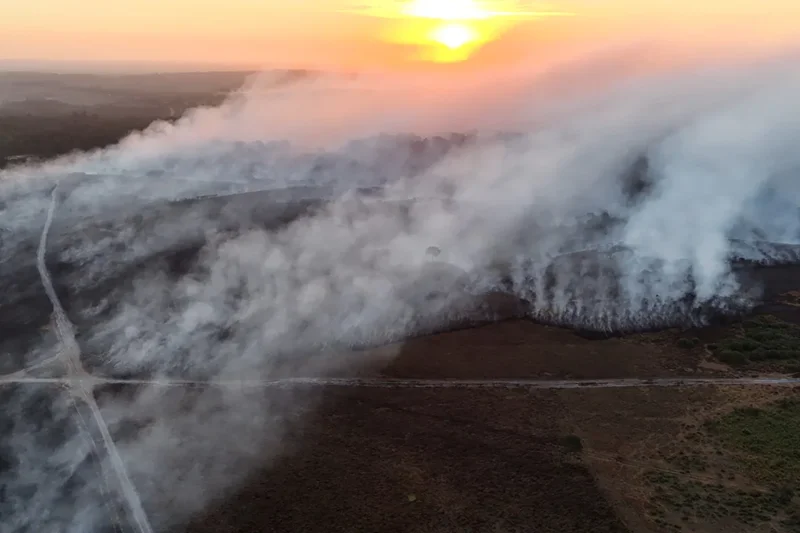
Firefighters have been battling a major blaze in the New Forest for days as dry and blistering heatwave conditions hamper efforts to contain the inferno.
A fire, spreading across more than 1.6 square kilometres of land, started on 9 August and crews say they expect to stay “for several more days” as they contend with water supply issues and volatile wind conditions, amid a near-nationwide drought.
Shantha Dickinson, of Hampshire and Isle of Wight Fire and Rescue Service, said it had been a “very challenging few months so far for wildfires”, adding that tackling them was “incredibly resource-intensive”.
The service, aided by crews from neighbouring services, initially deployed 26 fire engines along with four water carriers to the A31 eastbound following 160 emergency calls regarding a van catching fire on Sunday evening.
The flames spread from the burning vehicle onto the central reservation and then into nearby heathland, travelling south-easterly towards Backley Bottom in what has been described as a "challenging rural location".
The ongoing blaze in the New Forest is just one of many wildfires that have broken out across the country this year during what is on course to be the hottest summer on record.
Drought has been declared in about 70 per cent of the country, putting millions of people under water restrictions and hosepipe bans, just as the UK has entered its fifth heatwave of the year.
The dry conditions and back-to-back heatwaves have created the perfect conditions for wildfires and there are several still ongoing.
The National Fire Chiefs Council said its services have responded to 966 wildfires this year, including 458 in July alone.
According to Cairngorms National Park in Scotland, there is an ongoing wildfire situation in Glenmore and Strath Nethy.
Although the situation continues to improve and the majority of the national park is unaffected, these areas have remained restricted since the fire started several weeks ago on 15 July.
In England, crews from 23 fire stations across Devon are battling a blaze which broke out in Beacon Heath on 1 August. Firefighters are working to bring the fire under control and prevent it from spreading any further.
A heathland fire in Suffolk, just three miles from the Sizewell B nuclear power station, burned an area the size of 210 football pitches. The fire which started on 29 July, has now been stood down as a major incident.
Suffolk Fire and Rescue Service has said the incident is not over and urged people to stay away from Dunwich Heath and the adjoining beach.
Another fire in Llanwonno, Wales, which has since been extinguished grew to the size of more than 500 football pitches.
A major incident was declared when the mountain fire raged for days from Saturday, 1 August until the incident was stood down on 7 August.
More than 1,400 acres – the equivalent to 900 football pitches – was burnt in a wildfire at Tintwistle Moor, in the Peak District.
A major incident was declared on 12 July due to the scale of the wildfire and by the beginning of August the alert was stood down.
Plumes of white smoke could be seen as far as Fife when Arthur's seat in Edinburgh caught fire again in July.
Six fire engines were sent to tackle the grassfire and crews worked overnight to get the blaze under control.