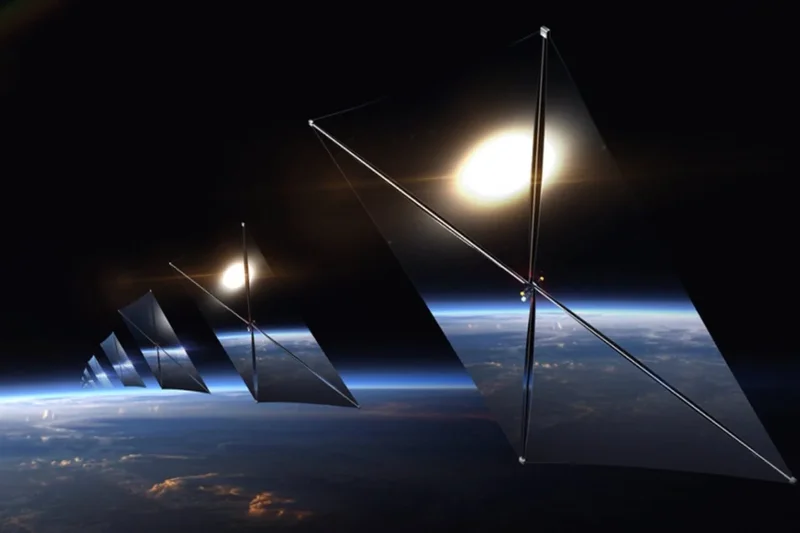
A California-based startup’s wild idea to deliver sunlight after dark may pose a serious health hazard for those gazing up at the night skies, experts are warning.
The Federal Communications Commission (FCC) recently gave the green light for Reflect Orbital to launch its prototype satellite, which will test its ability to reflect light down to Earth. If all goes well, the company is hoping to launch thousands more of its in-space mirrors. The proposed constellation would not only disrupt astronomers’ views of the cosmos, it could also result in permanent eye damage, The Verge reported.
Space reflection
The idea behind Reflect Orbital’s proposed constellation is simple: bouncing sunlight off a mirror and reflecting it onto a designated area. To do that, the company wants to deploy up to 50,000 in-space mirrors mounted on satellites to low-Earth orbit. Its prototype satellite, named Earendil-1, is designed to deploy a 59-foot (18-meter) film reflector when it launches to space later this year.
Reflect Orbital would use its satellite constellation to illuminate areas up to 3 miles (5 kilometers) at a time with intensities ranging between 0.8 and 2.3 lux. By comparison, a full Moon provides an illumination of around 0.05 to 0.3 lux on a clear night.
The company claims it “exists to demonstrate that sunlight from space can be an important part of humanity’s clean-energy future and provide critical lighting at night to save lives,” Reflect Orbital claimed on X. Several astronomy groups, however, have sounded the alarm over the proposed constellation.
The FCC’s approval of Reflect Orbital’s prototype satellite was met with heavy criticism, with four environmental groups filing a petition urging to reverse the decision, NBC reported. DarkSky International also issued a statement in response to the proposed constellation, advocating for âtransparency, environmental review, and public accountability before any such systems are approved or deployed.â
Experts are warning that looking up at the reflected light could damage people’s eyes, similar to a solar eclipse. “Any time you have a solar eclipse, what do meteorologists, astronomers and eye doctors tell you? Donât look at it without protection. Why? Sunlight is incredibly intense,” optical engineer and LED lighting expert Eric Bretschneider told NBC. âPeopleâs eyesight gets damaged, so itâs not a question of if itâs going to happen. Itâs a question of when.â
Similarly, amateur astronomers looking at the night skies through telescopes could easily be blinded if facing the direction of the prototype satellite, Royal Astronomical Society deputy executive director Robert Massey told The Verge.
Bright skies
For its part, Reflect Orbital stated that it works closely with astronomers to mitigate the effects of its satellites as a member of the International Astronomical Unionâs Centre for the Protection of the Dark and Quiet Sky.
âOur satellitesâ default will be âoffâ and we will retain full control to turn them off, dim the light and relocate the spot at any stage,â the company wrote in an emailed statement. âEvery spot of light we deliver will be requested, approved and contained. We will only provide redirected sunlight when it is signed off by the appropriate authorities in the relevant jurisdiction.â
Concerned astronomers worry they wonât know when the satellites will be turned on or where theyâll appear in the night sky, potentially causing them to look directly at the satellites by accident, according to The Verge.
The upcoming launch of the company’s prototype satellite will not only be a test of the technology but also of how much it will affect those gazing up at our skies.