- See more Daily Mail on Google - save us as a Preferred Source
US Vice-President JD Vance told Kyiv to stop targeting oil tankers using a critical Black Sea port, because the strikes were adversely affecting US companies, according to Ukrainian officials.
Ukraine had been carrying out an intense drone campaign against foreign-flag vessels heading for the Caspian Pipeline Consortium (CPC) terminal near Novorossiysk.
Washington became alarmed that Kyiv was further disrupting oil markets and harming American businesses by attacking the vessels carrying crude piped from Kazakhstan to the terminal.
Kyiv has not struck tankers near the CPC terminal since Vance asked President Volodymyr Zelensky to halt the attacks, during a call on July 31.
The country agreed not to attack CPC infrastructure or non-Russian tankers as long as those ships were not under Ukrainian sanctions and were not transporting Russian oil or other Russian cargo, the officials said.
'We very carefully listen to our American partners,' a senior Ukrainian official told the Financial Times, adding that Kyiv has established relevant 'mechanisms' in response to the US request.
The CPC had been 'a regular part of the conversation with the US and the Kazakh governments', the person said.
US energy companies Chevron and ExxonMobil both own stakes in CPC, Kazakhstan’s main oil export route, and in the western Kazakh oilfields that service it.
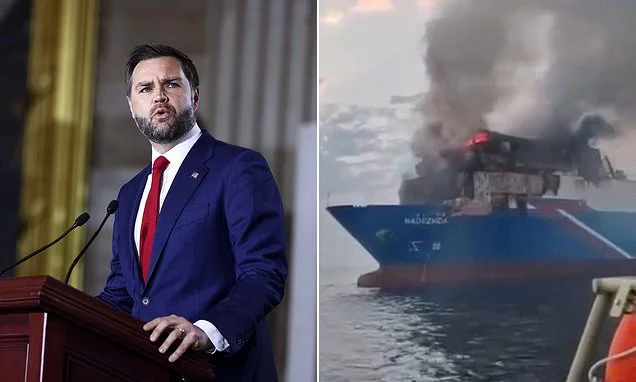
The Nadezhda vessel was struck in a drone attack near Russia’s Black Sea port of Novorossiysk
US Vice-President JD Vance told Kyiv to stop targeting oil tankers using a critical Black Sea port, because the strikes were adversely affecting US companies, according to Ukrainian officials
Smoke rises from a fire on the cargo ship Nadezhda after it was hit in a drone attack near Russia's Black Sea port of Novorossiysk, August 3
Chevron owns 50 per cent of Tengiz, the nation's biggest oilfield, while Exxon owns 25 per cent.
A US official confirmed to the FT that the Trump administration had warned Kyiv to halt its campaign against non-Russian vessels in the Black Sea, as well as CPC infrastructure.
'The administration views the CPC as a vital conduit of Kazakhstan-origin energy for European markets that serves as an alternative to Russian energy supplies,' the official said.
The US vice-president's request is not the first time Washington has attempted to deter Kyiv from hitting American business interests in Russia.
In February, Olha Stefanishyna, then Ukraine’s ambassador to Washington, said that she had received an official diplomatic warning from the US state department, following a Ukrainian drone strike on Novorossiysk port late last year.
'We have been hearing that Ukrainian attacks to Novorossiysk affected some of the American investments,' she said, adding: 'It was related to the very fact that American economic interest was affected there. We have taken note [of] that.'
Kyiv's attacks on the CPC terminal in July - alongside an intense campaign on Russian shipping in the Sea of Azov - caused turmoil, repeatedly forcing Kazakhstan to stop piping oil to Novorossiysk and more than doubling shipping rates and insurance.
As a consequence, CPC loaded just 1.3mn barrels a day last month, down more than 300,000 b/d from June and 600,000 b/d fewer than in May, according to Kpler.
As Middle Eastern supplies remain squeezed by the Iran war, Kazakh crude has become particularly important to global markets.
A vessel chartered by Exxon was struck during the attacks as it waited to load at the CPC terminal on July 17.
A ship chartered by Chevron was also hit by Ukrainian drones towards the end of July, in an attack that also hit three other tankers in the Black Sea near Novorossiysk.
Last month, Chevron chief executive Mike Wirth announced the company was working with Washington and other governments to ensure the 'pipeline stays flowing'.
Ukraine’s strikes were part of a long-range drone campaign on oil infrastructure aimed at choking off revenues that fund Moscow's continuing invasion.
Vance has proved himself to be one of the most controversial figures in the Trump administration’s handling of the Russia-Ukraine war.
He became infamous for reprimanding Zelensky during their first Oval Office meeting in February 2025.
Earlier this year, the US vice-president said halting military assistance to Kyiv was 'one of the things I’m proudest that we’ve done as an administration'.
Ukraine agreed to the Trump administration’s request because it was seeking a US licence to produce Patriot interceptor missiles, a source told the FT.
Kyiv hopes to purchase several hundred of them before the winter, when Moscow is expected to intensify its aerial attacks on essential infrastructure.
During the July 31 call, Zelensky told Vance that Patriots and air defence were his country's 'top priority', the Ukrainian president’s office said.
Kyiv has intensified its campaign against the Kremlin's energy infrastructure elsewhere, striking three refineries deep inside the country this month.
The attacks have severely restricted Russia’s refining capacity, forcing it to suspend exports of fuel and putting pressure on global prices of diesel and petrol.