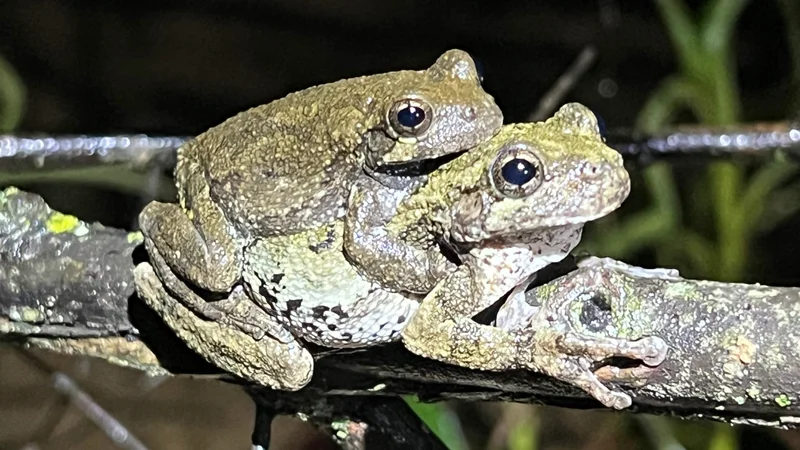
Too many choices is not always a good thing. Even if you are a female Cope’s gray treefrog (Hyla chrysoscelis) searching for a mate. When too many desirable mates croak and screech their availability, the female frogs struggle to make the right choice. This phenomenon called “choice overload” is detailed in a study published today in the journal Cell Press, and may impact how species evolve.
Cope’s gray treefrogs have a wide range. They are found in Virginia west towards Texas and north into Canada. These petite frogs only measure about two-inches long, and have bumpy green or gray skin that can look like tree bark.
“You may encounter them coming up to your window at night to eat the insects that fly toward the light,” study co-author and University of Tennessee, Knoxville animal behavioralist Jessie Tanner explained in a statement.
During mating season from late April into early July, the males serenade females by puffing up their throats and emitting a series of high-pitched vibrations. The females gather around ponds and listen to these “choruses,” which can get very loud. The males make harsh rapid trills that are tolerable for humans at a distance, but can be a bit unpleasant at close range.
To study how the females select the best mate, the team built an amphibious dating arena. The 6.5-foot-wide enclosure is in a soundproof and temperature-controlled room to mimic their natural environment. They placed female frogs one by one into the middle of the enclosure and began the serenade. Several speakers spread around the enclosure played recordings of real male frogs making their mating calls.
Previous research shows that female Cope’s gray treefrogs tend to prefer males with longer calls, so the team mostly played these longer “target” calls. They also added in one or more “distractor” calls that were much shorter. To select which call they preferred, females hopped towards a speaker.
The team observed that more male calls led to more confusion for the females. When they only had two options (one target call and one distractor call) they hopped towards the longer target call 77 percent of the time.
When the females had to listen to eight different males’ calls, they only picked the target call just 25 percent of the time. In some situations, the females got so overwhelmed that they didn’t make any choice at all.
To test if the females were having difficulty hearing individual males amidst all of the extra chatter, they ran an identical experiment but added in background noise of numerous male calls overlapping. This extra noise played from an overhead speaker, but did not have much of an effect on how the females chose mates. This suggests that they were struggling with the number of mates available.
Choice overload like this could shape animal genetics over time. Evolutionary theory suggests that if female treefrogs have strong preferences for males with long calls, the males with short chirps should disappear from populations over time. However, that hasn’t happened yet.
These new results suggest that choice overload could be keeping those males with short calls in the gene pool by causing enough confusion that females end up choosing a mate who is, in theory, less optimal.
“The decisions that females make are really biologically important,” said Tanner. “By choosing a male with a good-sounding call, the females can get genetic benefits for their offspring. But maybe they’re not able to exercise that choice effectively all the time.”