The Tensor G6's new TPU is secretly the best Pixel 11 upgrade no one's talking about
Aug 12, 2026 — 11:00 AM ET
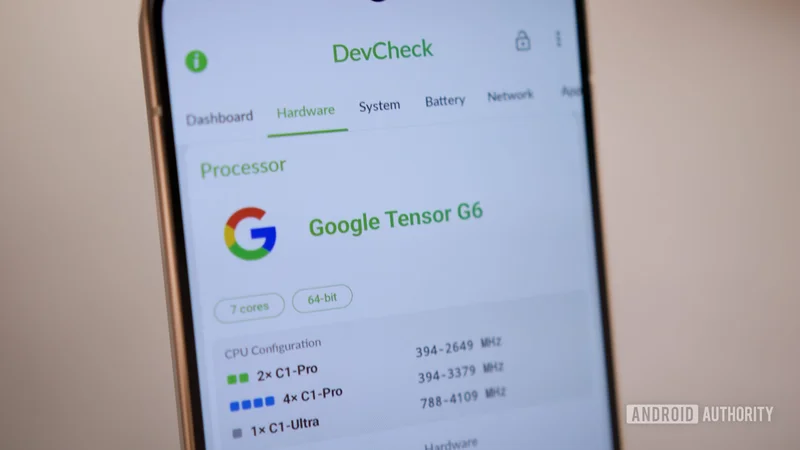
Scouring the new Pixel 11 series for significant hardware changes this year, the biggest standout is the Tensor G6’s new and improved Tensor Processing Unit (TPU). Google says the Tensor G6’s TPU delivers 50% more compute power and up to 3.5x faster performance in some workloads. Impressive numbers, sure — but what does that actually mean when you pick up a Pixel 11?
For starters, let’s get to grips with what the TPU actually does. While Tensor’s CPU handles your apps and its GPU mostly handles games, the TPU is primarily tasked with number-crunching for machine learning workloads, featuring dedicated dot-product matrix math units and high-speed memory access. In other words, it’s the main AI processor inside Google’s Pixel handsets. It’s used for a wide variety of on-device tasks that don’t require the cloud, such as speech recognition, voice transcription, and text suggestions.
If you own a Pixel 10 Pro, are you upgrading to the Pixel 11 Pro?
Google’s TPU also covers a wider range of functions than just booting up Gemini Nano. The TPU is deeply integrated with the Tensor’s image processing pipeline, allowing the Pixel to leverage it as part of a heterogeneous system for computational photography tools like Night Sight, Super Res Zoom, portrait segmentation, video processing, and more. This year’s upgrade is one of the factors behind Google’s ability to extend long-range zoom out to 120x, up from 100x last year.
Bottom line: a more powerful TPU in this year’s Pixel 11 series means more horsepower to run increasingly demanding AI tools without the costs, latency, and privacy issues associated with cloud computing.
New on-device AI features for the Pixel 11
As you’d expect, the Pixel 11 series has a few new AI tricks up its sleeve, powered by its more powerful processor. For starters, Google claims that Gemini Nano delivers higher-quality, lower-latency performance on its newer phones, resulting in more accurate, faster responses to small queries. This is arguably where Pixel 11 owners will feel the TPU upgrade most, not necessarily in 50% faster responses, but in more capable, powerful use cases.
The phones also introduce new voice-to-text capabilities that automatically remove filler words like “um,” helping to form your spoken thoughts into more polished text. The Pixel Camera app now also supports automatic sign language to text translation. Furthermore, Magic Capture takes up to 500 pictures and uses Gemini to determine the best six suggestions — five photos and one video — for you to keep. Live Translate can translate videos, podcasts, and voice messages into your chosen languages as you watch and listen.
Privacy-first AI features are powered by fast, on-device hardware.
Proactive Assistance is perhaps the most broadly useful new tool, surfacing contextual information from across some of your apps, such as your contacts or messages, when you might need them. The idea is to help you stay on top of your schedule and respond to messages and emails quickly. Because Proactive Assistance processes this information on-device, your data can stay in a private, encrypted space.
This is in addition to existing on-device audio and text summaries and smart replies in Gboard. We’ll just have to see how many of these features can be backported to older hardware, or if the new, faster TPU is a solid requirement.
More power for developers
Since mid-2026, it’s been possible for third-party developers to (finally) target the TPU inside Google’s Tensor processors, using LiteRT and the Google Tensor SDK beta. LiteRT, formerly TensorFlow Lite, is Google’s framework for deploying on-device ML and GenAI across various hardware platforms, while the Tensor SDK provides a way to target the TPU on Pixel devices. That latter point is worth highlighting, as the Tensor SDK is still in beta, so don’t expect swathes of new fast AI tools running on the Tensor G6 just yet.
Still, 50% more compute obviously means these developers have more power at their disposal to run their own neural workloads with full hardware acceleration. And the significance here isn’t necessarily that every AI app will suddenly run 50% faster, but that developers have more headroom to run larger or more demanding models locally. That’s potentially useful for everything from translation and transcription to image processing, object recognition, and generative AI.
The TPU keeps Tensor in focus for developers, despite otherwise more mid-range specs.
More importantly, it gives developers another reason to take Tensor’s TPU and other Android hardware acceleration in general more seriously than in recent years, when support was vendor-centric. For Google in particular, a more powerful AI accelerator available to third-party developers is important, as it offsets Tensor’s comparatively modest GPU performance compared to rival silicon — GPUs are often a “backup” option for running some machine learning workloads when dedicated AI accelerators aren’t available.
The important word is eventually. The tools are still maturing, but giving third-party developers access to more capable AI hardware makes our smartphones considerably more interesting as on-device AI evolves. If Google’s developer tools mature and adoption follows, the Tensor G6’s faster TPU could become useful for far more than Google’s own AI features. You can test out some of the possibilities by checking out the Google AI Edge Gallery app.
Not everything needs Tensor’s AI
While Google’s on-device AI improvements are potentially powerful, the fact remains that a significant portion of Android’s and Pixel’s most prominent AI features still rely on the cloud. Gemini Intelligence, for example, not only pulls information from your online Google documents but also runs some of its processing in the cloud. In fact, you’ll want a Google AI Pro subscription to make the most of a lot of Google’s best AI features and to avoid restrictive rate limits.
Likewise, Google’s “Banana” image generator remains cloud-only, as do Video Boost processing features for improving low-light, high-resolution video capture. Point being, while on-device AI is very useful and important, a 50% TPU boost doesn’t suddenly mean that your phone has anywhere near the processing power available from high-performance cloud services. Our phones can’t do it all.
Google's new TPU can't do everything, but it's a step towards more powerful, local AI.
The Pixel 11’s 50% TPU boost doesn’t necessarily mean it’s bringing swathes of groundbreaking features right out of the gate. But it gives Google more headroom for increasingly demanding on-device features, while allowing developers to better leverage Tensor’s AI hardware. Combined with Google’s continued investment in local AI and its expanding developer tools, that’s a meaningful step toward making smartphones more capable AI devices without relying on the cloud for everything.
For users, that means faster, more capable AI that can work without an internet connection, with lower latency and better privacy. It won’t replace the cloud for Google’s most demanding AI workloads, but that’s not really the point. The Tensor G6’s TPU is another step toward shifting more AI processing from data centers onto our phones — and that could ultimately matter more than any individual AI feature launching with the Pixel 11.