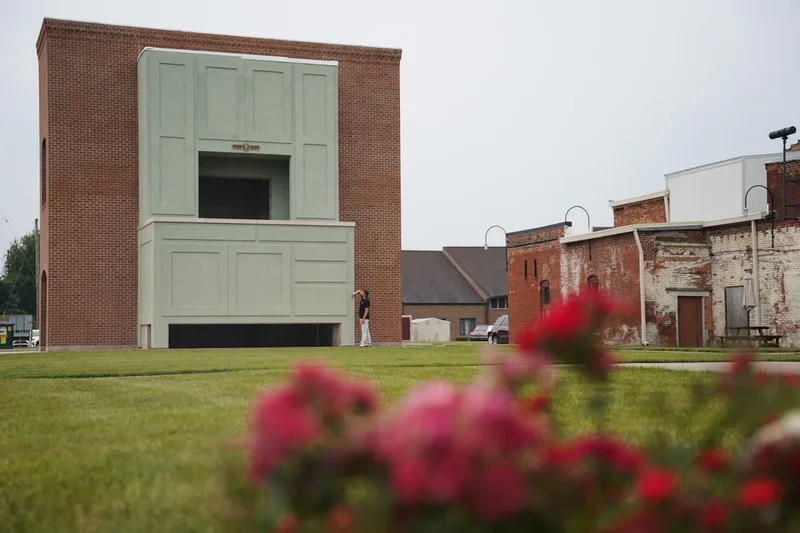
Once a fixture in early 20th-century American homes, the Hoosier cabinet was the original all-in-one kitchen setup. Though long out of favor, an enormous, climbable replica has now been displayed outdoors in a northern Indiana town to highlight the cabinet’s unique history in home cooking.
The 30-foot (9-meter) replica of a Dutch Kitchenette opened last month as part of the 150th anniversary of Coppes Napanee, one of only two remaining firms that manufactured the popular cabinets over a century ago. The item was named after its primary maker, the Hoosier Manufacturing Co.
Promoted as the world’s largest Hoosier cabinet, the structure is built against a brick wall and features stairs leading up to a loft where visitors to Nappanee can take in the view. It overlooks Coppes Commons, the former Coppes Napanee factory site now operating as an indoor marketplace, artisan space, and museum. Next door, the firm continues to build custom cabinets.
Wesley Mast, owner and president of Coppes Napanee, noted that he generally encounters two distinct reactions when people first see the massive installation.
"There’s the one extreme where people are like, ‘Why? Why such a big cabinet?’" Mast said. "And my response is always like, ‘Why not?’"
"The other response we get is like, ‘That’s so cool. Where did you get this idea? I love it.’"
Mast explained that the cabinet "brings us another level of attention and branding and makes this place more of a destination than just a pass-through."
A freestanding workstation and storage unit, the Hoosier cabinet consolidated and accelerated meal prep. The designs enjoyed widespread popularity from the 1890s into the 1930s, but their appeal diminished following World War II as built-in, wall-to-wall cabinetry became standard in modern housing.
A hundred years ago, "this was the kitchen," Mast said. "This was kind of the first piece of furniture that went into the house as a kitchen and was considered all-in-one, the kitchen itself in just one piece."
Nationwide, there were 5,000 dealers selling Hoosier cabinets, according to Mary Figueroa, curator of History at the Indiana State Museum and Historic Sites, which retains four of the units in its collection.
Before the introduction of the Hoosier cabinet, kitchen spaces relied on separate shelving, a solitary table, and a corner cupboard.
"But this was a piece of furniture that kind of consolidated all of that, allowed women to save their steps and have everything that they could possibly need to make a meal right at their fingertips," Figueroa said.
The cabinet offered storage for goods such as flour, sugar, spices, loaves of bread, and additional pantry supplies. They earned the nickname "kitchen pianos" because all required items were kept within easy reach. The units featured built-in flour sifters alongside booklets featuring recipes for meats, soups, breads, and desserts.
Promotional materials even claimed the product would "strengthen your marriage" and "make you more beautiful" by saving steps and time for women, Figueroa noted.
Nappanee sits in Elkhart County, an area recognized as a major U.S. center for recreational vehicle manufacturing, wood production, and the country's third-largest Amish settlement. It is located roughly 150 miles (241 kilometers) north of Indianapolis.
Now, Nappanee can also feature the massive cabinet as a drawing card for travelers.
"It’s bringing awareness," Figueroa said. "I mean, you can’t miss it."