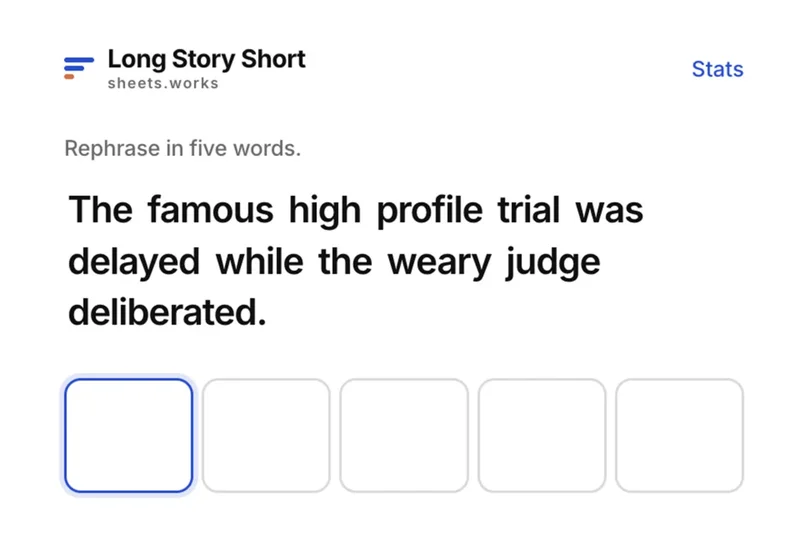
If youâre a company and you havenât launched your own Wordle-esque two-minute game, are you even really in business? It seems to be a rite of passage for agencies and social platforms to devise addictive little time sinks for which people can reach when they have a couple of minutes to killâand Long Story Short, launched earlier this week, is a company called Sheets.Worksâ contribution to the genre.
The game works like this: you’re provided with a 12-word sentence, and you have to choose five of those words to convey all the original sentenceâs information. The starting sentences are deliberately verbose (or, at least, I hope they are.) Todayâs example is this: âThe famous high profile trial was delayed while the weary judge deliberated.â
I wonât spoil the answer, although itâs pretty straightforward. But that answer does illustrate a couple of frustrating things about this game. If I had to reduce that sentence to five words, Iâd probably end up with something like, âJudicial deliberations delay prominent trial.â But you canât change the words in any way, which means youâre stuck with either âfamousâ (not really the right word in this case) or âhigh profileâ (better, but itâs two words, which means 40% of your sentence is a compound adjective). You also canât change the part of speech a word is filling (so the noun âjudgeâ canât become âjudicialâ) or even the tense of a verb (so  âdelayedâ canât become âdelayâ.)
Ultimately, though, the biggest problem with Long Story Short is that itâs an inherently subjective exercise. With, say, Wordle, youâre either right or wrong. A letter is either part of the answer or it isnât. Thatâs not the case here. In fairness to Long Story Shortâs designers, they do seem to appreciate this, and the game provides its reasoning for the chosen words once youâre done. In this case, for example, it doesnât like retaining âdeliberatedâ because thatâs âwhat judges do every day.â But there are many reasons why a judge might delay a trial beyond having a good long think.
And here I am, thinking way too much about how to edit a sentence. A generation ago, I might have applauded the ingenuity of a game that honestly couldnât have been designed better to appeal to journalists and editors, but frankly, I doubt that anyoneâs thinking that way in 2026.
What’s the point of this little game anyway?
If thereâs any underlying motivation about which to wonder, itâs this: I do hope that this game doesnât serve to teach brevity and concision to large language models. One of the aspects of AI writing that still gives its non-human provenance away fairly regularly is its propensity to waffle on without saying anything in particular. LLMs often produce writing that sounds like a high school student trying desperately to meet a minimum word count, and itâd be awfully disappointing if this ended up as some sort of crowd-sourced exercise in teaching it not to do so.
To be clear, I have no reason to believe this is the case. Itâs just that⦠well, to cut a long story short, as it were, itâs that after a couple of yearsâ worth of watching the work of writers and editors being slurped up wholesale and without compensation to train the godawful chatbots that are still merrily assisting people to harm themselvesâand creating unprecedented environmental strain while they do soâIâm perhaps a little more cynical than I used to be. Sorry. But not really.
But, yâknow, whatever. This is a fun little game that teaches you to edit sentences. Knock yourselves out.