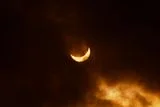
On Aug. 12, 2026, a total solar eclipse will sweep across parts of Spain, Portugal, and Iceland, becoming the first such eclipse to hit mainland Europe in the 21st century.
After nearly three decades of waiting, viewers who will be stuck inside during the eclipse might worry they have missed their chance to see the skies darken and the sun disappear. But luckily, European skywatchers will get a second chance in less than a year, when the 2027 “Eclipse of the Century” rolls around.
Read More: The 2026 Total Solar Eclipse Is Here — How and Where to See It, and Why Totality Is a Rare Event
When to See the ‘Eclipse of the Century’
After Aug. 12, 2026, the next total eclipse in Europe will be a biggie. Called the “Eclipse of the Century,” this eclipse will darken skies on Aug. 2, 2027, in southern Spain and across parts of the Middle East and North Africa. It will also create a partial eclipse across much of Sub-Saharan Africa, Europe, India and Southeast Asia.
Experts are saying this eclipse will be massive and also unusually long. In its peak of totality — where the eclipse lasts longest — a region of eastern Egypt will be plunged into darkness for nearly six and a half minutes. Of every eclipse in the 21st century, only the July 22, 2009 eclipse had a longer central duration. The longest eclipse on record, however, was over 7 minutes long.
Read More: 5 of the Longest, Shortest, and Most Important Solar Eclipses Ever Recorded
How to Measure the Magnitude of an Eclipse
How are experts able to predict the size of an eclipse? It comes down to math, according to NASA. By calculating the eclipse's magnitude — which represents how much of the sun’s diameter is obscured by the moon — experts can calculate the size of the eclipse.
Total eclipses always have a magnitude greater than 1, but the magnitude of 1.079 seen in the 2027 eclipse will be the largest for the rest of the century, and is again only outscored in the 21st century by the 2009 eclipse.
Read More: Not Every Solar Eclipse Brings Darkness — Here's Why Every Eclipse Is Unique
How to View the Eclipse Safely
Whether you’re an eclipse chaser or casual viewer, don’t forget to bring proper eye protection while viewing the eclipse. NASA states that it is never a good idea to look directly at the sun, as it can damage your eyes, even during an eclipse. However, once totality of a total solar eclipse is reached, it is okay to take eye protection off and observe your surroundings, but be sure to replace your protective eyewear before totality ends.
Instead, make sure to use official eclipse glasses or viewers to get the best view of this amazing event and keep your eyes safe.
Read More: When a Total Solar Eclipse Darkened an Empty Zoo, Macaques Climbed and Zebras Ran
What Comes Next for Eclipses?
Now, if you're not able to attend both Aug. 12, 2026, and Aug. 2, 2027 solar eclipses, don’t despair entirely. There will be more total eclipses this century — 68 in total — and there will be one in 2028.
However, European eclipse-chasers better start saving up for a big trip now, because the 2028 eclipse will only be visible in totality from Antarctica, Australia, and New Zealand. If your budget doesn’t extend to a continent-hopping voyage, you will have to wait until 2053 for the next European eclipse, which will once again brush across the southern tip of Spain.
Read More: A Total Solar Eclipse and the Perseids Meteor Shower Will Share the Sky in August 2026
Article Sources
Our writers at Discovermagazine.com use peer-reviewed studies and high-quality sources for our articles, and our editors review for scientific accuracy and editorial standards. Review the sources used below for this article:
- This article references information from NASA: Eclipses: Frequently Asked Questions