Your support helps us to tell the story
From reproductive rights to climate change to Big Tech, The Independent is on the ground when the story is developing. Whether it's investigating the financials of Elon Musk's pro-Trump PAC or producing our latest documentary, 'The A Word', which shines a light on the American women fighting for reproductive rights, we know how important it is to parse out the facts from the messaging.
At such a critical moment in US history, we need reporters on the ground. Your donation allows us to keep sending journalists to speak to both sides of the story.
The Independent is trusted by Americans across the entire political spectrum. And unlike many other quality news outlets, we choose not to lock Americans out of our reporting and analysis with paywalls. We believe quality journalism should be available to everyone, paid for by those who can afford it.
Your support makes all the difference.
Read more
We’ve all been there: the jeans that felt so great when you bought them a few months ago just won’t do up. Is it the giant bowl of pasta you ate at lunch? Is it just a bit of hormonal bloating? Or has your weight fluctuated?
Whatever the reason, this is a common occurrence. Bodies – particularly women’s bodies – change all the time. Hormones have a reported effect on bloating and weight gain or loss during the menstrual cycle and menopause, and now with the rise of weight loss drugs, women’s body shapes are fluctuating so much that “Ozempic dressing” has become a trend.
The problem is that our wardrobes aren’t designed to change with us. If your dress size has changed, that means buying new clothes – an added financial cost for you and a damaging cost for the environment. Even if you can still squeeze into your clothes when bloated, it’s not exactly comfortable. No wonder the athleisure trend of wearing stretchy leggings all day has been so popular for so long.
But now there’s a new solution that doesn’t involve dressing for the gym: adjustable clothing. Designers like Dries Van Noten and Loewe have recently created clothing with elasticated and drawstring waists, while Phoebe Philo even used a knitted stretch panel in one of her jackets to allow for extra weight gain. And the last couple of years have also seen a rise in new fashion brands that only sell adjustable clothing.
“I started my business because my body has changed so much over the years,” explains Alice Holland-Lu, founder of The Female Archetypes. “I’ve been a size six and a size 16, and I just felt there were not enough or any solutions out there for women whose weight is fluctuating. Nobody was making sustainable solutions for women whose bodies are always shifting and evolving.”
Her brand is designed to appeal to professional women who appreciate quality clothing that is made ethically with longevity as the main priority. Instead of using elasticated waists or drawstrings, she uses clever systems of hidden zips, poppers and removable panels in her range of jeans, shirts, jackets and dresses to ensure that they can fit anyone between a size 10-18.
“Everything we do is subtle so there are no really obvious additional buttons on the outside. Because, quite frankly, if you’re feeling self-conscious, the last thing you want is for someone to see that your jeans are on the wider setting. Our clothes can cover you not only through different sizes, but fluctuation during the day: when you sit down, when you stand up, we are all different sizes in the morning and the evening. And I want to eat pasta at lunch, so I need clothes that adapt to those needs.”
Sanja Studio jeans are genderless and adjustable (Matt McConaghy at MyMy Creative)
Of course, adjustable clothing is not in itself a new concept – the wrap dress, which can be tied to accommodate different waist sizes, has been around for years. But fashion has typically avoided clothing that can see a woman through every body change in her lifetime because, naturally, that means customers will buy less clothing.
“That’s a big part of the problem with it being economically difficult [for brands],” explains Rachel Kan, founder of sustainable fashion consultants Circular Earth. “But I think it is a trend we’ve seen coming forward, particularly in smaller businesses where people are thinking about circularity and longevity and doing something about it. In larger businesses, I haven’t seen it much myself – they generally tend to stick to their usual size ranges, but they do get a lot of returns for fit, which is a massive problem.”
Kan was recently inspired to join forces with a group of other fashion insiders to create their own collaborative brand selling adjustable trousers: Sanja Stories. They only sell one product, created by an ex-Burberry designer – a pair of genderless, non-toxic, hand-woven trousers.
We design almost backwards, fabrication-wise, into what already exists. Because, quite frankly, we don’t need any more clothes in the world
Alice Holland-Lu, founder of The Female Archetypes
“We wanted a blank canvas that could be styled with anything,” explains Kan. “You don’t want to have 10 pairs of trousers – you want a small capsule that can go with many things. You can tuck in a T-shirt for the school run, or wear with a blazer for work. It’s versatile, and genderless so you can style it with anything and make it yours.”
Each pair of “Sanjas”, as Circular Earth call them, costs £35 to make, and is sold for £150 each so everyone can be paid fairly. Customers can pay in instalments while their trousers are made (they have to wait up to six months unless you buy the express batch that arrives in one month) and during that period, they receive information on how the product is made and real circularity. “The waiting helps customers to love it more with the emotional durability,” explains Kan. “They love the story and the journey.”
This is a radical way of shopping compared to the fast fashion consumerism of the everyday high-street, but as the interest in sustainable fashion grows in tandem with the cost of living crisis, adjustable clothing feels like the way forward.
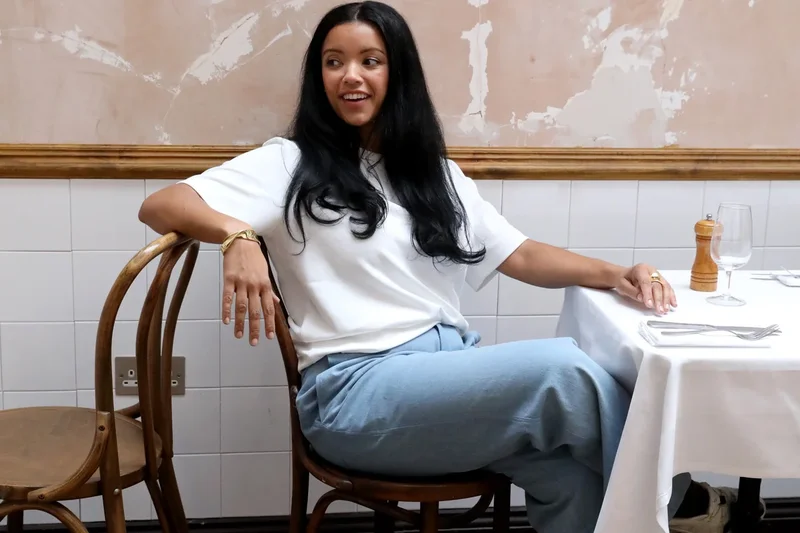
The usability of these items is one thing – the fact that they are actually stylish is a plus (The Female Archetypes)
The “Sanjas” can be ordered in basic sizes (XS to XL) but have buttons and drawstrings to ensure they can accommodate weight gain or loss. Meanwhile, The Female Archetype’s wide-legged jeans and chic white oversized shirt can last a woman throughout her whole pregnancy – and then remain a stylish fashion choice post-partum and beyond.
Ideal for pregnancy, the clothes are more expensive than high-street maternity wear at £295 for a pair of jeans and £225 for the adjustable overshirt, but they’re guaranteed to last. “All our clothes are made from dead stock fabric or fabric that already exists because there’s a lot of fabric out there,” explains Holland-Lu. “We design almost backwards, fabrication-wise, into what already exists. Because, quite frankly, we don’t need any more clothes in the world.”
It means that most items are classics – blazers, trench coats, wide-legged jeans at The Female Archetype or the slightly baggy Sanjas that have a 90s combat feel that can be elevated with a crisp shirt and heels. Adjustable fashion isn’t about following trends – it’s about creating capsule items that can be worn over and over again.
Kerryl Bullen founded Ever by X in Australia back in 2018 and originally only sold one dress that fits a size 8-22, and appeals to anyone in their early twenties to their late 80s. “I was developing a luxury travel dress,” she explains. “As a new mum of twins, I needed instant readiness and to switch from city to coast, day to night, with minimal wardrobe change.”
The dress she designed is also multiwear which means it can be adapted nine ways – the perfect item to take on holiday. But as Bullen’s customer base grew (she now has 20,000 customers worldwide), she realised the dress also had the appeal of making women feel good without worrying about what dress size they were wearing.
New life: the adjustable jeans are made from dead stock material (The Female Archetypes)
“We never talk size, age or that our garments provide ‘confidence’ like some brands do, as our wearers are themselves,” she says. “Age and dress size is peripheral to this.” The brand now offers six designs, and like most adjustable clothing brands, has a tiny carbon footprint and only uses dead stock textiles.
When it comes to the economic challenge of making a profit from clothes designed to last, Bullen says loyal customers are enough. Her website is full of reviews from shoppers buying the same dress in multiple colours because they love it so much. Meanwhile, The Female Archetype and Sanja Stories have built devoted customer bases who feel invested in the brands' growth – something that’s much harder to achieve for larger fashion labels.
“From a business perspective, you’re going to sell less, but from a sustainability perspective, it is so much more sustainable,” says Holland-Lu, who primarily gives jobs to women with caring responsibilities, allowing them to work flexibly, and strongly believes in paying people fairly.
“We believe that to sit at a sewing machine, you don’t need to speak English or have a degree,” she explains. “So when we say we empower women, we do. Because unlike other brands, the customer feels good with our products and we’re empowering women along the way to make the clothes. So, I feel like we can actually stand by those words.”