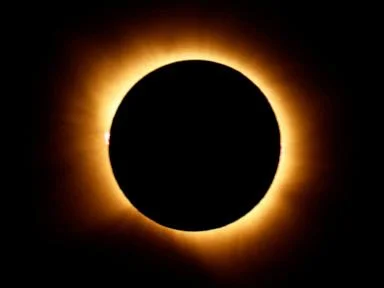
A total solar eclipse is sweeping across parts of the Northern Hemisphere Wednesday, giving millions of skywatchers in the path of totality a chance to witness one of the year's biggest celestial events.
The Aug. 12 eclipse is visible in parts of Greenland, Iceland, Spain, Portugal and Russia, while people in parts of the United States can see a partial solar eclipse, according to NASA.
As the eclipse unfolds, photos are capturing the celestial spectacle and crowds gathering to watch it.
See photos of the 2026 total solar eclipse
The view of the eclipse varies depending on location, with only those within the path of totality able to see the sun completely blocked by the moon.
Who can see the total solar eclipse?
NASA notes the total solar eclipse will be visible along a narrow path that stretches across Greenland, Iceland, the Atlantic Ocean, Spain, a small corner of Portugal and northern Russia.
People within the path of totality will see the moon completely cover the sun for a brief period, turning daytime skies dark.
Where can you see the eclipse in the U.S.?
Parts of the northern United States, from Alaska to North Carolina, will experience a partial solar eclipse on Wednesday, according to NASA.
The timing and amount of the sun covered by the moon will vary depending on location. In Anchorage, Alaska, the partial eclipse will begin at 7:36 a.m. local time and reach its maximum at 8:21 a.m., with about 28% of the sun covered. In New York City, it will begin at 1:07 p.m. and peak at 1:54 p.m., with about 9% coverage.
Other cities where the partial eclipse will be visible include Boston, Philadelphia, Washington, D.C., Detroit and Portland and Bangor, Maine.
What is a solar eclipse?
A solar eclipse occurs when the moon passes between the Earth and the sun, casting a shadow on Earth that fully or partially blocks the sun, according to NASA.
A total solar eclipse happens when the moon completely covers the sun for observers within the path of totality. Outside that path, people see a partial solar eclipse, where only part of the sun is obscured.
Do you need eclipse glasses?
Yes. Anyone viewing a partial solar eclipse should wear certified solar eclipse glasses or use a handheld solar viewer that meets the ISO 12312-2 international safety standard, NASA recommends. Regular sunglasses are not safe for viewing the sun.
The agency says the only time it is safe to view the sun without certified eclipse glasses is during totality, when the moon completely covers the sun. Since the Aug. 12 eclipse will be partial across the United States, viewers should wear eclipse glasses throughout the event.
When was the last total solar eclipse visible in the U.S.?
The last total solar eclipse visible from the United States occurred on April 8, 2024, when the path of totality crossed 15 states from Texas to Maine, according to NASA.
When is the next total solar eclipse in the U.S.?
The next total solar eclipse visible from any part of the United States will occur on March 30, 2033, when totality will be visible only in Alaska, NASA says.
The next total solar eclipse visible from the contiguous United States is expected on Aug. 23, 2044. Another coast-to-coast total solar eclipse will follow on Aug. 12, 2045.