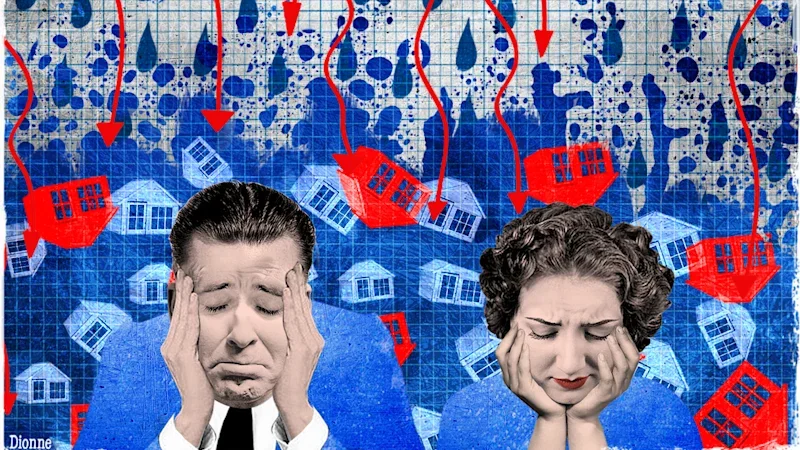
How miserable are you feeling?
The misery index was created by economist Arthur Okun who, in the late 1960s, put his mind to the types of situations that make people – and their countries – feel pretty rotten.
Okun’s index was simple. Add unemployment to the inflation rate and you have a pretty rudimentary, and pretty accurate, insight into misery. The higher the index, the more miserable the population.
If prices are going up and people are losing jobs, then households and businesses can rightfully think the economy is not working for them. They may be miserable. They may also get angry.
Okun had only two factors in his index. In Australia, we need another: the official cash rate.
When you add the cash rate to inflation to unemployment right now, you can see the pickle that Treasurer Jim Chalmers and Reserve Bank governor Michele Bullock – and the rest of us – find ourselves in. This also provides an insight into why the far right and far left are attracting so much interest from voters.
For the Australian misery index (*trademark pending) has climbed sharply this year.
By my reckoning, it was at its most recent low point around March 2025, the time of the federal election that Anthony Albanese so easily won. Inflation was 2.1 per cent, the jobless rate was 4.1 per cent, and official interest rates were 3.85 per cent.
But it started climbing from the middle of the year. By December, it was about 15 per cent higher. And then, after Donald Trump and Benjamin Netanyahu began their ill-advised and ill-considered war on Iran, it worsened as inflation climbed, the Reserve Bank started lifting interest rates and the jobless rate began to inch up.
In March this year, the misery index was 25 per cent higher than it had been less than 12 months earlier.
The index is not as high as it was in 2022, when inflation was surging and the Reserve Bank was driving up interest rates half a percentage point at a time. That was also the year voters gave Scott Morrison the big heave-ho.
It’s no coincidence that as the misery index has risen, support for parties like One Nation has climbed. A party that has dealt in misery magnification its entire existence will always do well when people feel the world is against them.
You don’t really have to offer solutions, especially ones that take more than a bumper sticker to explain.
But if you happen to be the leader of a major party that has to offer real and sometimes complex solutions to assuaging the public’s misery, then you’re on a hiding to nothing.
Opposition Leader Angus Taylor (and before that, Sussan Ley) are discovering what that means.
As this masthead’s Resolve Political Monitor and Newspoll show, the Liberal Party is like a rug store that constantly advertises a “going out of business” sale. Except these guys may really have to shut the doors if there’s not a turnaround in their fortunes.
Jim Chalmers and Anthony Albanese are betting that a key part of the misery being felt by an increasing number of young Australians is down to the state of the housing market. Hence, the budget changes to property taxation.
If my Aussie misery index included house price growth over the past five or 10 or 20 years, for young people it would be off the scale. Little wonder they show so much interest in the Greens and their simple answers.
The budget’s changes to negative gearing and capital gains tax have clearly had an impact on the property market. This, in turn, has prompted an outpouring of anger from the vested interests that stand to gain from ever-increasing house prices (and damn the consequences for young Australians or future generations).
Frankly, there’s been some stupid and insincere analysis around the property market, particularly about the threat of “negative equity”. There’s been a tidal wave of crocodile tears from “experts” who fear for young people who may have bought a home in recent months.
It’s almost as if they have deliberately ignored price falls such as those in 2022 or early 2020 or those between 2017 and 2019, when house values in Sydney alone eased by 14 per cent. Or the long downward grind in Perth between 2014 and 2017 that wiped more than 15 per cent from median house prices.
No one seemed to care about negative equity during those periods.
The Reserve Bank, however, does keep an eye on negative equity and the property market and the overall level of misery. Remember, its job is to keep inflation between 2 and 3 per cent while ensuring as many Australians as possible have a job. And its big weapon to do that is interest rates.
In other words, the RBA is the Australian misery index.
Announcing on Tuesday that the bank had decided to hold interest rates steady, Bullock went hard at her press conference to warn that if inflation doesn’t slow as quickly as the bank is expecting, then the nation’s home borrowers are going to get whacked with another rate rise.
Great, you say. Even more woe.
Bullock put to one side that the bank’s monetary policy committee had unanimously decided not to lift rates. There was also little reference to how the bank’s freshly minted forecasts all pointed to the economy losing inflationary steam over the past three months.
But she did note that the bank’s three previous rate hikes have yet to fully work their way through the economy (which can take up to 18 months), and that a slowdown in the property market would be likely to curb consumer spending and dwelling investment, which has been a key source of inflation over the past five years.
All of which suggests that it’s going to be some time before Australians will start feeling much better about themselves.
What a miserable thought to end this column.
Shane Wright is a senior economics correspondent.
The Opinion newsletter is a weekly wrap of views that will challenge, champion and inform your own. Sign up here.
More: