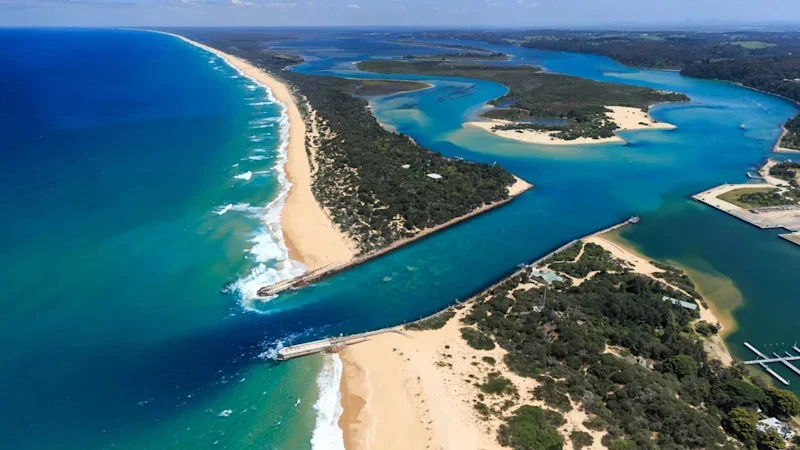
I thought it amazing that there was a beach that was 90 miles long.
My six-year-old brain couldn’t fathom it. Even standing on the highest sand dune, I couldn’t see where the beach ended and began.
It seemed to go on forever and ever, framed by the wild ocean, undulating dunes and flights of seabirds overhead, calling.
For almost every summer of my childhood, my parents would pack up the Holden and decamp to Lake Tyers, a small beach community where the Gippsland Lakes meet Bass Strait.
It’s one point of access to the fourth-longest uninterrupted beach in the world, known as the Ninety Mile Beach, even though it stretches for 94 miles (151 kilometres.)
Get exclusive travel deals delivered straight to your inbox. Sign up now.
It seemed like we were travelling to the ends of the Earth, but Lake Tyers was only a few hours’ drive from our suburban Melbourne home. The landscape was then, and still is, relatively untouched, probably due to its remoteness and the wild beauty of its surf, which can be treacherous.
I haven’t visited for many years, but if memory is a place, it’s where I was happiest.
It was the simplest of holidays. No hotels, motels or rentals for us. We slept in khaki army tents in a camping ground managed by the Methodist Church.
The tents seemed enormous. We had room for a kitchen that consisted of a portable stove, Laminex table and chairs. There was a lounge area, and two bedrooms separated by curtains – handy when Santa Claus came and had to place his gifts under the tree without being spotted by prying children’s eyes. (The best year – a doll each for my sister Coral and me, in cradles specially made by our father.)
I would lie on my stretcher at night and marvel at the stars through the hole in the top of the tent. It was magical, even if we had to walk down a bush track in the pitch black of night to go to the toilet block.
In later years, my father, ever the handyman, adapted a trailer so that it could be a private bedroom for his two growing daughters.
My mother was extremely houseproud, so the tent had many of the comforts of our Balwyn North home. Although we spent most of our time free-ranging on the promontory or on the beach and getting very dirty, she always made sure we had freshly washed and ironed clothes.
We brought suburbia to the bush but after a week or so, the bush won and the kids on the camping ground turned into wild little creatures, left to our own resources by day.
There was a great sense of community. Central to the camp was a big shed covered in strips of bark. Adults and children would devise concerts, contributing comedy acts and music. I won the concert one year for my interpretation of Ipsy Wipsy Spider.
There were costume competitions and our creative father set about making ours with gusto. One year he made me a dice costume. That meant wearing a big, awkward box while the other little girls were dressed as princesses. But it was original!
Another year, rehearsing a play with other kids, I fell off a chair and sliced my hand open on an old Christmas ham tin. (Why it was there, I have no idea.) It was the only mishap I’d have there, although we were on constant lookout for ticks and brown snakes.
We learnt at an early age to respect nature. The sea, full of hazardous rips and currents, was dangerous for inexperienced swimmers and surfers, so we kids paddled on the shore or took swimming lessons in the calmer waters of the lake.
The other danger was sunburn. Although my mother insisted we wear T-shirts in the sun, we still sometimes managed to get burnt, which required applications of cold teabags.
My most vivid memories are of sitting in the dunes as dawn broke while my father, dressed in rubber waders, used long rods to throw lines into the surf. The fish were plentiful, and he’d never fail to return to camp with flathead or trevally that he fried up for breakfast – still the most delicious meals I’ve ever eaten.
In the early days, we had a “manny”. Harry was a cousin of my grandfather’s, and he was a sweet man who giggled a lot. Family lore was that he was “kicked in the head” by a horse when he was young, hence why he was so sweetly simple.
Harry was, in fact, a gay man brought up at a time when feminine men were ostracised. My family never treated him other than a normal member of our tribe, and we loved him. Later on, he retired to a Salvation Army care home and met the love of his life.
There was a dark undercurrent to those halcyon Lake Tyers days.
The Anglican Church had set up a mission there in 1861, and the banks of the lake were dotted with shrines housing statues depicting scenes from Christ’s life.
We’d pass them on boat trips up the lake and I found many of them violent and terrifying.
Once, we visited the house of a retired missionary. Inside, it was piled high with crumbling newspapers. He wore a dilapidated suit and his teeth were ground down to stubs. He may have been a kind man, but he scared the wits out of me.
What I didn’t know until much later was the real story of the Lake Tyers Mission (Bung Yarnda) which was set up by an Anglican missionary in 1861.
In 1917, the Central Board for the Protection of Aborigines adopted a “concentration plan”. The plan forcibly moved all Victorian Aboriginal people to Bung Yarnda, the traditional land of the Gunaikurnai people, as other missions throughout Victoria were shut down.
At the time we were holidaying in Lake Tyers, the Indigenous population was protesting attempts to close the mission and assimilate them into the wider community in Morwell.
We young campers knew none of the true story. We’d drive along Lake Tyers back roads that took us through the settlement. In the racism of the time, we’d be told stories of how the relocated people would “go walkabout” and light fires in the houses they were given. No one asked why.
When I look back, my happiest place is really about my parents’ love. The Ninety Mile Beach is still a wonderful destination for a holiday, but now my parents are gone, it can exist only in memory, which is a perfectly fine location for it to be.