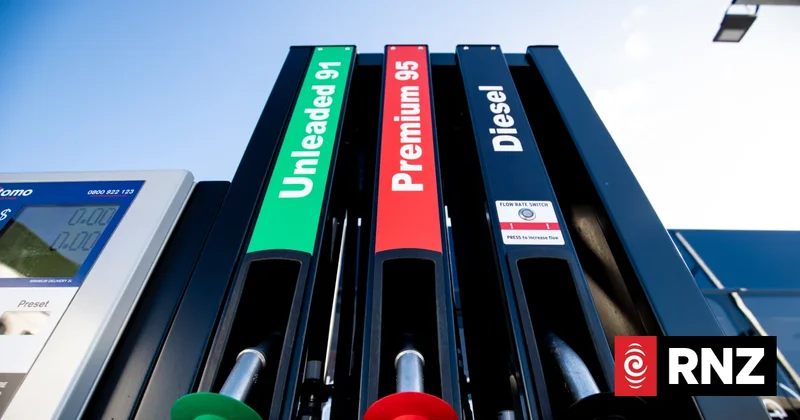
Three petrol companies account for more than half of New Zealand's climate pollution - not including agriculture.
Z Energy, BP and Mobil's combined greenhouse gas emissions have barely shifted since last year, even though this year's data included the beginning of the fuel crisis sparked by conflict in the Middle East.
Overall, companies reported 31.6 million tonnes of carbon-equivalent emissions - a decrease of just under 1 million tonnes (3 percent).
The three petrol companies accounted for 16.2m tonnes of that.
Fossil fuel producers and steel and aluminium companies rounded out the top 10, with little change from last year.
The data, which is published annually by the Environmental Protection Authority, covers the year to 30 June 2026, and includes companies that are part of the Emissions Trading Scheme (ETS).
The EPA data notably excludes some of New Zealand's largest emitters, including Fonterra, after the government ended reporting requirements for agriculture in 2024.
As a result, it now accounts for less than half of the country's actual emissions, which the New Zealand Greenhouse Gas Inventory measured at 75.8m tonnes in 2024.
Despite that, it remains the only public information available where many companies' emissions can be directly compared.
Since agriculture was excluded, Z Energy has topped the list for the last two years, reporting emissions of 7.2m tonnes in the most recent year, a drop of five percent.
Its most recent corporate climate statement shows the company's overall emissions are significantly higher than what it has to report to the EPA, with 12m tonnes recorded in the 2025 calendar year.
Z has managed to halve its operational emissions - what it emits in the course of running its business - since 2019, with most of that change happening in 2022 and 2023.
However, the carbon dioxide from the fuel it sells, which accounts for the vast majority of its emissions - has stayed static.
Data no longer includes country's top emitter
Prior to last year, agriculture companies regularly made the top 10 emitters, with Fonterra topping the list every year with reported emissions that were nearly double the next-largest emitter.
The company still voluntarily discloses its greenhouse gas emissions, and a spokesperson said its latest data would included in the company's annual report next month.
Its most recent annual report showed the company emitted 26.7 million tonnes in carbon-equivalent emissions in 2025 - a 2.2 percent increase on 2024.
Most of that increase came from dairy cows, whose methane emissions account for more than three-quarters of the company's overall emissions.
Fonterra has managed to lower its on-farm emissions by about 7 percent since 2018, which it uses as a baseline reporting year.
The company still reports a small proportion of its emissions to the EPA, from the coal it uses in its industrial processes.
Those emissions alone were still high enough to earn it a 13th placing out of nearly 130 companies on the list.
Other companies previously in the top 10 who no longer have to report their emissions include meat processors Affco and Alliance, milk exporter Open Country Dairy, and Silver Fern Farms - which also voluntarily discloses its emissions.
Its latest disclosure, for 2025, showed 4.8m tonnes of emissions - most of that also from methane produced by livestock.
Genesis was the sole energy company to feature in the top 10, almost entirely due to its ownership of the coal-fired Huntly power station.
Its emissions dropped dramatically from 2024-25, though.
In a statement, the company said that was consistent with a 42 percent decrease in the amount of coal the company had to burn last winter, compared to 2024 when low hydro levels and a gas shortage combined to create a winter energy crisis.
Genesis was investing in renewable energy and battery storage, but Huntly still played a critical role for now, the statement said.
"As a result, annual emissions are expected to fluctuate, while the long-term trend continues downward."
Other gentailers were able to draw on Huntly as back-up generation - but Genesis still carried the emissions.
More than 70 percent of the company's light commercial and passenger vehicles was now electric or hybrid and the company planned to convert to a fully electric fleet by 2028, it said.
"We continue to invest in EV charging infrastructure across our sites."