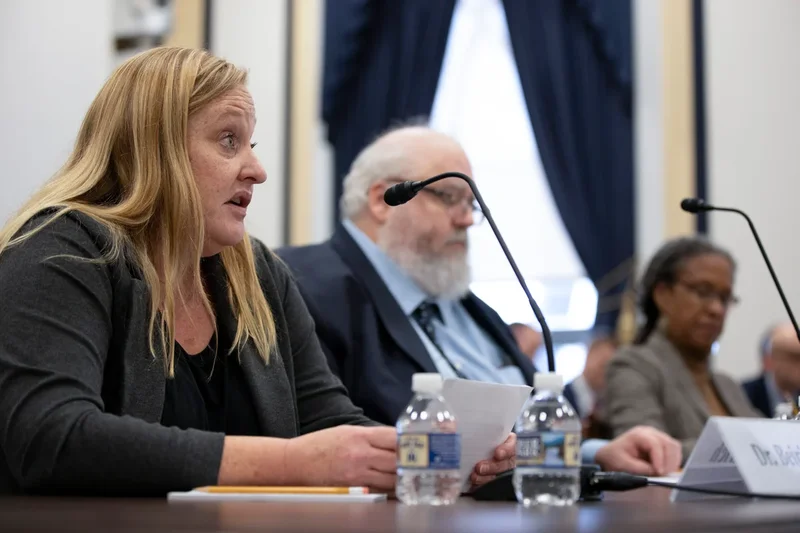
Federal prosecutors have added a former official from the Southern Poverty Law Center to a broader Department of Justice criminal case involving the Alabama-based civil rights organization. The nonprofit has long been a target of conservative critics who accuse it of political bias.
Heidi Beirich, an expert on political extremism who served as the law center’s chief financial officer, was named in an indictment unsealed on Wednesday. She was expected to make her first court appearance in Riverside, California, later that day.
The 59-year-old Palm Springs, California, resident faces charges of wire fraud conspiracy, conspiracy to submit false statements to a federally insured bank and conspiracy to conceal money laundering as part of the government’s case against the SPLC in Montgomery, Alabama.
Her attorney, Michael Proctor, accused federal prosecutors of trying to penalize his client for her "decades-long record of success dismantling hate groups."
“A free and fair society does not use the justice system to silence its political opponents,” Proctor said.
Attorney General Todd Blanche announced the charge at a new briefing in Washington, but did not name Beirich.
An SPLC spokesperson had no immediate comment.
Beirich led the SPLC’s Intelligence Project, which incurred the anger of conservatives with its annual report on organizations that it classified as hate groups. Critics accused the law center of unfairly tarnishing right-wing groups with the same label that it applied to white supremacists.
Beirich co-founded the Global Project Against Hate and Extremism in 2020 after leaving the SPLC. She has testified before Congress about far-right extremism and is frequently interviewed about the subject by news outlets. Her current organization did not immediately respond to emails seeking comment Wednesday.
A superseding indictment filed in June appears to refer to Beirich as “Employee-2” and by her former title as director of the SPLC’s Intelligence Project.
The indictment alleges that $4.1 million in donations were used to pay informants inside extremist groups. Prosecutors said some of the money was used for recruiting new members and purchasing Ku Klux Klan robes and materials for cross-burning ceremonies.
The indictment said “Employee-2” oversaw the payment of donor money to SPLC informants or “field sources” The indictment alleges that “Employee-2” was in a romantic relationship with one of the sources who infiltrated a neo-Nazi group at the direction of the SPLC and that they shared a house and bank accounts.
The paid informants included KKK members and white nationalists who initially approached the SPLC for help leaving the extremist organizations but were offered monthly payments and expense reimbursements.