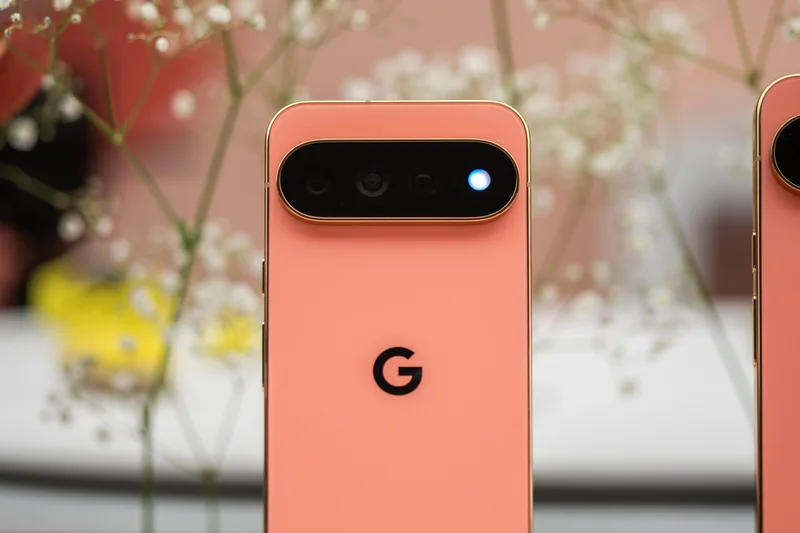
If you look at a photo taken by a smartphone today, it’s hard to find much that’s technically wrong. Faces are bright and visible. The skies are pristine and blue. Even at night, scenes are well lit and noise-free. If the physical limitations of a tiny camera are what you’re trying to solve for, you could probably label smartphone photography a mostly solved problem.
Google is making the Pixel cameras better by making them worse
Google’s new Camera Looks feature will do less computational photography — and that’s a great thing.
Google is making the Pixel cameras better by making them worse
Google’s new Camera Looks feature will do less computational photography — and that’s a great thing.
But in our current moment, the photos people are drawn to are not flawless — and that’s created a real problem for the people making smartphone cameras. “The gap between what two random people want from their camera is growing dramatically,” says Isaac Reynolds, who leads the Pixel camera team at Google. Some people want a perfectly optimized photo, Reynolds says. “But there’s a growing number of people who want something that they feel is more authentic or traditional, by their definition.”
That’s what Reynolds and the Pixel team are setting out to solve with Camera Looks, a total rethink of how the camera captures and styles an image on the Pixel 11 series. The phones include a new suite of processing tools aimed at giving people much more control over the camera’s output. At first glance, they look a lot like filters, with names like Black Tie, Classic, and most strikingly, Digi, in reference to the growing trend of buying cheap digital cameras from the early aughts. But unlike a filter, which generally applies editing tweaks after the processing happens, Camera Looks is changing how image data is processed at the sensor level.
“The pipeline spans the entire system,” Reynolds says. “It’s inside HDR Plus. It’s inside the processing engine. It’s inside the camera app as well in how we make certain decisions about auto exposure and integration time and number of frames packaged and captured.”
In the last decade or so, smartphone cameras have been engineered to do battle with the limitations of physics using what’s known as “computational photography.” Too dark? Night mode uses multi-frame image stacking to brighten the photo without adding too much noise. Need to zoom in but don’t have a telephoto lens? An on-device model can artificially create data it expects to be in your photo. Too small of a sensor for natural blur? Phones can use subject segmentation to recognize objects, cut out the subject, and emulate depth of field.
The result has been crisp, clear photos — and also a lot of (mostly younger) consumers carrying around old iPhones and cheap point-and-shoots from the early aughts to get a simpler, less processed, and (to their eye) better look.
“If you are looking for a minimal look … we simply don’t do the processing at all.”
The Pixel 11’s new Camera Looks feature is Google’s response to this growing trend. And to solve it, the Pixel team is allowing users to dial back how much processing happens when they snap a shot. Some of the Pixel’s Camera Looks will merge fewer frames together, leaving the highlights a bit blown out instead of compressing them to a midtone. Some of them won’t apply as much sharpening and will instead leave the image softer on the edges. You could argue that these new photos are technically “worse” — with reduced detail and dynamic range — but the result should be a photo closer to what any given user actually wants. This is a completely different way of thinking about computational photography, using tools to optimize for style instead of for technical perfection.
Until now, the Pixel camera pipeline has done the same type of processing for every user, and any edits to match their preferred style had to be made after the fact. But when an image is already fully processed, you’re stuck with the data and artifacts caused by that processing. “Once you’ve processed it that way, you can’t do less. If there was a merge artifact, that is baked in. It’s irreversible,” Reynolds says. With the Pixel 11, “we bring it a lot earlier, and that way if you are looking for a minimal look, which is minimally processed, we simply don’t do the processing at all.”
This, I think, is the most Google way to handle this change in camera mindset I could have imagined. In order to keep people from being too confused about technical jargon like tone compression or frame merging, Google is intelligently making processing decisions for you based on style selections most users can understand — and more importantly, can see. Reynolds tells me that there were long debates inside the camera team for just how many sliders users should have access to, and they landed on more than you’d probably expect.
“ There are so many in there that I actually had to have an escalation meeting with my PM and my UX team about how many controls we were allowed to put in there,” Reynolds says. “There’s a lot of controls that photographers say are critical to have. We had a lot of trouble cutting it down.” For every Camera Look, you’ll get a set of six or more different levers, like contrast, warmth, tint, and saturation. And some Looks, like the black-and-white look Black Tie, will give you extra options, like red, green, and blue filters, which darken certain frequencies of light on black-and-white film.
This is notably different from the way Apple is currently thinking about cameras on the iPhone. Since the iPhone 13, Apple has included “Photographic Styles” in its camera — a series of presets that users can dial in through only two settings, tone and color (brightness/contrast and saturation). Google gives you access to these settings, too, but you’re also getting access to computational settings like sharpness and grain, which can more dramatically tune the look of your image before you shoot.
Giving users this much control over their images is a major step change for Google. The last time I had an in-depth conversation with Reynolds was in 2019 for the launch of the Pixel 4. At the time, Google’s priority was not to make a camera at all, but rather a magic box, where the user would simply point, shoot, and get what it considered the “perfect” image.
Simplification is not the priority this year. Now, it’s about choice. But Reynolds is still convinced that Google’s default settings are correct for most people, so the first option in the list of Looks is called “Original” — the experience Google has delivered for years. “ We do user studies with large N counts that are global, where we very, very carefully control the demographics, and we’re very confident that the original Pixel look is the right look,” he says. “We have no debate about that.”
The ‘Digi’ Look is going to be popular
There are simpler looks that only make subtle changes from Original, like Natural, Shadows and Vanilla, but there are also much more stylized Looks, like Editorial, Classic, and Velvet. If I were a betting man, I would say Google styled these directly after Fujifilm’s popular film simulations, but Reynolds won’t quite go that far. “These are film-inspired,” he tells me. “I would not say that these are film copies. I wouldn’t want to tell you that this is supposed to be Kodachrome or something.”
I expect that the most popular Camera Look will probably be Digi, though in my brief time with the phone I was partial to Minimal. The Digi Look is inspired by digicams, digital cameras from the early aughts that have low dynamic range and high contrast. In just the last five years, search volume for “digicam” is up 500 percent, according to Google Trends, and cameras that used to sell for $5 at thrift stores now go for hundreds of dollars on the secondhand market. Some companies like Canon have even caught wind and are rereleasing old digicam models just to cash in on the trend. It makes sense for Google to want to adopt the look, too.
I’m extremely happy to see Google changing things up in the camera department. At least for me, Google’s Pixel camera processing has gotten far too clinical, and lost the realism that once made it so revered. Now, it’s adapting to what a growing audience says they want from a camera — something real, stylized, and unique to the way they want to see the world.
Photography by David Imel / The Verge
Follow topics and authorsfrom this story to see more like this in your personalized homepage feed and to receive email updates.
Most Popular
- Xbox Elite 3 prototype pad leaks with tiny built-in screen
- Google’s Pixel 11 series pairs a little new hardware with a lot of new software
- Google’s upcoming Pixel phones are for the fans, even if its launch event isn’t
- Why your Amazon order confirmation emails have become so unhelpful
- Mark Zuckerberg doesn’t understand how to live