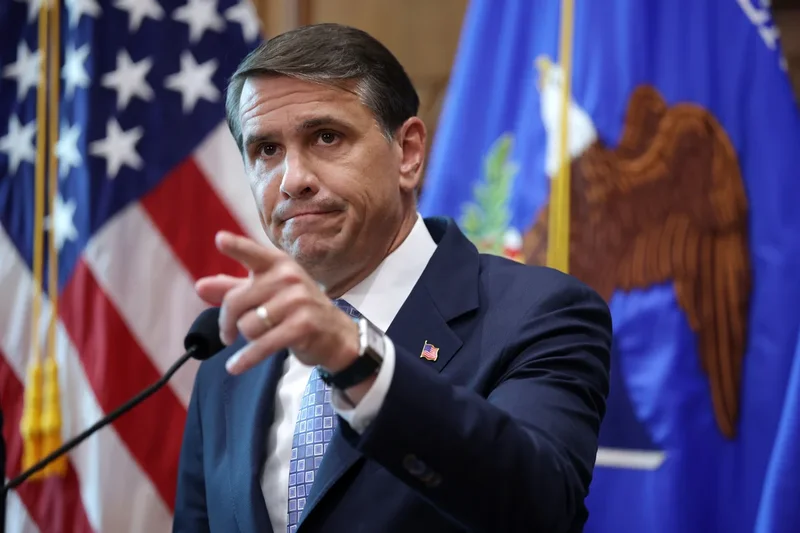
President Donald Trump has said that the fate of an “Anti-Weaponization Fund” for his political allies is up to his newly sworn-in Attorney General Todd Blanche.
Now that the president’s former criminal defense attorney is leading the Department of Justice, Blanche was bombarded with a flurry of questions from reporters at his first press conference as the nation’s top law enforcement official on Wednesday.
Naturally, the fate of that fund was one of them, and while Blanche insisted that the fund is indeed “dead” — he still left open the possibility of multimillion-dollar payouts to the president’s aggrieved allies, including Jan. 6 rioters, through other means.
Blanche and the Trump administration maintained that the payout fund was dead during a protracted confirmation battle to ensure he received enough Republican votes from a razor-thin Senate majority. But the future of what critics are calling a “slush fund” for Trump’s allies is among several critical questions facing Blanche as he leads a dramatically transformed Justice Department in concert with the White House.
Blanche was also questioned Wednesday about the fates of the politically charged prosecutions of Dr. Anthony Fauci and a 67-year-old former Olympian who was accused by the president of vandalizing the Lincoln Memorial Reflecting Pool — despite Washington, D.C.’s top prosecutor and administration officials admitting there is no evidence to prosecute him.
On Tuesday, The Wall Street Journal reported that the White House has pressed the Justice Department to revisit a case against David Hearn despite a stunning court document from U.S. Attorney Jeanine Pirro to dismiss charges against him
“I don’t know what you mean by the White House has asked us to do that,” Blanche told a reporter Wednesday.
“I don’t have an update on that. I think there’s been… there’s been a lot of comments and source-based comments about what, if anything, is happening with that case,” he said. “I don’t have an update, no.”
Last week, House Republicans referred Fauci to the Justice Department alleging criminal contempt of Congress after the infectious disease expert invoked his Fifth Amendment right against testifying to a panel investigating the origins of COVID-19.
“Any update I would expect to come from this department, if there is ultimately a decision made, won’t be any time soon,” Blanche said Wednesday.
Blanche’s closeness to Trump has been a massive sticking point in his confirmation battle, one that Democratic members of Congress say could risk further compromising the Justice Department’s “independence” by shielding the president from legal threats while taking his direction when it comes to prosecuting political enemies.
Hours after Blanche was sworn into office as attorney general, the Justice Department’s Office of Legal Counsel issued a stunning memo arguing that the president could claim executive privilege over communication between him and his “private advisers” if those conversations were considered confidential and related to his presidential “decision making.”
Democrats who urged their Republican counterparts to reject Blanche’s nomination say the memo could shield Trump from investigations into Jeffrey Epstein, government contracts and whether members of the Trump family enriched themselves through his administration.
“This dubious expansion of executive privilege to cover Trump’s outside advisors is a clear attack on Congress’s oversight powers, and creates an environment ripe for corruption that protects only the president and his friends,” said Rep. Robert Garcia, the top Democrat on the House Oversight Committee.
In a last-ditch effort to win over skeptical Republicans, Blanche conceded that the so-called slush fund is “rescinded and shall have no force or effect.”
But he reiterated the terms of an immunity provision that shields Trump from tax investigations, a deal that he testified to members of Congress isn’t going anywhere. That was enough for Senators Thom Tillis and John Cornyn, who said they were “pleased” with Blanche’s note and voted to confirm him.
Despite the Justice Department halting plans for the fund, Trump has continued to express his support for it. After his new AG was sworn in, he told reporters that it was “up to” Blanche as to whether it lives on, despite his pledge to members of Congress that it was dead.
“I’m not sure how I can further say that the Anti-Weaponization Fund doesn't exist, or would use the word ‘dead,’ but if anyone has any ideas,” Blanche told reporters Wednesday.
“I get that this is a super fun story to not let die, but I don’t know what else to say,” he said.
He also said that the Justice Department and the White House would support legislation to formally ensure no such fund exists, but the administration has never needed a dedicated fund to settle claims against the government.
January 6 rioters and other aggrieved allies of the president have continued to file claims through the Federal Tort Claims Act, which taps into the government’s permanent Judgment Fund that is used to pay court judgments and other settlements involving the federal government.
“Yes, the president feels very strongly — as do I — that there were people who were victims of a Department of Justice that was absolutely weaponized, and he feels very strongly that he would want to make them whole, as do I,” Blanche said. “But it won’t be through the Anti-Weaponization Fund, which was never set up.”