As a historian of China who studies how societies come to accept ideas as knowledge, Tristan Brown doesn’t formally research American history often. So when the American Historical Review called on scholars to submit essays about objects connected with the American Revolution, Brown wasn’t the most likely contributor.
But the associate professor at the Massachusetts Institute of Technology liked the idea of a challenge, and an object did jump to mind: a Chinese tea label he’d seen displayed at Boston’s Old South Meeting House, believed to have been salvaged from the Boston Tea Party in 1773.
While researching the artifact’s provenance, Brown discovered that it dated not to the colonial era, but some 100 years later. The surprising research, published last month, not only amends a historical inaccuracy but sheds light on how societies come to establish collective memory around artifacts.
“History is never finished,” Brown tells MIT News’ Benjamin Daniel. “Even objects that have sat in museums for decades can reveal entirely new stories when we ask new questions.”
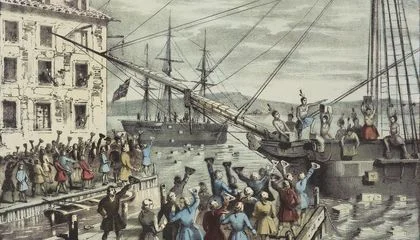
In the 1770s, the British Parliament taxed tea that colonists in America consumed. In an act of protest against this taxation, on December 16, 1773, disguised colonists boarded ships in Boston harbor and threw more than 300 chests of imported tea overboard. This demonstration, which came to be known as the Boston Tea Party, contributed to heightened tension between the colonies and the British government leading up to the American Revolution.
“This extraordinary event was performed by ordinary people,” Evan O’Brien, creative manager at the Boston Tea Party Ships and Museum, told the Boston Globe’s Andres Picon in 2018.
Physical artifacts from the Boston Tea Party are extremely rare, as those “ordinary people” involved retained tight secrecy around what was, at the time, a serious act of treason. But around the centennial of the American Revolution, in 1876, descendents of those involved in the protests began coming forward to proclaim their connection or showcase family heirlooms from the time.
The tea label was donated to the Old South Meeting House in 1987 by descendants of Thomas Wells, a Boston blacksmith who, during the Boston Tea Party, supposedly took the label off one of the tea chests as a souvenir. The Old South Meeting House, where 18th-century revolutionaries met to plan protests against the British government, hung the label in a permanent exhibition.
“By the early 1900s, the story had appeared in a local newspaper, which reported that the label had been taken from a tea chest during the Boston Tea Party,” per MIT News. “Repetition in family accounts, newspapers, commemorative culture, and eventually museum interpretation helped transform an unverified tradition into an apparently authoritative history.”
Scholars from Harvard University and the British Museum previously examined the label, finding neither evidence confirming nor disproving the story. Brown himself didn’t doubt the label’s authenticity as a Tea Party relic when he embarked on his study of it.
“It was hard to imagine how an American family with no ties to China could have possessed a label written in formal Chinese listing the exact teas that were traded in the region,” Brown tells MIT News.
But the artifact’s true origin came to light when Brown took a closer look at the Chinese text on the label. Previous translators had used Mandarin to decipher it. But Brown, noticing that one set of its characters appeared to represent the phonetic pronunciation of a foreign word, tried the translation in Cantonese instead.
When read in Cantonese, Brown found that the phonetic characters yielded the words “Smith, Archer,” a reference to Smith, Archer & Co, an American import-export company that shipped teas from East Asia to the United States in the 19th century, nearly a century after revolutionaries dumped British tea into Boston Harbor. When combined with the fact that Cantonese was the primary language used in the 19th-century Chinese tea trade, this new translation refuted the label’s association with the Boston Tea Party.
“The label is a 19th-century commercial document that later acquired a revolutionary pedigree,” Brown wrote in his research.
Brown points out in MIT News that this rewriting of an artifact’s history doesn’t reduce the tea label’s historical value, but rather reframes what makes it interesting. Amended stories such as this one offer insights into the way the country and its citizens seek to remember the past. The tea label may not have witnessed the events of 1773, but it nevertheless unveiled to Brown some truths about the significance of the event to descendants of Americans who joined the protest.