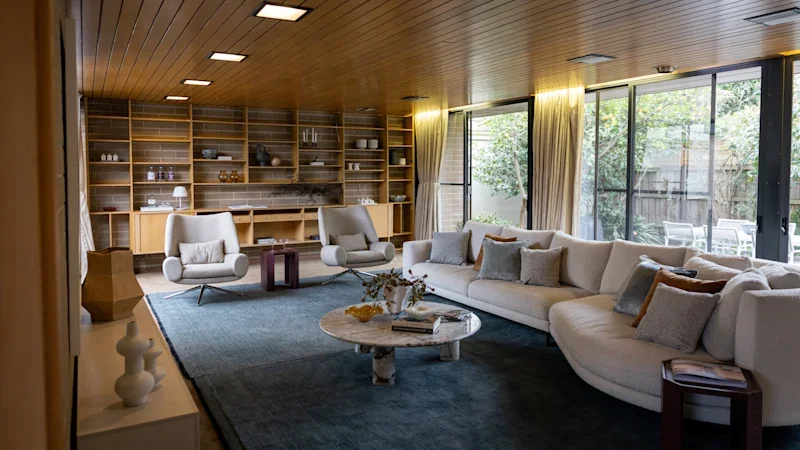
When Esther Clerehan, 65, looks around Fenner House, she remembers it as she first saw it more than 60 years ago.
Esther’s father, the acclaimed Melbourne architect and writer Neil Clerehan, designed the heritage-listed modernist brick townhouse in 1964 for the Fenner family, who were retired pastoralists.
“You know how when you first see a space as a child and then go back as an adult, and it’s so much smaller?” Esther says.
“Well, that’s not what I feel like here. The proportions are generous to grand for a compact house. You do not walk in here and think, ‘oh, this is a bit small’; you actually get surprised at each room at how generous it is.”
Now, for just the third time, the iconic Fenner House is for sale, with an asking price of $5 million to $5.5 million.
In 2016, this compact-yet-generous townhouse in South Yarra’s busy Domain Road was added to Victoria’s heritage register, 49 years after Clerehan won the Victorian Institute of Architects’ most outstanding house award for it in 1967. The award is now known as the Victorian Architecture Medal – the state’s top prize, recently awarded to the St Kilda Pier.
Like its contemporaries, Fenner House is a tribute to mid-century design, featuring seamless indoor-outdoor integration; large, north-facing windows; an open-plan internal design that connects the kitchen, dining and living spaces seamlessly; and mid-century design traits such as exposed brick walls, timber ceilings and floor-to-ceiling glass.
Clerehan also designed it around three courtyards – visible from every room – and reversed traditional planning, with bathrooms and a walk-in cloakroom lining the front facade. Beyond that are three bedrooms.
“When you walk in, you straight away see the use of space, but I think the next thing you notice is the light in every room,” Esther says. “Dad was obsessed with capturing light. So every room has light, every room has [views of the] garden, and that’s what makes it extraordinary.”
Rory Hyde, an associate professor in architecture at the University of Melbourne, says the house is “amazing and completely brutal”.
“From the street, it’s completely uncompromising; it’s low, but it’s very imposing. It’s got a sort of power about it, there are no windows, it’s like, ‘what is this?’ It looks like a substation or something,” he laughs.
Fenner House is also different in that it’s an “inside-out house”, Hyde adds.
“Normally, we think of a house as an object sitting in the plot facing outwards, [but] this is something which takes up the whole plot to boundaries, and then looks inwards into the courtyards,” he says. “As a result, you end up with more windows, more glass, and all the rooms get north light – there’s a certain kind of freedom about being organised in that way.”
Along with his much-celebrated work, Clerehan also wrote for The Age’s Small Homes Service for many years, designing vast numbers of sample house plans. He also designed The Age Dream Home in 1954 in Surrey Hills (it has since been demolished).
“Dad was very much into architecture of all eras and absolutely had an opinion on whether something was worthy or not,” Esther recalls.
“When we were growing up, he was always busy – he worked 24/7. The weekends were looking at houses; the nights were talking to clients on the phone and writing. He loved what he did, and he didn’t consider it work, so he worked all the time.”
Marshall White Stonnington real estate agent Ben Bongiorno says the house, which was listed for sale on August 5, has already had a record number of people through the open on August 8.
“There’s a good contingent of people coming through that might not necessarily be buyers, but in saying that, I think already a few people are talking about trying to buy it,” Bongiorno says.
Due to its iconic heritage status and price tag, the property is attracting a wealthy demographic, he says.
“It’s a botanical precinct buyer,” Bongiorno says, someone looking for a collector’s item. “It’s buying beautiful history, isn’t it? It won house of the year in 1967, and it is widely regarded as Neil Clerehan’s most important residential work. It’s been an absolute privilege to represent.”
For Esther – whose mother is artist Sonia Clerehan – having famous parents was always a little amusing.
“As a child, I was always surprised when people knew who he was because when you’re a kid, it’s just a dad,” she laughs. So when people would say, ‘Oh, you’re Neil Clerehan’s daughter’, I’d be shocked. But now, of course, it’s just pride that he can still be remembered.”