A veteran of the country’s north-west once told me, “You come out of the Kimberley to recover.” He was right. Everything in that gargantuan rockery is anathema to a modern human’s comfort, the place is a Thoreauvian sequence of Squid Game. I have so many welts, bites, stings, abrasions and bruises covering me that I look like a trespasser brought down by birdshot before being flogged. The pharmaceuticals are useless; swellings flicker and flare floridly across my hide like the bioluminescence on certain gaudy octopus that pulse and shimmer when goaded by a shark or an Attenborough.
To walk the wild Kimberley is to make innumerable staccato decisions – where to step, which piece of stone might tip you headfirst into a sandstone crevasse garnished with spinifex? Which route will lead into a tangle of vine and elephant grass? Which into head-high spinifex and a barrage of eager green ants? Even camel hate spinifex, each plant a supernova of spines containing toxins to inflame, blister and infect your skin.
Every day at walk’s end I used a hunting knife to lever ticks from my crevices as if I were a carpenter prising roofing nails from tin ... and then whisky to aid sleep on rock, of course, always rock, amid the screech and wing beat of bats as big as corgis.
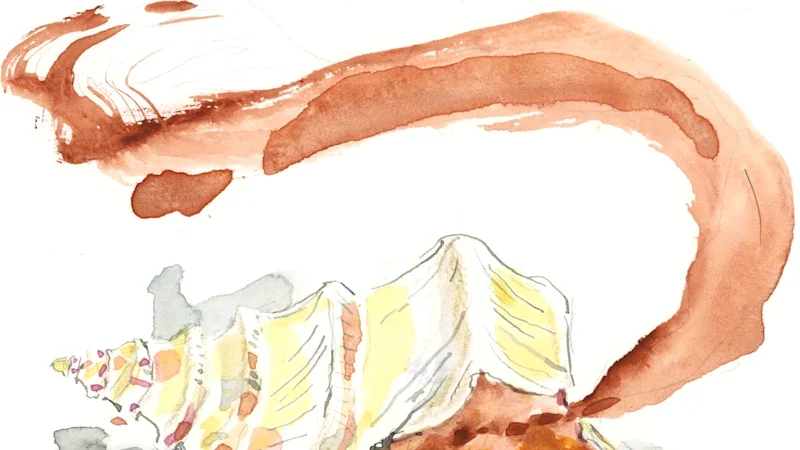
We were as remote as any place on today’s planet. On a plateau overlooking a wild river we found a cave mouth shaped like a gaping wound in a rock face three metres above the ground. Climbing to it, we found inside a conch shell the size of a football. Its patterns had faded to white.
How many years had it been here, carried two days’ walk from the sea – 200? 20,000? Had it been traded? How had it been got from the water among the massive crocodiles at this river’s mouth? Shells are as beautiful as flowers, but rarer and less ephemeral. This one must have been a treasure to its owners, likely handed from one keeper to the next through generations.
The cave looked down on an amphitheatre of orange stone, its pillars and protrusions decorated with ceremonial figures the colour of dried blood. They were leaping and dancing, dressed in feathered skirts, elbow and knee bands and massive feathered headdresses like stooks of hay. It was as fine a place for ceremony as anything wrought by Christopher Wren.
As I turned the huge shell in my hands it occurred to me that it was a musical instrument, as sonically profound and elemental to an ancient liturgy as a church organ, sitting there in the wall. And I suppose the figures dancing on the stone were dancing to notes once blown from this exotic instrument by some excited musician, some hopeful composer smiling as he brought the thing to his lips, some Amadeus delighted to watch the folk lose themselves in his notes, happily leading them on to abandon.
The amphitheatre came alive for me and I could see the leaping shadows flickering in the firelight on the stone walls and hear the many singers, their voices echoing off the rock back into the dance in a feedback loop that must have sounded like affirmation from the pertinent spirits, freeing the whole on to higher enchantment.
Parents hefted toddlers aloft in the dance, larger children mimicked the moves of the cooler adults, old folk sat at the dance’s edge not wanting to dull the exuberance with their limited footwork, but smiling, approving, occasionally shouting encouragement.
I imagined the whole corroboree as a kind of ecstatic gospel service in one of those churches in the US South that birth famous musicians, famous music and unparallelled emotion. All of it enabled by this conch shell I held in my hands, this invaluable gastropod trumpet blown by a barefoot Dizzy Gillespie.
I hefted the conch and lifted it towards my mouth, thinking I might attempt some antique note, some brief replication of a sound the blood dark figures on the walls might recognise and come alive to. But I didn’t do it. Nor would I pull the stops on a pipe organ in a deconsecrated church.
We climbed up and put the conch back in the cave on the stone where we found it. It sits there in a place once central, sacred, now remote, an inanimate thing suffused with ghostly history and wondrous potential, like a church organ awaiting an organist and congregation that will never come again.