- See more Daily Mail on Google - save us as a Preferred Source
Aren’t we supposed to be the Land Of Health And Safety, banning everything from cheese-rolling contests to Remembrance Parades because authorities say it just isn’t safe to hold them?
Yet the Government has deliberately blessed the arrival on our roads and streets of two extraordinarily dangerous menaces, e-scooters and e-bikes. Where are Health And Safety when you really need them?
There is hardly a town or city that has not heard the rush and whine of these machines, or seen the changes they bring.
This week the BBC reported that three trauma centres – in Liverpool, Manchester and Sheffield – say they have treated 477 under-16s for e-scooter injuries since 2019, with the number of cases per year rising from fewer than ten in 2019 to nearly 150 in 2024. Detective Constable Steve Pennington, from Greater Manchester Police, warned e-scooters ‘are not harmless toys and could lead to horrific consequences when used by inexperienced riders’.
The official answer to this is that the privately-owned scooters so often involved in these accidents remain illegal. Technically you cannot ride them on public roads. But any road or pavement user knows that this law has ceased to be enforced in any systematic way.
They are everywhere. And one main reason for this is that the Government has undermined its own law. It has licensed the use of hired scooters in more than 50 English cities, including London and my home town of Oxford.
E-bikes on pavements present hazards for pedestrians, especially for the disabled and elderly. 'Where are Health And Safety when you really need them?' writes Peter Hitchens
Recently it added schemes in Leeds, Brighton and Hove and Plymouth, plus Cornwall.
These exemptions are supposed to be experiments, though they began in 2020, under the pretext of Covid, and there is no sign of them coming to an end or any clear indication of what would have to happen for them to be deemed a failure.
If the Government had been actually trying to make the law look ridiculous, it could not have thought of a better way. Oxford is full of these devices, swerving and bumping about, zooming through red lights, menacing pedestrians and cyclists and making the roads more chaotic for drivers.
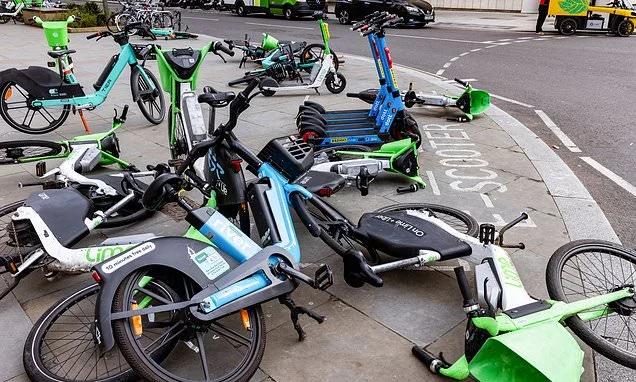
They have more or less taken us into the Third World. They lie about in ugly orange heaps near historic monuments or are parked in equally ugly official reservations provided for them by the local authority. They are, of course, frequently just left where their riders finished with them.
Special sites for them are marked out on the pavement. If they are legal, how can anyone take the ban on privately-owned scooters seriously?
A survey of 29 police forces found that 5,544 illegal e-scooters were seized and taken off the streets between 2023 and late 2025. That isn’t very many. From what I have seen, this must mean that tens of thousands go unmolested.
As for the legal ones, they have greatly diminished the quality of life. I have myself been walloped (fortunately quite mildly) by one of them in Oxford’s majestic High Street. At the time I was helping a pedestrian who had tripped and fallen.
The most amazing thing was the rider’s total lack of remorse, embarrassment or even interest in what she had done. I can only assume she was medicated in some way. I have never seen the police stop people breaking clear rules for hired scooters, such as the one saying only one person should ride them at a time.
I have myself been walloped (fortunately mildly) by an e-scooter in Oxford’s majestic High Street. At the time I was helping a pedestrian who had tripped and fallen, writes Peter Hitchens
This happens so often that perhaps those involved think it must be legal and I can hardly blame them. The police, even when present, are plainly uninterested.
I can find no specific figures for the numbers stopped or fined for this blatant, frequent offence. This is often a problem with revealing what is going on with e-scooters or their more menacing cousins, e-bikes. Central records are hard to find. Enforcement of rules against harder-to-spot misdeeds, such as riding while drunk or on drugs, or riding underage or without any sort of licences must be weaker still.
Everyone in the real world knows that speed limiters on e-scooters and e-bikes, supposedly keeping them below 16mph, are a sick joke. Many of these devices can do 40mph, often more, and can be seen tearing round the streets – doing so with impunity. For, as muggers, phone-snatchers and other criminals have quickly discovered, they are the ideal vehicles for crime. They have no number plates and cannot be traced. They have the freedom of the pavements, because nobody will prevent them being there. Who can catch them?
Anyone with two ounces of imagination could surely have seen the likely consequences of allowing these ‘experiments’ in a country where the police are largely absent from the streets.
We work ourselves into a national frenzy over the possible menace of Artificial Intelligence. Maybe it will end our civilisation. It is hard to tell. But e-scooters and e-bikes are a real problem here and now. They take the solid form of hard, fast hunks of metal hurtling about in our midst.
The actual arrival in our cities of powerful, cheap, lightweight, easily-recharged electric motor vehicles has stimulated almost no thought at all – even though it is one of the most significant technological changes since the invention of the motor car.
Anyone who brings up the subject, or suggests it may matter, is almost always met with empty-headed catcalls on anti-social media of: ‘Haven’t you anything more important to worry about?’
The licensing of them has barely been debated in Parliament.
E-bikes were permitted on roads and cycle tracks through an EU regulation confirmed without debate. E-scooters were semi-legalised through a fishy procedure called the ‘negative process’ by which the new rules would go through (in a few short days) as long as there was no substantial opposition. And there wasn’t.
Back in July 2020, a little-known body called the Secondary Legislation Scrutiny Committee asked: ‘Is it a pilot scheme to test the viability of a controversial vehicle on British roads? Is it a means to rapidly expand transport capacity in cities all over the country during the Coronavirus pandemic? And are those two objectives compatible?’
It said MPs and Lords might wish to ask the transport ministry for more evidence to support its case for scaling up the number of trial schemes. It wondered if there was enough data on safety, nuisance and likely costs to local authorities to justify this expansion. It sought clarity on the actual targets and objectives of these trials.
It also said that similar schemes in other countries had been ‘very divisive’, which is one way of describing the fury against them in cities such as Paris.
I see no sign that anybody listened. Is there some strong, rich lobby pushing the other way? We need a proper national debate and proper Parliamentary scrutiny.
I have searched for years for any sign that anybody in government is thinking seriously about the problem. Will it be the usual thing, that we must wait until a terrible tragedy has taken place, perhaps captured by cameras in all its grisly pain and misery, before anything is done?