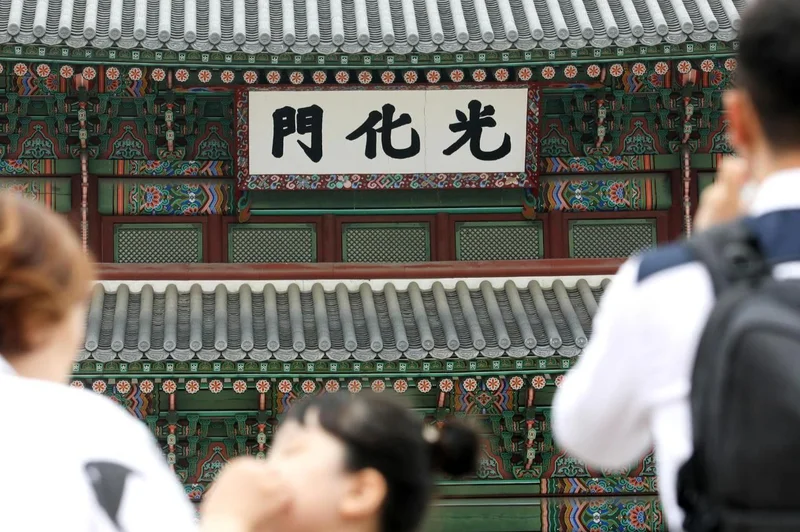
The Gwanghwamun signboard features black Chinese characters set against a white background, pictured here following its 2023 restoration. Courtesy of Cultural Heritage Administration
For centuries, Gwanghwamun — the majestic main gate of Seoul’s Gyeongbok Palace — has stood as the symbolic heart of Korean nationhood. Yet its signboard, restored in 2023 to mirror the original 19th-century Chinese calligraphy, remains a flashpoint in a long-simmering battle over culture, history and national identity.
The government will launch its first National Forum for All on Sunday, inviting 200 citizens to Yonsei University for an eight-hour marathon debate on the question: Should Korea add a Hangeul (Korean alphabet) plaque alongside the historic Chinese character sign at Gwanghwamun?
Organized jointly by the Ministry of Culture, Sports and Tourism and the Ministry of the Interior and Safety, the deliberation seeks to move beyond binary political shouting matches. Through small-group breakouts, expert panel presentations and real-time mobile polling, participants will wrestle with the tensions between preserving historic authenticity and asserting modern linguistic pride.
The stakes go far beyond typography.
Purists argue that cultural heritage requires absolute fidelity to the original form, noting that Gwanghwamun was erected during the Joseon Dynasty when classical Chinese characters served as the official written script of governance. Adding a modern Hangeul sign, critics contend, risks compromising the structural and historical integrity of a national monument.
Proponents, however, counter that Gwanghwamun is not merely a static museum piece, but a living national symbol. Hangeul, the intuitive phonetic alphabet commissioned by King Sejong in 1443 to democratize literacy, represents one of Korea's proudest intellectual achievements. Mounting a Hangeul plaque beside the traditional Chinese characters, advocates argue, bridges the historic past with contemporary national values.
"Is Gwanghwamun a historical site to be preserved in its original state, or a living civic space that should reflect the values of our era?" said Culture Minister Chae Hwi-young, framing the central dilemma ahead of the forum.
The forum brings together prominent voices across archaeology, urban design and linguistics. Presenters include Park Hyun-mo, head of the King Sejong Leadership Institute, who favors adding Hangeul to enhance national identity, and Kim Hyun-kyung, a professor at the Korea National University of Heritage, who warns that altering the gate’s facade sets a dangerous precedent for heritage conservation.
To be broadcast live online, the eight-hour trial will serve as a bellwether for Korea’s public policy framework. Officials plan to use the digital polling data and qualitative findings from Sunday’s debate to directly inform future legislative and administrative decisions regarding the iconic landmark.
This article was published with the assistance of generative AI and edited by The Korea Times.