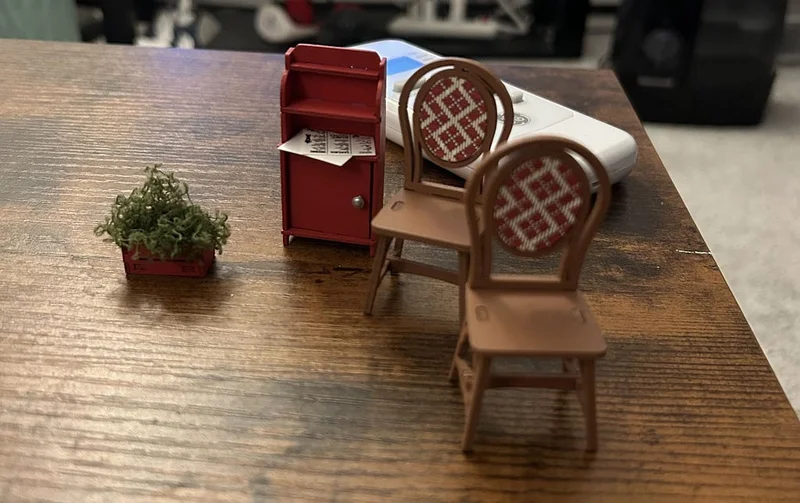
How models change what we notice, question, and understandTiny furniture[Content warning: This article contains images of miniature death scenes.]I recently started building a miniature house in my free time. I am clumsy and have messed up a lot of things, but I still find the process therapeutic. Part of it is how cute everything looks at that scale. The world feels so orderly and manageable.However, not every dollhouse is built to make you feel safe or comforted. One example is Frances Glessner Lee’s collection of miniature death scenes. Known as the Nutshell Studies of Unexplained Death, these models, built at a scale in which one inch represents one foot, were based on composites of real cases and created to train investigators to examine death scenes.A dollhouse full of deathNutshell Studies of Unexplained Death (source)Lee reproduced domestic spaces in obsessive detail. Her rooms held worn furniture, working doors, scattered belongings, tiny bullet holes, and bodies positioned according to the circumstances of each death. Investigators were given only limited information and asked to examine the scenes carefully.The models were not murder mysteries waiting to be solved. Lee described them as exercises in observing and evaluating indirect evidence. Their purpose was to teach investigators how to work through a scene methodically instead of settling too quickly on one explanation. The training encouraged investigators not to let an initial explanation determine how they interpreted every subsequent detail. The Nutshells taught them to continue observing and to consider evidence that might challenge their first impression before deciding what happened.https://medium.com/media/1e4082e23b20439b81719ae67c382793/hrefI remember wondering whether the dollhouses were just a strange gimmick. Photographs, written reports, and diagrams were already available for documenting a scene. Why go to the trouble of constructing an entire room in miniature?Only later did I realize that this approach reflects a much broader idea in design and cognition. Models do not merely represent existing knowledge. Making them can also produce knowledge. A model changes our relationship to what we are studying. This makes connections easier to see and can lead us to conclusions we might not otherwise reach. It can also provide a shared point of reference that helps people compare interpretations and think together.Seeing the whole before the partsLee’s models may not always contain more information than photographs or reports, but they made certain relationships easier to perceive.In The Savage Mind, the anthropologist Claude Lévi-Strauss asks why so many works of art take the form of reduced representations, including Japanese gardens, miniature vehicles, and ships in bottles. When we try to understand a real object or environment, he argues, we normally work from the parts toward the whole. A building surrounds us, so we move through it one room at a time. A landscape extends beyond our field of vision, so we see only the section in front of us.This partial view can affect how we reason. The first striking detail we encounter may shape our initial explanation before we have seen everything else. We then assemble the rest of the scene around that impression.A miniature reverses this relationship. As Lévi-Strauss writes, “knowledge of the whole precedes knowledge of the parts.” Standing over a miniature, you briefly become the giant of its world. The object feels less formidable because your relationship to it has changed. Changing that relationship also changes the questions you can ask. Instead of moving through the scene one fragment at a time, you can begin with its overall arrangement. How does this object relate to the rest of the room? Is the body visible from the doorway? Does the placement of the furniture make sense?A wider view does not guarantee a correct conclusion. It can still be misread. But it makes it easier to compare several relationships before settling on one interpretation. With Lee’s models, investigators could examine a room as an interconnected environment instead of reconstructing it piece by piece.Lévi-Strauss helps explain why making the scene small mattered. The cognitive scientist David Kirsh helps explain why building it outside the mind mattered.The model as something to think withIn “Thinking with External Representations,” Kirsh asks why people create diagrams, sketches, models, and notes rather than doing all their thinking internally.Working memory is limited. When a problem contains many objects and relationships, we spend mental effort simply trying to keep that information available. External representations move some of this work into the environment. By keeping the room’s arrangement visible, the miniature allows investigators to spend less effort holding it in memory and more effort examining the relationships within it.But saving memory is only part of it. External representations remain stable in a way that mental images may not. Details in a scene reconstructed in our head can disappear or shift as we reconsider it, while a physical model stays fixed. Investigators can look away, question a theory, and return to the same arrangement. The room does not change simply because their interpretation has changed.This persistence can also reveal unexpected interpretations. Once something becomes physically visible, people can approach it in ways its maker may not have anticipated. A mental image can remain tied to its first interpretation, especially when that interpretation already makes sense to us. A scene laid out in front of us may reveal a relationship that contradicts it.The model also gives people something concrete to discuss. Instead of arguing from separate mental reconstructions, investigators can point to the same doorway, body, or object and explain what they see. Different interpretations can then be compared against the same arrangement.In that sense, the Nutshells did more than present evidence. They did not simply illustrate a conclusion, they could push back against one.Making can produce knowledgeConstructing a model can itself be a form of thinking. When we are trying to solve a problem, constraints help us test whether an idea actually works. They narrow the range of possible answers, reveal contradictions, and force us to confront decisions we may have avoided.A verbal idea can appear complete while leaving many relationships unspecified. Building something forces the maker to decide how the parts actually fit together. This turns vague relationships into physical constraints.While building my own miniature house, every step makes me think within the physical limits of the model. One wall has to meet another. A door needs enough room to swing open. Something that seemed perfectly reasonable in my head turns out to be awkward or impossible once I try to build it. The model shows me what fits, what conflicts, and what I never fully thought through.Every model is also an editNo matter how carefully its maker works, moving something from the real world into another form always means losing something.A photograph’s angle is chosen by the photographer. What a report contains depends on what someone decided to record. A small hole in a wall might matter, but if the original investigator never noticed or photographed it, a later viewer may never know it was there.A dollhouse has the same limitation. It is bound by the information available to its maker and by the maker’s judgment about what matters. It cannot reproduce everything about the original space, including its smell, temperature, sounds, materials, or the way it changed over time. Every representation asks someone to decide what to keep, what to simplify, and what to leave out. Those decisions shape what other people notice and which conclusions come most easily. Lee’s models never simply reproduced a neutral crime scene. Each offered a particular version of one, shaped by what she knew and by the kind of attention she wanted to teach.My miniature house has nothing to do with murder or blood, but the process of building it helped me rethink my first impression of Lee’s work and better understand the ideas behind it. For me, building a miniature house became more than just something fun and cute. It made me more aware of how my attention was guided throughout the process. What I chose to include in each room was shaped by my personal judgment. My mental model was also challenged again and again. What made sense in my head sometimes ran into physical constraints once I tried to build it.That was when I stopped seeing Lee’s models as just a collection of weird dollhouses. I began to see the decisions, constraints, and design choices built into every room.Referencehttps://americanart.si.edu/exhibitions/nutshellshttps://www.cambridge.org/core/journals/epidemiology-and-psychiatric-sciences/article/corpus-delicti-frances-glessner-lee-and-the-art-of-suspicion/19BA72EBBB3F600944A2E34AC4127E87https://www.web.mit.edu/allanmc/www/levistrauss.pdfhttps://link.springer.com/article/10.1007/s00146-010-0272-8What a dollhouse full of death taught me about thinking was originally published in UX Collective on Medium, where people are continuing the conversation by highlighting and responding to this story.
What a dollhouse full of death taught me about thinking