Dear Vix,
I’m in my mid-fifties and I’ve got a beautiful family – a doting husband, two grown-up kids who (and I know how fortunate I am to have this, compared to some of my friends and peers!) make a real effort to visit us and spend time with us at the weekends. I also have a two-year-old grandchild who I love spending time with* – every Thursday I look after him and we go to the farm, we feed the ducks and we visit museums. We draw and paint and bake and I take him to parent-child groups. It reminds me of being a young mother, again. *
I also have a solid group of friends* I’ve known since we were girls and at school together – we don’t get to see each other as much as I would like to, because we all have busy lives and we understand that it’s tricky to make the time. But I know that I could call one of them up, if I needed to, and they’d be there for me. *
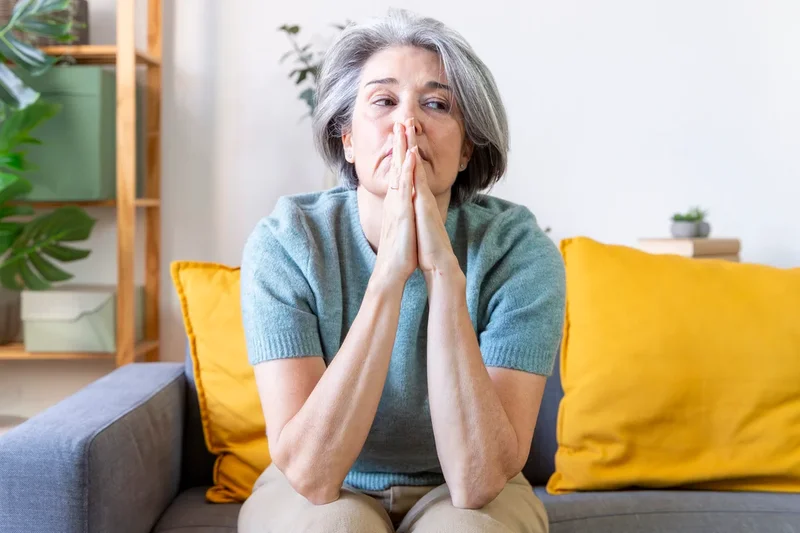
Despite all of this great fortune, I’m feeling blue.* I wake up and as soon as I think about the day ahead, my heart sinks. Sometimes I lie there for hours just willing myself to get up and out of bed. I don’t want to be a misery for my family, but my husband has noticed that I’m “off” and keeps asking me what’s wrong. I don’t know what to tell him. It almost feels silly, to be honest, because there’s nothing “wrong” at all – quite the opposite, really. I have no reason to feel like this! *
Yet no matter how much I remind myself of how lucky I am and how I should be dancing on the rooftops in gratitude for my lovely life, I don’t feel able to snap out of it. What on earth is wrong with me?
Sad Grandma
Dear Sad Grandma,
I’m so sorry you’re struggling. I want you to know that your lovely life – while truly lovely, and fortunate – is no indicator of the way you are feeling. In fact, I think there’s a danger when people scold themselves and believe they “shouldn’t” be feeling the way they are, because they are objectively “lucky”. We can fall into a game of comparisons: we can tell ourselves we are being “ungrateful”; that we “should” be over the moon compared to others who have it “worse” than we do.
But I don’t think that helps. In fact, it does the opposite – it invalidates you, when the truth is that these issues can (and do) co-exist. We all know there is great harm and suffering in the world: just look at the wildfires and heatwaves, the Ebola health scare, the attacks on Iran, Ukraine and Gaza, the women and children making dangerous, desperate trips across the Channel in flimsy dinghies every day.
But you are also feeling something. You are also suffering. Their pain doesn’t take yours away, or vice versa. And if you’re feeling any pain at all, then it is important.
As for what you can do about it, I’ve recently had letters from people in the same age bracket as you who are feeling similarly – and I was interested to discover why, so I decided I would ask an expert to help with your letter. Psychologist Anne Dickson, author of “Trusting the Heart” (a practical guide to recognising, navigating and expressing our emotions) says that more and more modern women are struggling to identify what they’re actually feeling – and that this emotional disconnect with themselves is showing up as burnout, anxiety and exhaustion.
Women, she says, are frequently socialised to prioritise productivity, harmony and caretaking over emotional honesty, leaving many unable to distinguish stress from grief, sadness from depression, or fear from overwhelm.
In fact – just as you have said here – she says that women are in danger of no longer knowing (or recognising) what they are really feeling. And the key to breaking this cycle? According to Anne, swapping emotional overload, people-pleasing and doomscrolling with taking time to recognise the signals from our body.
“Recognition and familiarisation with our emotional experience has a special importance for women in a world where women’s bodies are still thought of and treated as objects,” she told me. “Emotional reconnection helps to re-establish genuine confidence (trust in oneself) through a blend of mental and physical experiences, allowing the body and mind to co-operate in harmony instead of fighting against each other.
“First, we can learn to acknowledge rather than ignore the physical cues that our bodies constantly send us. Those tell-tale signs – tight throat, sinking stomach, shallow breathing, quickened heart rate, headaches, back pain – tell us something is happening. What is it?
“Even if all you can identify is confusion, take a moment to consider the situation you’re in. This is how we begin to take steps to trust, listen and learn. Once your feelings become conscious, you can choose to put them into words.
“We all have to suppress feelings in the short term to continue with various responsibilities, but when we detect emotional tension interfering with our normal functioning, we can learn to pay attention. You recognise what your body feels like when you’re hungry or want sex even if you don’t put those sensations into words.
“Greater familiarity with our bodies helps discern imminent emotional overload and prevent it becoming problematic over the longer term. Once we learn to identify feelings, name them and communicate them effectively we also become able to recognise emotional overload; to locate within our own bodies the connections between emotion and illness so we can be much more proactive about our physical and mental wellbeing.”
I would love you to use some of Anne’s tips to try to identify how you are feeling – don’t worry about the “why”, for now. Perhaps write them down in a journal and track your emotions over a week or a fortnight. I would like you to write down the good moments, too – the times you feel happy, present, or simply “OK”. Experiment with different settings and see if that has any bearing on your emotions: try being outside more, or socialising more often. Loneliness can play a huge part in our happiness, especially in our modern “very online” society.
Then, I’d like you to pay a visit to your GP, to rule out any physical causes of your “blue” days. Our hormones change (particularly when menopause is involved) and a simple blood test could help you identify any key shifts. If you are feeling depressed, your doctor will be able to advise you of any medication that could help you.
I’d also encourage you to key your husband in on how you are feeling at the moment. He sounds caring and loving – it doesn’t matter that you can’t explain it “perfectly”; I believe that he will want to know how you are feeling anyway, just as you would for him.
Do you have a problem you would like to raise anonymously with Dear Vix*? Issues with love, relationships, family and work? Email dearvix@independent.co.uk *