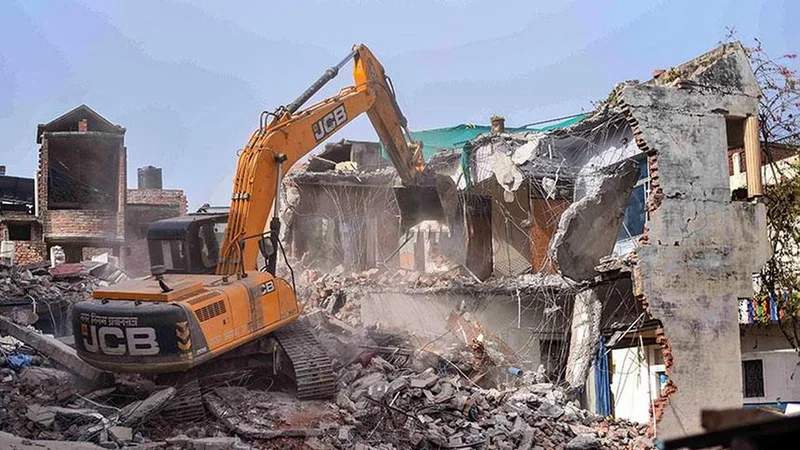
The story so far: The Allahabad High Court’s decision in a recent case title: Faimuddeen v.s State of Uttar Pradesh, has resulted in a split verdict even when the Bench agreed on the need to curb arbitrary demolitions. The two judges, Justice Atul Sreedharan and Justice Siddharth Nandan, however, differed on how far the High Court can go in creating additional safeguards beyond those already laid down by the Supreme Court.
The case
Hamirpur residents Faimuddeen, his son and his wife ended up in court after the Uttar Pradesh police booked one of their relatives under the POCSO Act, the IT Act, and UP anti-conversion law. Mr. Faimuddeen said his own name wasn’t even in the original FIR but it was added later. Then came the sealing of the family’s sawmill and lodge, and notices on their house. To them, it looked like the start of a demolition drive, the kind now associated with “bulldozer justice.”
Their argument: this was collective punishment, plain and simple, violating Articles 14, 19(1)(g), 21 and 300A.
The State disagreed. It said the lodge case traced back to an old encroachment dispute, and the sawmill issue was about forest law violations. Hence, both have nothing to do with the criminal case at all.
Justice Sreedharan’s stand
In a detailed 51-page judgment, Justice Atul Sreedharan built on the Supreme Court’s reasoning in In Re: Directions in the Matter of Demolition of Structures, Olga Tellis, Chameli Singh and related cases, holding that the right to shelter cannot be separated from the rights to life and livelihood.
He quoted the Urdu poet Bashir Badr — “log toot jate ek ghar banane me…tum taras nahi khate bastiyan jalane me” (people are broken just trying to build a home, and you feel no pity in burning down entire settlements) — and argued that demolitions today are less about law and more about feeding a public “on a staple diet of bulldozer justice over the electronic media, social media and messaging platforms.”
Then he turned to the State’s claim that the structures were illegal to begin with. His response: buildings don’t spring up overnight. If they exist, it’s usually because the officials meant to stop them looked away, “out of political convenience, or worse”.
“Over decades, the average Indian has normalised corruption. It is no longer wrong as long as one does not get caught. Even in the rankings of Transparency International 2025 report, India ranks at 91 amongst 182 nations, but even that does not shame us. The recent controversy relating to the theft of donations at the Ram Temple is the proverbial last straw on the camel’s back. Nothing can shame a people who remain unfazed by the theft at the Ram Temple which epitomises the nadir of the Indian’s integrity,” court noted.
Left unchecked, he warned, this kind of corruption concentrates wealth in fewer hands, deepens inequality, and eventually breeds unrest. He, then suggested that to prevent the same, the government must think to amend the Prevention of Corruption Act, 1988 to bring in the death penalty for corruption convictions.
Calling post-FIR demolitions a “retributive exercise of executive discretion” dressed up as routine municipal action, he laid down two new rules: no demolishing an accused person’s home within two years of an FIR unless there’s a genuine, urgent public need; and if a structure has stood for three years or more, residents get a year’s notice before any demolition , again, barring real necessity.
On that basis, he quashed the demolition proceedings against the family’s home and lodge and blocked any fresh action for two years. The sawmill case, being separate under forest law, was allowed to continue.
Justice Siddharth Nandan wasn’t convinced
In a shorter, 23-page order, Justice Siddharth Nandan concurred with adopting the Supreme Court’s directions in the Bulldozer judgment and in Rajendra Kumar Barjatya, including safeguards against selective action and accountability for erring officials. However, he declined to endorse the directions imposing a two-year embargo on demolitions, a mandatory one-year prior notice for long-standing constructions and the blanket quashing of proceedings against the petitioners.
According to him, these directions effectively amend the statutory framework governing urban planning and unauthorised constructions. Since laws such as the Uttar Pradesh Urban Planning and Development Act already prescribe notice periods and procedures, the court could not substitute them with judicially created timelines. While courts can ensure due process, they cannot legislate new substantive requirements.
What now
Since the two judges split on the substantive directions, there’s no majority yet. The Chief Justice will now send the disputed points to a third judge. He will not rehear the whole case but will only settle the specific questions the bench couldn’t agree on.
Published - July 23, 2026 11:34 am IST