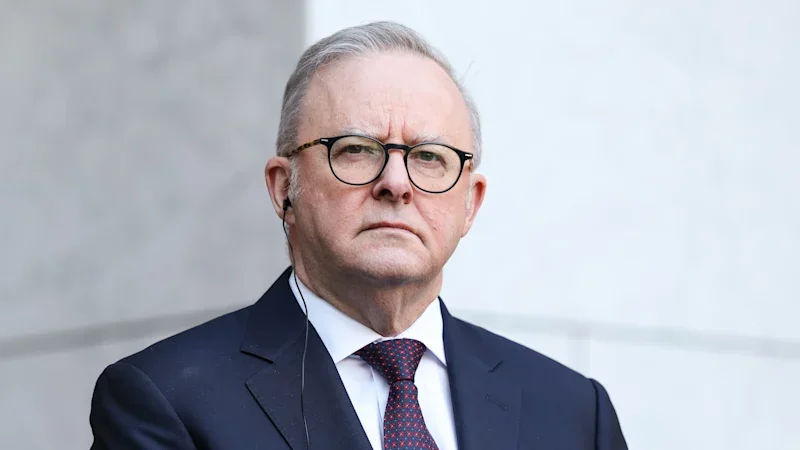
Prime Minister Anthony Albanese spent weeks away from his Sydney residence earlier this year as the government bolstered security and built a blast-resistant safety bunker in Kirribilli House, underscoring anxiety about escalating threats to leaders on both sides of the political divide.
This masthead can reveal that three men faced court just this week accused of making violent threats towards the prime minister. Across the country, there are about 20 ongoing court matters in which people are accused of making violent threats, mostly online or by phone, against Albanese. Nearly 40 people have been charged with Commonwealth crimes since September last year for threatening MPs and other high office holders.
The previously unreported caseload points to what ASIO boss Mike Burgess has described as the degrading security environment in which a terror attack is now rated as “probable”.
Authorities are increasingly worried about the risk of a public official being killed or hurt. Security officials privately cite the long tail of the pandemic fuelling distrust and conspiracies, segments of the Muslim community being less willing to work with police after October 7, social media desensitising a generation of young people, and Australians’ increased frustrations with cost of living and global instablility.
A wider range of MPs, including Liberal Andrew Hastie, now receive higher levels of protection at their homes, offices and at events. Some are avoiding higher risk engagements with voters and changing how they travel in the community, according to sources in the government and security establishment, eroding the democratic life of Australia.
The three cases this week include Karim Salem, a 45-year-old man with views aligned with the sovereign citizen movement who is accused of making threats to shoot the prime minister in a Facebook post; his matter in the Coffs Harbour court was adjourned until October. Gregory Tait appeared at Parramatta Court on Wednesday accused of making calls to the prime minister’s Sydney office threatening to kill him. Harrison Powell was arrested on July 20 and charged with making online threats towards the prime minister and was refused bail after appearing in court in Perth.
“We’ve seen an enormous escalation in not just online hate and extremism but also fixated threats targeting individuals,” said Josh Roose, a leading extremism expert and Deakin University professor.
The pandemic and a wide range of economic and social problems were creating a fractious society and allowing political and religious extremists to create online communities “profiting off the pain an anger”, Roose said.
“The key political emotion here is anger: people feel disempowered, resentful, and they’re looking for someone to blame. They are finding online communities which amplify that and find individuals to blame.”
Government sources said Albanese was unable to stay at Kirribilli for weeks around the time of the federal budget in May as workers upgraded security across the building under what has been dubbed the Official Establishments Security Uplift Project. The Lodge in Canberra, where Albanese spends most his time, has also been the subject of safety works. Bomb-safe bunkers have been built at both residences.
None of the threats that have made it to court were specifically tied to the decision to upgrade the two residences. Rather, the government received advice that such upgrades were necessary given the worsening security environment.
At Kirribilli, perimeter walls have been raised to block a view from nearby six-storey apartment buildings, whose occupants previously had a line of site into the precinct. Material has been added to the side of the perimeter wall to prevent people jumping into the grounds.
At The Lodge, a gap in a fence that allowed a clear view into the residence has been covered.
New National Security Investigations units were set up by the Australian Federal Police late last year to target politically motivated violence, maintain social cohesion and protect democratic institutions. The groups have already received a $69 million funding boost since their establishment. AFP commissioner Krissy Barrett told this masthead when the units were set up that the conflict in Gaza and the active presence of neo-Nazis were two focuses.
Police data shows threats to MPs and electorate officers grew from 555 reports in 2021-22 to more than 1000 the next year. In the latest reporting period between July 2024 and February 2025 there were more than 700.
The NSI teams have since September last year charged 56 people with Commonwealth offences, including 38 who threatened parliamentarians and other high office holders.
The Home Affairs department has also ramped up its work with MPs, an increasing number of whom are having their diaries assessed to check for dangerous public events and receiving upgrades to their home security.
In a speech at the UN in July, Barrett put a spotlight called on tech firms to take more responsibility for escalating extremism. “The need for these conversations is urgent because the scale and pace of crime will only become more acute because of artificial intelligence,” she warned.
“The risk is our collective justice systems, mental health systems, education systems and financial systems will become overwhelmed by a grievance generation, especially when victims become perpetrators and perpetrators become victims.”
Political violence has been increasing across the world. Most recently, right-wing Reform UK spokesman Anne Widdecombe, 78, was killed in her home.
One Nation leader Pauline Hanson expressed concern for her safety in June. She revealed communications directed to her and her office saying “I’m going to kill you” and “your protection won’t protect you forever”.
“In Queensland, I feel relatively safe, but I’m well aware that it takes just one mentally unstable person to create a safety risk for myself, my staff or members of the public,” Hanson said at the time. “Doing my job shouldn’t put my safety, or the safety of the public, at risk.”
A teenager boy from Brisbane was charged with making homemade explosives that he was allegedly planning to use to attack former opposition leader Peter Dutton by flying drones over his acreage north of Brisbane. He was found not guilty after spending two years in custody up to June last year.
Coalition home affairs spokesman Jonno Duniam said, “The rise of threats and increasingly menacing security risks to parliamentarians is deeply concerning.”
More: