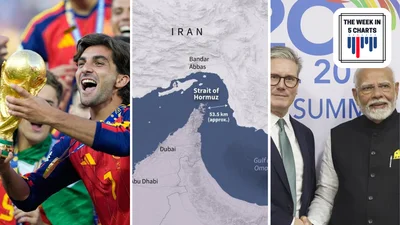
(1) Spain chokes Messi and Argentina to lift second title
Spain won their second World Cup on July 19 (Sunday) with Ferran Torres scoring the only goal of the match in the 106th-minute of the final at MetLife Stadium in New Jersey. Argentina struggled to escape Spain’s suffocating press and looked instead for moments in transition.
Spain had last lifted the World Cup in 2010, when Spanish legend Andrés Iniesta slotted in the winner in the 116th minute against Netherlands in the final, securing a 1-0 victory. Brazil has had the most glory, having won the World Cup five times.
With the Argentinian team having zero shots on target throughout the 120-minute final, 39-year-old Lionel Messi was unable to overtake France’s Kylian Mbappe - who scored 10 goals this World Cup - in the Golden Boot race.
Only 8 teams have lifted the World Cup, in the history of the competition.
(2) Key aspects of the India-U.K. trade agreement
India’s free trade agreements received a push with the India-U.K. Comprehensive Economic and Trade Agreement (CETA) coming into effect on July 15, 2026, a year after it was signed.
As per the deal, the U.K. has effectively eliminated 9,249 (or 96.8%) of 9,736 of its tariff lines — which means that the tariffs have dropped to zero that also translates to $14,854.2 million or 97.7% of trade value. India has done the same for 7,747 (or 64.1%) of the 12,090 tariff lines, with a phased elimination on an additional 21% of tariff lines.
The U.K. will benefit as India will eliminate tariffs on a total of 77.3% of the trade volume, including 47% of the trade volume being impacted through the phased elimination of tariffs. The total altered tariff lines and trade values are shown in the graphic below.
In FY 2026, the principal commodities traded with the U.K. are shown in the graphic below:
The categories of products affected in the tariffs are shown in the scatter plot below where the y-axis (or the vertical axis) represents the tariffs on the products before the CETA. All the tariffs of the products shown in the graphic have now been eliminated or reduced to zero.
(3) U.S. seeks 100% tariffs on Indian goods
A Bill seeking 100% tariffs on India and four other countries for buying Russian oil was tabled in the U.S. Senate on Thursday last week (July 16). It had the support of 60 lawmakers, coming amidst ongoing talks between India and the U.S. on a trade deal.
U.S. tariffs on Indian goods have oscillated between 10% to 50% and potentially 18% contingent on bilateral deals, as talks between the two countries evolved and the U.S. Supreme Court took up the legality of President Donald Trump’s sweeping measures. Here is a timeline of these developments.
Trump has floated 100% tariffs on specific products in the past, like some patented drugs, movies produced outside the country, computer chips and semiconductors unless companies build in the U.S. Tariffs on agricultural products have been another sticking point between the two countries in coming to a consensus on trade, with Trump accusing India of having 100% tariffs on some agricultural products.
However, this legislation is different. If enacted, it would be first instance of the U.S. Congress explicitly authorising tariffs as a geopolitical instrument to penalise countries accused of financing another nation’s war effort.
(4) More ships in Strait of Hormuz attacked
Two commercial vessels carrying 30 Indian crew combined were attacked off the coast of Oman in the Strait of Hormuz on Tuesday last week (July 14) after the temporary ceasefire between Iran and the U.S. fell apart earlier. The attacks resulted in the deaths of two Indian seafarers aboard the vessels. It was the latest in a string of similar attacks in the past in the Strait.
Indian seafarers dead and injured aboard vessels in the tumultuous Strait of Hormuz
Since March 1, at least 59 such incidents have been confirmed, as per the International Maritime Organisation, with at least 17 confirmed fatalities.
After the attacks on Jalveer and Settebello, India summoned U.S. Embassy representative Jason Meeks and lodged its “strong protest” against U.S. Navy’s attacks on vessels and the resulting seafarer deaths. On June 14, U.S. Secretary of State Marco Rubio told External Affairs Minister S. Jaishankar that violations of the American blockade and “illicit transport of Iranian oil” would not be tolerated.
Moreover, the Union Minister for Ports, Shipping and Waterways Sarbananda Sonowal ordered real-time vessel-by-vessel monitoring of Indian seafarers, the appointment of dedicated liaison officers for every affected Indian sailor and a dashboard to track every Indian seafarer aboard vessels in the Persian Gulf, Strait of Hormuz, and Gulf of Oman.
(5) 10th death in Trump immigration move
A man fleeing federal agents in Florida was struck and killed by a tractor-trailer, marking at least the 10th death involving encounters with immigration officers since the start of President Donald Trump’s mass deportation campaign.
The man, a 28-year-old Mexican national, Juan Jairo Coronilla Duran, was sitting in a vehicle with three other people outside a gas station near St. Augustine on Tuesday (July 14, 2026) when they were approached by Immigration and Customs Enforcement (ICE) officers, officials said. The man then darted across the busy thoroughfare and into the path of a semitrailer, according to a highway patrol spokesperson.
The deadly encounter came a day after an ICE officer fatally shot a motorist in Maine and a week after one shot and killed a driver in Houston, officials said.
The deaths have stirred renewed criticism of the agency’s tactics.
On Wednesday, Trump said ICE agents should continue making traffic stops, pushing back on reports that most stops would be suspended.
Published - July 21, 2026 05:58 pm IST