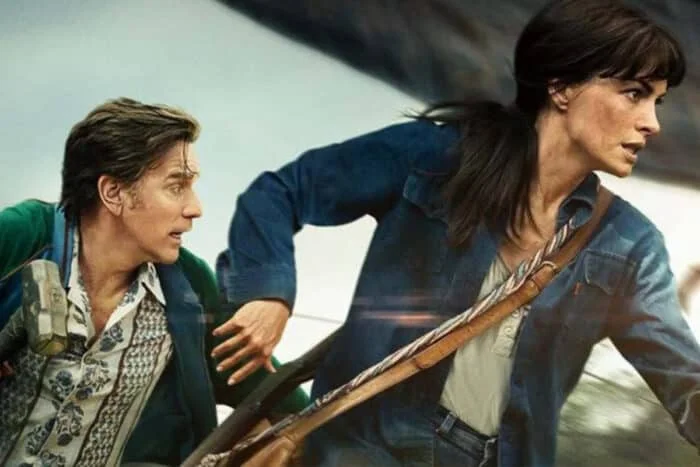
‘The End of Oak Street’ delivers nostalgic, heart-pounding Amblin-era energy
Entertainment Columnist’s Note: My movie review of ‘The End of Oak Street’ will spoil everything for you! Hahaha.
Let us face it: David Robert Mitchell’s ‘The End of Oak Street’ is a breathtaking, white-knuckle homage to classic 80s Amblin-era blockbusters. For those of us who grew up enveloped by that legendary era of filmmaking, it masterfully balances relentless, monster-driven tension with a deeply moving, melancholic family drama. In fact, this film feels like a rare, precious anomaly in our current landscape of self-aware, overly ironic studio offerings.
On a related note, if you had told me a few years ago that the director behind the creeping indie horror masterpiece ‘It Follows’ would pivot to a massive, high-concept science fiction survival movie involving suburban blocks and dinosaurs, I would have thought it was a wild gamble. Yet here we are in the middle of August 2026, witnessing one of the most unapologetically fun and emotionally grounded cinematic surprises of the year—a masterclass that reminds us why we fell in love with going to the movies in the first place.
Article continues after this advertisement
The setup: Suburbia plunged into prehistoric chaos
The premise is beautifully straightforward yet instantly gripping: a mysterious cosmic event completely rips a pristine suburban neighborhood right out of its foundations, transporting the entire block to an unrecognizable, prehistoric landscape. At the heart of this surreal nightmare is the Platt family, who must quickly realize that surviving this hostile new world requires sticking together through absolute, sheer prehistoric terror.
The visionary: Say what you want about director David Robert Mitchell, but there is no denying the famed filmmaker is an absolute master of his craft. He anchors the chaotic premise with his trademark stylistic precision, turning what could have been a generic creature feature into something deeply poetic, idiosyncratic, and genuinely terrifying.
The production: Aided by a stellar team that includes master producer J.J. Abrams, director of photography Michael Gioulakis, and legendary composer Michael Giacchino, the film feels like an adrenaline-fueled cross between ‘Jaws’, ‘The Goonies’, and the kitchen suspense sequence of ‘Jurassic Park.’ This movie is an original in its own right. There are several reasons that will rivet the moviegoers’ full and fixed attention solidly to the big screen, and these factors are the fluidity in the storytelling, driven characterization, and masterfully balanced dramatic moments.
The atmosphere: Michael Gioulakis’s cinematography completely sells the time period and suburban aesthetic, while Michael Giacchino’s score masterfully shifts from Amblin-esque wonderment to sweeping, nail-biting dread. Tonally, it takes the moviegoer deeper and deeper into a sense of looming danger. It is meticulously made from scene to scene, leaving an unmistakable signature style that will leave you completely mesmerized.
The performances: All-in on the terror
What truly elevates ‘The End of Oak’ Street far beyond your run-of-the-mill popcorn blockbuster is the phenomenal, absolute all-in dedication of its principal cast. Let’s get real for a second—Anne Hathaway is on an absolute tear across cinema this year, and here she delivers a fierce, emotionally raw performance as a matriarch pushed to her absolute breaking points. There is one specific, stand-out sequence for me where Anne Hathaway’s onscreen character blasts a roaring T-Rex with a shotgun that will easily go down as one of the most cheered, memorable theater moments of the decade.
Article continues after this advertisement
Meanwhile, Ewan McGregor brings a crucial, wounded sincerity to his role, pairing beautifully with rising stars Maisy Stella and Christian Convery. These young actors are exemplary—they portray a real, unforced familial panic rather than acting as mere hollow plot devices to move the story along. You can clearly see that the main cast members were all on the same page, and that onscreen chemistry pays off massively. While the film tortures its characters relentlessly, director David Robert Mitchell never loses sight of the endearingly sweet bond that keeps this family afloat. For me, that is the real heart of the movie.
Style vs. Logic
Is the film completely logical? Probably not. If you walk into the theater expecting a meticulous, hard-sci-fi explanation for how a cosmic anomaly hyper-targets a single street grid, you will leave deeply frustrated. Haha. Instead, the narrative unashamedly prioritizes pure thrills and sensory spectacle over rigid exposition. Yet, it cleverly offsets its narrative leaps by introducing a sharp, localized layer of grief and melancholy that successfully grounds the entire survival ordeal.
Article continues after this advertisement
As for the creatures, they are delightfully nasty and viciously realized. They offer far more raw entertainment value in a single, breathless five-minute stretch than anything we have seen from major monster franchises in years.
My verdict
‘The End of Oak Street’ is an absolute triumph of original, big-budget genre filmmaking. It avoids the tired, “Well, that just happened” modern blockbuster tropes in favor of earnest stakes, masterful pacing, and incredible creature set-pieces. David Robert Mitchell has captured lightning in a bottle, proving that you can deliver pure summer escapism without sacrificing a film’s artistic soul. Do yourself a favor, purchase a movie ticket (as I did), and see this on the biggest screen possible.