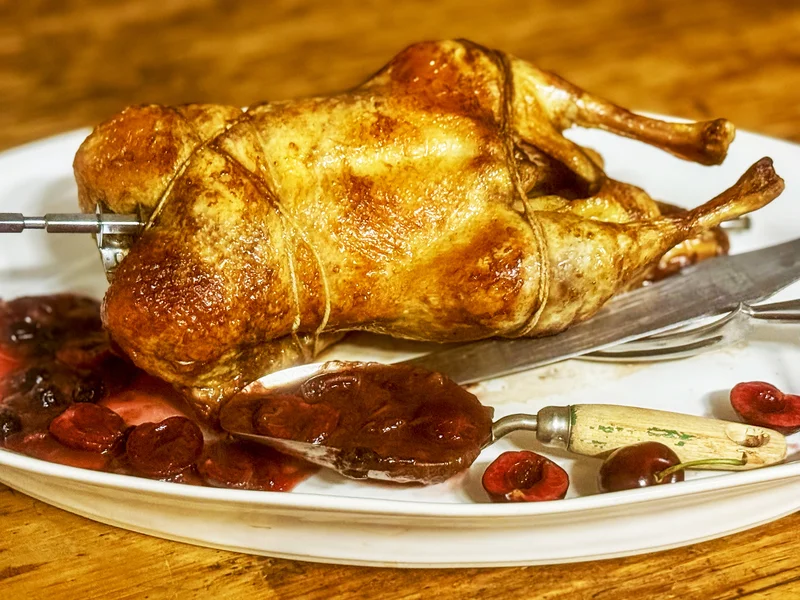
Do you enjoy being dictated to? I know I donât. And we are all dictated to ad nauseam by nearly every chef in the world: duck flesh must be pink!
I beg to differ. It can be pink. Perfectly medium rare. A delight to the tongue and palate. But does it have to be that way? Nope.
Weâre told that on a Western fine dining table, it absolutely must be served medium rare, on pain of the chef charging out of the kitchen with his cleaver to do you in. It is written in stone, apparently, or maybe in blood. And I do understand that â duck breast can be superb cooked medium rare, though I canât say I like it rare (unlike a beef steak, which I enjoy close to blue).
Asian nations largely cook their duck well done, yet with soft flesh, and a supremely crispy skin.
But not all European nations cook their duck medium rare. In the Czech Republic, it is served well done after having been cooked for hours. Iâve eaten roast duck in Prague where it is a staple dish, where youâre likely to be served it with knedlÃky, the overly stodgy Czech dumplings. Youâre unlikely to find rare roast duck in Prague.
But the European love for well done duck is broader than that â youâll find it in Poland, Germany, Denmark and Romania too. And even France has techniques that render duck well done. Confit legs, for instance.
Anyway, when weâre roasting a ruck on the rotisserie element of a large air fryer oven, which is what I did this week, we have the option of having it thoroughly well done or medium rare. All you have to do is cook it on a higher heat for less time, and you might find a happy medium-rare result. Might. Itâs not guaranteed.
I was aiming for well done meat, however, and make no apology for it.
However, unlike a chicken, you canât just bung your whole duck in the oven after seasoning it. You have to prick it many, many times, so that as much fat as possible will ooze out into a dripping tray below.
So, you must have that dripping tray in there, or the bottom of your oven will be in a terrible mess.
While shopping at the Gardens Centre branch of Woolies, which for years was my local, I also found some beautiful fresh rhubarb, and fresh cherries, stalks and all. They cost a small fortune, which is why I generally avoid Woolies for shopping these days.
The rhubarb and cherries became a sweet-and-sour sauce, with the addition of some chicken stock, a friendly touch of Frangelico and a generous splash of Port. Yes, actual Port, from Porto. I also stirred in 2 large tablespoons of shiraz conserve that has been eyeing me for a while on its forgotten perch on a kitchen shelf. Itâs from Klein River, out Stanford way, and is beautiful â tiny dark red shiraz grapes made into a very yummy sweet relish.
But first, grab a strong skewer and start jabbing that duck with as many holes as you can manage. Invisible ones â you donât want to tear the bird apart.
I used only salt as a seasoning. Duck doesnât need much help with flavour, and the very last thing I would do is to rub masses of Chinese five spice into it. I have grown to dislike five spice intensely. I donât know how I ever favoured it (which I did).
Tonyâs rotisserie duck with rhubarb and cherries
Ingredients
(Serves 2 to 4)
1 whole duck
Salt
10 stalks of fresh rhubarb
10 fresh cherries, sliced in half, stones removed
100ml chicken stock
3 Tbsp Frangelico or other liqueur of your choice
2 Tbsp Port or other fortified wine
2 Tbsp shiraz conserve or red fig jam, or whatever interesting jam you have in the cupboard (even marmalade will do)
Plenty of salt for salting the duck skin
A little salt for the relish
Black pepper for the relish
Method
I say it serves two to four, but honestly, thereâs not a lot of meat on a duck, so letâs make it two.
Prick the duck mercilessly with a skewer or toothpick. Focus especially on the fatty parts, but thereâs fat below all of the skin, so let yourself get a bit carried away.
Salt the skin well all over, as well as inside the cavity.
Attach the bird to a rotisserie rod and fasten it tight.
Preheat an oven or air fryer oven to 180°C.
Place a dripping tray at the bottom of the oven. Check this tray during the roasting, in case it fills up and overflows. If itâs approaching capacity, remove it carefully, drain it, and return it to the oven.
Use the air fryerâs lifter to secure the bird and its rod inside the machine. Youâll need oven gloves to avoid burning your hands or wrists. (That is a bit of an issue with an air fryer oven, by the way â because itâs quite small, thereâs more risk of touching the hot sides of the machine than there is in a large oven.)
Roast, with the rotisserie turning, for an hour at 180°C for a duck that should turn out well done in the centre. If you want it less well done, it should be ready after 45 to 50 minutes.
If the skin is not crisp enough for your liking, put it back in at 200°C for 5 minutes.
Let the bird rest for 15 minutes before carving.
Meanwhile, make the rhubarb-cherry accompaniment.
Dice the rhubarb into chunks of about 1cm in length, slice the cherries in half (discarding the stones) and put them in a pot with the chicken stock. Bring to a simmer and cook until the liquid reduces by about half.
Stir in the Frangelico (or other liqueur) and the Port, as well as the shiraz conserve or whatever jam you want to add. Season with salt and black pepper to taste. Stir and cook for 2 minutes.
Carve the duck and serve with the rhubarb-cherry relish alongside. DM
To buy a copy of Tony Jackmanâs Retro Karoo Food (Penguin Random House) signed by the author in gold, send an email to him at tony@dailymaverick.co.za
Or buy it through the Daily Maverick shop.
Tony Jackman is twice winner of the Galliova Food Writer of the Year award.