By kicking off the
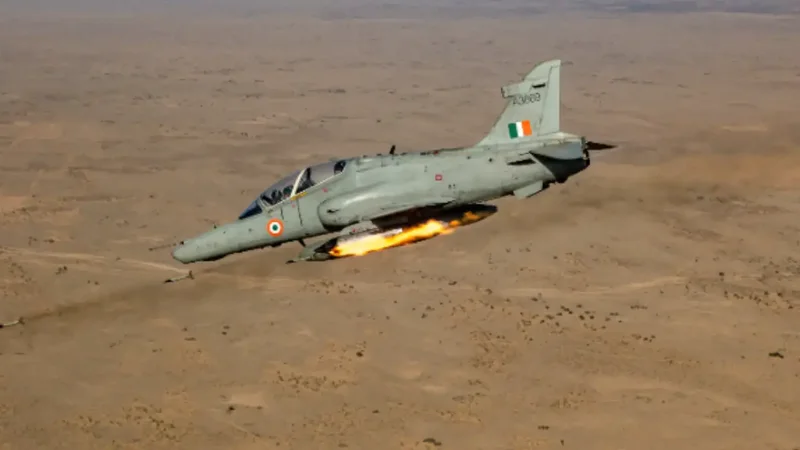
Indian Air Force has kicked off the process to acquire 150 advanced jet trainer aircraft that will supplant the current fleet of the British Aerospace (BAe) Hawk Mk-132 advanced jet trainers. The document seeks information from global aerospace manufacturers to provide information on their offerings for what the air force is calling Stage-III (F) trainers. These aircraft will be the final stage of training for budding fighter pilots before they move to fly more powerful and capable aircraft such as the Tejas, Rafale or Sukhoi-30 MKI.
The IAF seeks responses from firms globally about the capabilities and characteristics of their offerings by October 5. As the programme to replace the Hawk matures, the air force is planning to release the Request for Proposal (RFP) for the aircraft in December 2027. With trials and other procedures, the aircraft is not likely to enter IAF service till at least the 2030s. The air force has mentioned that the trials of the aircraft will be on a no-cost-no-commitment basis â standard practice at this early, non-binding stage of procurement.
The need for different types of trainers
The Indian Air Force, like most other such forces imparts flying training in three phases, which grow in complexity as the training progresses. In the first stage of training the combat aviator in the making learns about the basics of flying, basic flying maneuvers, aviation theory, core instrument navigation, aviation meteorology, flight rules, aerodynamics, and aircraft systems. This phase, which is 24 weeks long, is conducted on the Swiss acquired Pilatus PC-7 MkII, turboprop trainer aircraft. The PC-7 is now being replaced by the domestically developed HTT-40 aircraft. It is after this stage that the trainee pilots are sent for more specific training for the different flying streams which are fighters, transport and helicopters.
In the second stage of flying training,, which is also 24 weeks long, trainee pilots move to different flying training establishments that cater to specific training for the stream the cadet will enter upon commissioning. For the fighter stream, these pilots train on the Kiran Mk-II aircraft, those destined for transports hone their skills on the Dornier-228, while helicopter stream trainee pilots develop their capabilities on the Chetak helicopter. This phase advances the skills of the trainee in navigation, tactics and aircraft handling.'
Stage III training is more operations oriented and is carried out by post commissioning. In this phase of training, the newly minted officers get training on advanced jet trainers such as the Hawk 132. In this stage pilots master high-speed maneuvers, tactical combat skills and advanced instrument flying. In this stage pilots are taught how to use their machines in combat and on the use of different combat as well as combat support systems in the aircraft. It is at the end of this stage that fighter pilots are sent to operational units as fighter pilots, where they are further trained on the specific type of aircraft they fly and move up in the command and control aspects as they grow professionally.
New trainers for the air force
The Indian Air Force is currently at a stage when it's squadron strength is at a decades low, currently standing at 29, although the air force has a sanctioned of 42.5 fighter squadrons. The current fleet of advanced jet trainers of the air force and the navy combined stands at 119. The need for 150 trainers could potentially hint at the force's intent of training more pilots as the size of the fighter fleet is set to increase, with the induction of the Tejas Mk-1As and additional Rafales. The air force is also expecting to induct the more powerful and currently under development aircraft such as the Tejas Mk-2 as well as the fifth-generation Advanced Medium Combat Aircraft (AMCA).
As the fleet size expands, it becomes more important to aggrandise the training apparatus, so as to streamline the air force which is moving to expand in number. The need for an advanced jet trainer has hurt the air force in the past. The IAF, had inducted the Hawk trainer in 2008, before that a large proportion of crashes suffered by the air force was due to the lack of trainers in the air force. As per a Parliamentary Committee on Defence report tabled in April 2010, the air force had stated that 33 of 74 or 44% of the crashes recorded between April 2004 and March 2010, were caused by human error. A majority of these crashes were said to be caused by the training gap caused by the lack of an advanced trainer. This forced trainee pilots to move directly from an intermediate trainer directly to very high performance aircraft such as the MiG-21. The lack of this capability and the high number of crashes attributed to it became a point of national focus, even entering the silver screen as the premise of the 2006 movie titled 'Rang De Basanti'.
More than just numbers
The IAF is seeking a slew of modern day capabilities in its next edition of combat trainer aircraft. As technology is advancing the capabilities of the modern combat platforms across domains, the air force prefers to have many of these capabilities in its own modern fleet of trainers in order to provide realistic and relevant training to the next generation of fighter pilots.
The IAF's RFI for its next advanced trainer sets a demanding technical bar. Key requirements include fly-by-wire controls, a glass cockpit with configurable hands-on-throttle-and-stick systems, and navigation combining NavIC with GPS and GLONASS. Zero-zero ejection seats are mandatory, along with resistance to flight departures and automatic recovery if a pilot releases the controls.
The bigger shift lies in simulation. The aircraft must carry embedded virtual avionics and an electronic warfare suite, plus the ability to simulate missile seeker heads mid-flight, linked via secure data link to a 360-degree dome simulator under a Live-Virtual-Constructive setup â with holographic debriefing built in.
Operationally, the IAF wants sub-30-minute refuelling and rearming turnarounds, hour-long engine changes, AI-based predictive maintenance, and an open architecture allowing future upgrades from vendors beyond the original manufacturer.
The aircraft in the fray
Some of the most modern aircraft in the fray are BoeingâSaab T-7 Red Hawk, Alenia Aermacchi M-346 Master and KAI T-50 Golden Eagle. Interestingly, the Tejas has been in the passed pitched by the Hindustan Aeronautics Ltd (HAL) as a lead in fighter trainer. The HAL is also developing an aircraft called the HLFT-42, a trainer concept being delivered by the state owned behemoth in Aero India 2023. The HLFT-42 is being designed from the ground up as an advanced trainer with combat capabilities.
Beyond specifications, the RFI signals a broader shift in the IAF's training philosophy. With squadron strength far below the sanctioned strength and inductions of Tejas Mk-1As, additional Rafales, the Tejas Mk-2 and eventually the AMCA on the horizon, the demand for 150 trainers well above the current combined IAF-Navy fleet of 119 suggests preparation for a larger, more capable fighter force ahead.
The training gap before the Hawk's 2008 induction was linked to a high proportion of crashes caused by human error, a crisis serious enough to inspire Rang De Basanti. This search for trainers is now reflective of a pro-active approach to stay ahead of the curve as the forces modernises, in order to be ready for any challenge the future could throw at it.