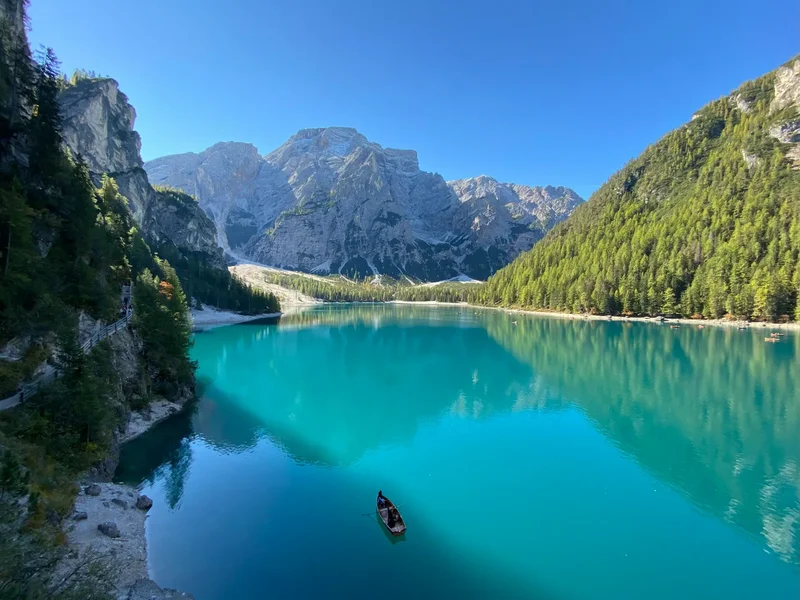
Italy’s Dolomites mountains span three regions and five provinces, stretching from Trentino-Alto Adige/Südtirol east across Veneto and Friuli Venezia Giulia. But South Tyrol (or Alto Adige in Italian) is unique among them for its deep-rooted Austrian identity.
Formerly part of the Austro-Hungarian Empire, South Tyrol was annexed by Italy in 1919 after World War I and later subjected to forced Italianisation under Mussolini, only gradually achieving a degree of hard-won autonomy in the decades following the Second World War.
That past heavily informs its present: around 70 percent of the population in the autonomous province of Bolzano – South Tyrol’s official administrative title – speaks German as a first language, and every town, village and street has bilingual German and Italian names.
Add to that the prevalence of pretzels, apple strudel and knödel dumplings, and it can feel more like you’re in a part of Austria with some Italian influences than the other way around.
South Tyrol has long been a popular destination for hikers and winter sports enthusiasts, but co-hosting this year’s Winter Olympics has further boosted its profile internationally. Here’s what to know if you’re planning a visit.
Multilingualism
Most people in South Tyrol are trilingual, speaking German, Italian and some English, and some also speak Ladin, an ancient language spoken throughout the Dolomites.
Under the province’s autonomous framework, all public employees must be able to communicate in both German and Italian, and in some areas, Ladin as well.
READ ALSO: From beer to hairdryers: 10 Italian words that come from German
In mountain towns and villages, German is the first language you’ll be greeted in, and you might come across one or two establishments where it’s the only one spoken – so it’s a good idea to come equipped with a basic translation app in case you need help interpreting a menu.
Getting around
Most mountainous or rural areas of Italy are impossible to explore without a car, but its strong public transport network makes South Tyrol an exception.
Bringing or renting your own car will naturally offer more flexibility, but if you’re based in the capital of Bolzano (Bozen in German), you’ll likely be able to take a train or bus to most of the destinations on your list.
Regular buses depart from Bolzano’s central station to ski resorts like Ortisei, where you can take a cable car to the Alpe di Siusi or the Seceda ridge line.
Visiting in peak season
Speaking of Ortisei, don’t assume you’ll be able to drive up during the summer holidays and find a spot in one of its many car parks, which fill up early in the day.
The growing number of visitors to South Tyrol’s most popular hotspots has pushed authorities to impose seasonal access restrictions, including at the turquoise-blue Lago di Braies and the Plätzwiese mountain plateau.
If you’re organised enough to book in advance and do manage to make it to one of these destinations, expect to share it with large crowds.
That doesn’t mean there aren’t an abundance of lesser-known alternatives equally worth your time: apps like Alltrails or Wikiloc can help you discover new areas that offer comparative peace and quiet even during the high season.
Travelling with children
You might assume a hiking destination like South Tyrol isn’t appropriate for small children – but that couldn’t be more wrong.
Many hikes are reached by cable car, meaning you’re already surrounded by spectacular views before you’ve even started out on the trail; some are even suitable for pushchairs.
All of them are dotted with malghe, Alpine refuges that offer cooked meals and almost universally provide children’s play areas, complete with slides, swings, sandpits and (occasionally) trampolines.
If you pay a visit to a swimming lake (which usually entails paying a small entrance or parking fee), you can expect spotless toilets, showers and changing facilities, as well as at least one bar and/or restaurant.
Changeable weather
South Tyrol is a rare year-round destination, with its cosy Christmas markets and ski slopes drawing visitors in the winter and its striking landscapes attracting expert and amateur hikers the rest of the year.
Particularly in the summer, however, the weather can be unpredictable, with storms appearing out of the blue – so it’s a good idea to pack a poncho in your backpack.
If you find yourself rained off a hike, don’t worry: there are dozens of historic castles well worth exploring.
The most popular rainy-day activity in Bolzano is a visit to Ötzi the Iceman, a perfectly preserved 5,000-year-old mummy, at the South Tyrol Archeological Museum. A word to the wise: everyone else will likely have had the same idea, so it’s worth checking the forecast and booking a slot ahead of time.