Why the position of Palestinian health workers in Israel has grown increasingly precarious
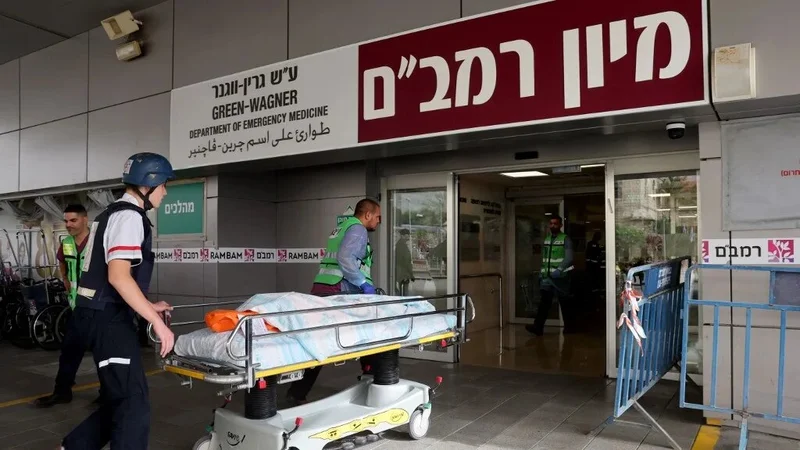
A recent controversy involving Palestinian medical staff at Haifa’s Rambam Hospital reveals several important things about the position of Palestinian citizens of Israel, particularly within the healthcare system.
The staff members were publicly lambasted following allegations that they mistreated and neglected Israeli soldiers in their care, including by speaking only Arabic at the hospital.
The subsequent public debate has gone beyond the specific details of this case, raising broader questions about linguistic rights. In several other recent incidents, Palestinian citizens of Israel have been banned from speaking Arabic in their workplaces.
Far-right politicians, including National Security Minister Itamar Ben Gvir, have amplified the Rambam allegations, fuelling claims that Palestinian healthcare staff should not speak Arabic at work - a demand that has previously been formalised in some hospitals.
Others, including public figures and healthcare workers, have testified to the professionalism and dedication of their Palestinian colleagues, whose profession transcends political, ethnic and religious differences. Some Palestinian healthcare staff have posted on social media about the many Jewish patients they have treated without prejudice.
At the same time, there is a broader atmosphere of panic and uncertainty about what the future holds for Palestinian citizens of Israel, and especially those within the medical establishment, whose position has grown increasingly precarious in the wake of 7 October 2023.
Since then, Palestinian healthcare workers have faced increased surveillance, disciplinary measures and threats to their livelihoods.
In the Rambam case, patients and their families participated directly in this policing, while the medical establishment largely tolerated it. The Israeli Medical Association did respond, albeit mildly, while other medical associations condemned the attacks on the Palestinian workers.
Institutional racism
At the same time, the case exposes a structural feature of Israel’s healthcare system: it is heavily dependent on Palestinian citizens, who constitute around 40 percent of its workforce - and yet, increasingly, they are institutionally treated as an internal threat to be managed and controlled.
Their professional incorporation into the Israeli system does not translate into political equality or protection. Their language, political expression and Palestinian identity all remain subject to regulation and surveillance.
Responses to the Rambam incident from within the medical establishment have also been revealing. Liberal and centrist voices have spoken out against the racism directed at their Palestinian colleagues, while simultaneously portraying the Israeli healthcare system as a space somehow insulated from the racist violence of broader society.
Meanwhile, support for - or silence towards - Israel’s genocide in Gaza, and the destruction of the enclave’s healthcare system, remains largely unquestioned.
This liberal framing, at times adopted by Palestinian workers themselves, distorts both the historical experiences of Palestinians within the Israeli healthcare system, and the events that have followed 7 October. More importantly, it obscures the political work that this system performs in governing Palestinians on both sides of the Green Line.
It separates Palestinian citizens’ struggle against institutionalised violence and racism from the broader structures of Israeli settler-colonialism and apartheid. Yet a state premised on treating Palestinians as a demographic, political and security threat to be eliminated will continue to produce structural racism and repression - even against those who are indispensable to its institutions.
This is how Palestinian healthcare workers should read the recent attacks. Distancing themselves from Gaza and the occupied West Bank, or adopting an externally imposed framing focused only on issues of citizenship, equality and democratic backsliding - in the absence of meaningful Palestinian political leadership - will not protect them.
The violence Palestinians face across historic Palestine takes different forms, but it is rooted in the same broader structures of Israeli settler-colonial rule. The racism and repression faced by Palestinian citizens of Israel thus cannot be separated from the genocide in Gaza or the ongoing ethnic cleansing across the occupied West Bank.
Palestinian citizens of Israel, including their leaders and health workers, must come together to organise against this status quo.
The views expressed in this article belong to the author and do not necessarily reflect the editorial policy of Middle East Eye.