Going tapless: Ng Teng Fong General Hospital redesigns ICUs for safety, sustainability
AI generated
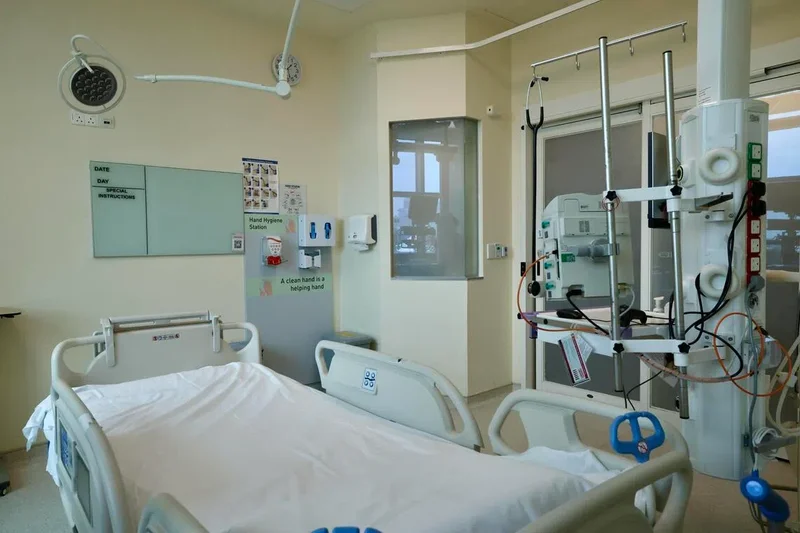
SINGAPORE — Ng Teng Fong General Hospital has removed traditional water taps and sinks in 44, or more than half, of its adult intensive care units (ICUs) to reduce contamination risks and its water and energy bills.
Instead, healthcare staff now use alcohol-based hand rubs when caring for patients in the ICUs. The hospital has a total of 74 such ICUs and it aims to remove the sinks in the remaining units by the end of 2028 as part of several moves made recently to reduce pollution and improve patient care.
In announcing the move at the Sustainability Nexus Forum 2026 on Aug 13, Ng Kian Swan, chief sustainability officer of Ng Teng Fong General Hospital and Jurong Community Hospital, said that the healthcare industry is one of the most pollutive sectors.
Urging healthcare players to do what is right to reduce their carbon footprint, he added: “There’s only one planet and no Plan B.”
The inaugural forum organised by Ng Teng Fong General Hospital and Jurong Community Hospital was attended by more than 300 participants from healthcare, logistics, infrastructure, energy, pharmaceuticals, academia and government sectors.
Speaking at the event, Senior Minister of State for Sustainability and the Environment Janil Puthucheary said that organisations need to be better positioned to maintain business continuity and even thrive when climate events strike.
“In a changing climate, those that prepare early will be better placed to maintain opportunity, protect our people and assets, and to seize new opportunities,” he said.
Adjunct Assistant Professor Surinder Pada, head of division and senior consultant of infectious diseases at Ng Teng Fong General Hospital, said that while sinks were installed to encourage hand hygiene, they are mostly used to dispose body fluids and wash equipment.
This could increase contamination risks and transmit harmful bacteria to patients, she said. “We have come to realise that if you place a sink too close to a patient, the water droplets can land on them and cause infections.”
Removing them will not only lower the chances of such waterborne infection but also help to save about 1.9 million litres of water a year, said the hospital in a statement on Aug 13. This amount of water is equivalent to three-quarter of an Olympic-sized swimming pool.
It will also help to avoid around seven tonnes of carbon emissions each year, which is equivalent to removing about six cars from the roads a year.
Ng Teng Fong General Hospital is also extending the life of its MRI scanners by upgrading and repurposing them instead of replacing them fully to reduce electronic waste.
Under this approach, the scanner’s magnet is retained while components that become outdated, such as computers and operator consoles, are replaced.
This can extend a scanner’s usable lifespan by another eight to 10 years, saving about $2.9 million per scanner.
Noting that MRI scanners comprise significant amounts of steel, copper, electronic components, and helium, the hospital’s head of radiography Melissa Liang said the disposal of an entire system when only certain parts are obsolete creates avoidable waste and requires significant resources to manufacture and transport replacement equipment.
By repurposing them and replacing certain parts help to reduce the raw materials used, conserve finite resources like helium and reduce manufacturing and transport-related carbon footprint, she said.
The hospital has four MRI scanners — one was refurbished in 2024 while another is slated to be refurbished by 2027.
The hospital is also replacing curtains in its isolation and ICU rooms with smart privacy glass, removing the need to wash them and saving an estimated 100,000 litres of water each year.