Eighteen months ago, the actor Lucy Davis, 53, best known for playing Dawn Tinsley in The Office, noticed a tiny, hard spot on her breast. It was so small that she almost didn’t bother getting it checked. But when she did, she was diagnosed with incurable breast cancer. It had already spread to her spine, right hip and ribs, and she announced yesterday on Instagram that it’s too late for chemo.
I cannot imagine what Lucy and her family have been going through. I’ve had breast cancer three times and my biggest fear is that one day I, too, will have incurable disease.
Now I don’t want to scare you, but Lucy isn’t alone. Around one in 20 people already have metastatic cancer when they are diagnosed. And some of them have no symptoms apart from a change in the breast. It’s only a scan that picks up the fact the cancer has spread.
One of the worst jobs I had as a consultant breast surgeon for three years was breaking the news to patients, especially when they are young. On average I would have to tell ten women a day they had breast cancer. But to tell someone that they couldn’t be cured is devastating.
If you spend any time on social media, breast cancer has become increasingly common. One in seven women will get breast cancer if we all live until we are 80. We know that more women under the age of 50 are being diagnosed every year.
Despite this, only six out of every ten women go for their screening mammogram and only four in ten check their breasts every month. A Breast Cancer Now YouGov survey in 2025 showed that women simply forget to check, they’re not confident or they don’t know how to do it.
Dr Liz O'Riordan has had breast cancer three times – and her biggest fear is one day being told it is incurable
Lucy Davis, 53, best known for playing Dawn Tinsley in The Office, noticed a tiny, hard spot on her breast and when she got it checked was diagnosed with incurable breast cancer
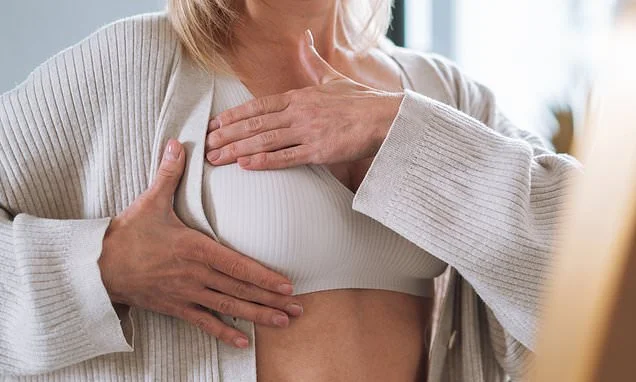
I was never told how to check. Mum never showed me. I only learned at medical school as part of my training. If you want to learn how to do it properly, you can check out my YouTube video, Breast Cancer Now and CoppaFeel websites.
There’s no point checking your chest if you don’t know what to look or feel for. Here are the 12 signs that might mean you have breast cancer – and no it’s not just lumps.
1. Skin colour change
If you have light skin, your breast could look red. If you’re a person of colour, your skin may look darker in tone, purplish or bruised. It may also be painful or hot to touch.
The most common reasons a breast turns red is an infection like mastitis during pregnancy and breast feeding. But if the infection doesn’t settle, you could have a rare type of breast cancer called Inflammatory Breast Cancer where cancer cells block the lymph vessels in the breast skin.
2. Skin that’s swollen or looks like orange peel
This is another sign of inflammatory breast cancer. When the lymph vessels become blocked, fluid collects in your skin making it look swollen. As things progress, tiny dimples appear, that look like orange peel or cellulite. You may not have a lump and the breast might not be painful, but this needs to be checked out.
3. Dimpling or tethering in the skin
This is why you need to look in the mirror with your hands by your sides, up in the air and pushing onto your hips. You might see a small indentation in the breast skin, like someone is pinching fabric from underneath. It’s caused by a tumour growing in the breast that’s pulling on normal tissue strands. When you raise your arms or push on to your hips, the bit of breast skin above the tumour is tethered, causing a dimple. There might not be a lump you can feel. That doesn’t matter.
Only four in ten check their breasts every month. A Breast Cancer Now YouGov survey in 2025 showed that women simply forget to check, they’re not confident or they don’t know how to
4. Nipple turning inward
Some of us have nipples that are naturally out, and some are naturally in. You should be able to pull your nipple out, and it should become erect when you’re aroused or cold. If one nipple is suddenly pulled in (what I call inverted) and you can’t pull it out, then there could be a cancer behind the nipple fixing it in place.
5. Nipple rash
Nipple rashes are fairly common. It may be due to a change in washing powder or fabric softener. But if you have a new rash that isn’t improving with a steroid cream, it’s getting larger or your nipple is red and sore, it could be a rare form of breast cancer that affects the nipple called Paget’s Disease. You should be referred to a breast clinic before you try another skin cream.
6. Bloody or clear nipple discharge
Nipple discharge is normal for most women in their thirties and forties. It’s a yellow / green / brownish colour, and the trick is to stop squeezing our nipples. It will settle down in time. But if you have clear, watery discharge, or blood coming from your nipple, this could be a sign of cancer. You may only notice a spot of blood when you take your bra off, or on your nightwear. And it can be mistaken for a jogger’s nipple, especially in men.
7. Breast thickness or fullness
It’s normal for your breasts to change in size and shape during your menstrual cycle. Some women go up and down a full cup size every month. But if one breast looks and feels fuller, this could be a sign of breast cancer. There’s a type of breast cancer called lobular breast cancer which grows in sheets working its way through the breast instead of forming a discrete lump. It’s what I had, and it can be hard to find on a mammogram or ultrasound for this reason.
8. Change in breast size or shape
Your breasts are sisters, not twins. One side is always a bit smaller or sits a bit lower. But if one breast suddenly gets bigger or smaller, or changes in shape, this could also be due to breast cancer. And again, there may not be a lump.
9. A breast lump
Breast lumps are really common when you’re in your twenties, thirties and forties. Cysts and harmless fibroadenomas (or breast mice) come and go. But a lump could also be cancer. That’s why every breast lump should be seen and scanned. I thought my cancer was a breast cyst, and I’m a breast surgeon. It’s hard to know what’s normal if your breasts are lumpy, but this is why it’s so important to check every month so you can spot a change. If you can hold a pencil under your breasts, you should be checking when you’re lying in bed or the bath instead of standing up. It makes it easier to feel the lower half of your breast.
One in seven women will get breast cancer if we all live until we are 80. We know that more women under the age of 50 are being diagnosed every year
10. Lump in your armpit
The lymph nodes in your armpit are there to help fight infection, and they can grow from the size of a pea to a marble if you’re poorly. But if you feel a large lump in your armpit and you haven’t been ill, it could be something serious. There are several cancers that can make these nodes grow, like lymphoma, as well as breast cancer. Sometimes surgeons like me can’t find cancer in the breast but we see it in the nodes. This is one of the hardest places to check accurately. Make sure your arm is down by your side when you check.
11. Recurrent breast cysts
Breast cysts are common around the perimenopause. I had a couple of women I would see every six months to have one drained. But sometimes the cysts are complex and there is cancerous tissue in the wall. So if you get cysts regularly, and one keeps coming back in the same place, get it checked to be on the safe side.
12. Persistent, one-sided breast pain
If breast pain on one side is your only sign, I can almost guarantee that you won’t have breast cancer. But if you have breast pain and a lump or dimpling, then the pain could be related to the cancer.
Doctors like me hope that by checking your breasts regularly you’ll spot the signs of breast cancer at an early stage so you have a greater chance of a cure. But for some people, like actress Lucy Davis, the signs are subtle, easy to miss and it’s already too late.
My heart goes out to Lucy and her family, and the thousands of people living with incurable breast cancer today. Don’t be like me. Don’t put your head in the sand. Check your breasts every month. It might just save your life.