In the lead-up to the 2019 World Cup pool clash in Yokohama, Springbok assistant coach Mzwandile Stick called for referee Jérôme Garcès to âtreat both sides equallyâ and to dispense with preconceived ideas of the All Blacksâ dominance in key areas of the game.
Steve Hansenâs team were the best in the world at that stage, and given all theyâd achieved â as back-to-back World Cup champions and trendsetters of the sport â one could understand why they received the rub of the green more often than not.
Indeed, when Stickâs comments were put to Hansen, the All Blacks coach accused the Boks of attempting to influence the referee and negate New Zealandâs strengths.
Nearly seven years later, the roles have been reversed.
The Boks are now the better side in the context of the rivalry and the most dominant side on the planet â having won back-to-back World Cups, and more recently, 12 Tests in a row.
Now the calls for fair treatment are coming out of the Land of the Long White Cloud, with the New Zealand Herald questioning the referee appointments ahead of the Rugbyâs Greatest Rivalry (RGR) Test series in South Africa (SA).
With that in mind, one can understand why the New Zealand Herald has described Carleyâs appointment for the first Test as âan ominous sign for the All Blacksâ.
Matthew Carley (England) will take charge of the first Test at Ellis Park on 22 August, while Nika Amashukeli (Georgia) will control proceedings in the second match at Cape Town Stadium.
Angus Gardner (Australia) will be in the hot seat when the series moves to the FNB Stadium, and Karl Dickson (England) will preside over a potential decider in Baltimore, US.
Some refereeing decisions in the recent tour matches have raised a few eyebrows.
While the All Blacks beat the Stormers 38-21 in the first tour fixture in Cape Town last week, the visitors conceded a whopping 16 penalties and three yellow cards.
Many applauded the Stormers for taking the fight to the Test side, while others such as All Blacks legend John Kirwan described Dicksonâs refereeing as âpedanticâ.
The debate will continue in the lead-up to the first Test, and in the three weeks that follow.
But a closer look at the referees in question, and specific matches theyâve managed in recent seasons, reveals some interesting findings.
Refereesâ focus has paid off
The current laws are open to interpretation, and as a result, every referee will have a slightly different approach to the management of the set piece, breakdown and aerial contest.
Knowing that, leading teams will spend a fair amount of time on referee analysis in the lead-up to big fixtures.
Some Test sides have gone as far as to appoint a full-time specialist on their coaching staff. Former Test referee Jaco Peyper joined the Boks in 2024 as the teamâs âlaws advisorâ, while Garcès has been working with France since 2021.
By all accounts, the appointment of Peyper has taken the Boksâ understanding of individual referees and World Rugbyâs directives to another level.
Over the past three seasons, the Boks have had a clearer idea of whatâs required ahead of specific Tests and have managed to stay on the right side of the law more often.
The Bok coaches are reportedly happy with the appointments for the Greatest Rivalry Tests â and a closer look at the stats reveals why.
What the stats say
Overall, the four referees in question have combined for 23 of the 97 Tests the Boks have played since Rassie Erasmus took charge of the team back in 2018.
The Boksâ winning ratio in these matches can be broken down as follows: Carley (78%), Amashukeli (75%), Gardner (60%) and Dickson (50%).
Those figures donât, however, account for SAâs dominance in more recent seasons.
The Bok players and coaches â many of whom have been in the system for close to a decade â have come to understand the respective referees and their varying approaches to the game.
For example, the Boks lost the first three matches that Gardner refereed in 2018, but won five in a row where the Australian was in charge between 2021 and 2025.
With regards to the rivalry with New Zealand, specifically the six-game stretch that has yielded five wins for SA, Carley was the man in the middle when the Boks romped to a 35-7 victory in London back in 2023, and when the Boks emerged with an 18-12 win in the deciding fixture of the 2024 Freedom Cup in Cape Town.
With that in mind, one can understand why the New Zealand Herald has described Carleyâs appointment for the first Test as âan ominous sign for the All Blacksâ.
Last year, Amashukeli presided over the Boksâ record-breaking 43-10 win in Wellington.
The Boks lost the preceding game at Eden Park when Dickson was the ref â but a closer look at the key contests in that fixture will encourage the South Africans more than the New Zealanders ahead of Dickson's next assignment in Baltimore.
Indeed, the coaches and analysts in both set-ups will be more interested by the officials' tendency to reward South Africa's dominance at the scrum and maul.
Reward for scrum dominance
The Bok scrum and maul bulldozed the All Blacks at Twickenham in 2023, when Carley was in charge.
The South African scrum forced four penalties and the maul one, and the pressure told on New Zealand, who conceded two yellow cards and one red.
A year later, Carley refereed the Freedom Cup decider in Cape Town. The hosts didnât have everything their own way at the set pieces on that occasion, but the All Blacks conceded a further two yellow cards.
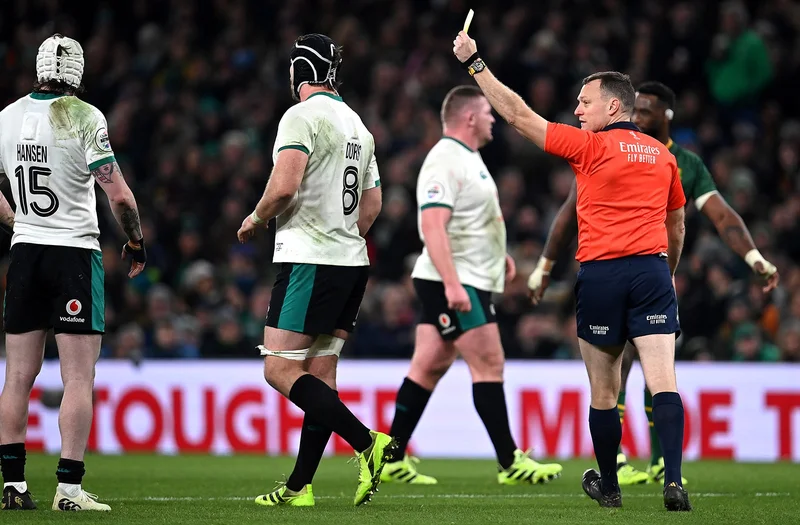
Last November, the Boks delivered one of their most destructive scrummaging performances in recent history, when they decimated the Ireland pack in Dublin en route to a 24-13 victory.
Carley awarded seven penalties at the scrum and three at the maul, while the hosts conceded four yellow cards and one red.
The Boks have drawn Amashukeli in just one match in the current World Cup cycle â namely the record-breaking win in Wellington last year.
The Georgian awarded two penalties at the scrum on that occasion, and the contest was largely shaped by SAâs kicking game (32 kicks from hand) and a clinical attacking display in the opposition 22.
Gardner was the referee when the Boks won six scrum penalties against Scotland in the 2023 World Cup pool match in Marseilles. Two years later in Durban, SA forced four set-piece infringements against Argentina and went on to claim a record-breaking 67-30 win.
The Australian also managed the big clash between the Boks and Six Nations champions France in Paris last November, a contest that yielded three scrum penalties for the South Africans and eventually a 32-17 victory.
Result still rankles
Dickson has refereed four matches involving the Boks, and the South Africansâ success-rate (50%) may seem low in the context of their overall record.
That said, the Englishman awarded four scrum penalties to the Boks in the loss to Ireland in 2024, and another four in last yearâs defeat to the All Blacks at Eden Park.
While the result of the latter game still rankles, the power scrum that resulted in a turnover and try for Malcolm Marx will not be forgotten any time soon.
More recently, Dickson refereed the battle between the Stormers and the All Blacks and was quick to reward the hosts for their dominance at the scrum and maul.
The flow of that contest in Cape Town will have given the Bok and All Blacks coaching teams food for thought ahead of the coming Tests.
Street-smarts deserve credit
Some might consider all of the above and conclude that itâs a simple matter of dominance and reward.
But communication and adaptability has been at the heart of the Boksâ success in recent seasons, and the players and coaches deserve credit for how theyâve managed the referees and â where necessary â adapted to an individualâs style of officiating.
Hansenâs All Blacks were the most successful team of the 2010s because they were also the smartest side on show. The same could be said of Erasmusâ Boks in recent seasons.
While the Boks have dominated the game â winning 31 of the last 34 Tests â there have been times when things havenât gone their way and theyâve been forced to adapt to secure the result.
Overall, they have earned the respect of the officials â and given all they have achieved, from results to specific performances at the scrum, maul and aerial contest, one can understand why they start so many marquee fixtures with an advantage.
This was the case in 2019 when the All Blacks were at the top of the world and remains the case today with the number one-ranked Boks heading into the Greatest Rivalry series as favourites. DM