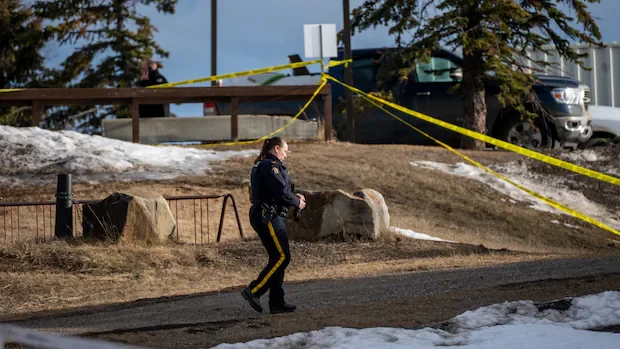
Unsealed documents reveal details of RCMP's response, investigation into Tumbler Ridge shooting
RCMP's minute-by-minute response to the shooting is made public – though critical details remain redacted
Documents unsealed by CBC News and a consortium of media outlets reveal new details of the RCMP's response and investigation into the February 2026 mass shooting in Tumbler Ridge, B.C.
The documents, which include search warrants, production orders and sealing orders, provide a snapshot of a complex investigation, laying out for the first time law enforcement's account of the day shots rang out at Tumbler Ridge Secondary School.
The newly unredacted files from the RCMP paint a picture of how front-line officers experienced the events of that day.
Significant portions of the documents remain redacted, including timestamps crucial to the chronology, such as how long it took officers to enter the school after receiving reports of shots fired.
The documents say that on Feb. 10, 2026, RCMP responded to an active shooter at the high school in Tumbler Ridge and found six deceased victims in a school littered with spent shell casings. They identify the shooter as 18-year-old Jesse Van Rootselaar, who was found dead in the school with self-inflicted gunshot wounds.
Search warrants filed by the RCMP describe the evidence, physical and electronic, that police identified as they attempted to piece together what happened that day.
One sealing order filed in early March describes concern that releasing records connected to the investigation could compromise future public inquests and pose a risk to the public.
911 calls reported erratic driver, shots fired
The mass shooting, one of the worst in Canadian history, shook the small northern B.C. community, and is now the subject of a coroner's inquest investigating the role that mental health, access to weapons, and artificial intelligence played in the tragedy.
Throughout the documents, Van Rootselaar is referred to by her last name, full name, "Jesse," and "the shooter."
A production and sealing order sworn by Const. Jonathan Paquin of the RCMP North District Major Crime Unit on March 6 describes a flurry of 911 calls received the morning that chaos unfolded in Tumbler Ridge.
On Feb. 10, RCMP received a call about "an SUV that had been driving erratically from [redacted], which is the residence of Jesse."
The vehicle driven to the school was later identified as a green 2023 Hyundai Palisade.
A caller reported that "there were two dead bodies and shotgun shells on the floor" and they "thought that the eldest son was armed and had left, and that the mother and son were dead."
RCMP advised the caller to leave the scene untouched, close the door and return to their residence.
RCMP then received multiple calls of shots fired at the secondary school.
The documents include a minute-by-minute accounting of various officers arriving on the scene, hearing shots fired, entering the school, and locating deceased victims and the deceased shooter.
"Police were shot at by the suspect which caused them to hold while being shot at," it reads in part.
Because timestamps are redacted from the documents, it's unknown how much time elapsed between the events described over several pages.
For example, the documents do not relay how much time passed between the initial 911 call describing the erratic vehicle, and police entering the school. This week, CBC News and a consortium of other media have been in court to argue that some of the redacted information be made public.
The production order also reveals confusion over whether there was a second shooter in the school, possibly because the shooter went by the aliases Jesse Jacobs and Jesse Strain, in addition to Jesse Van Rootselaar.
One inspector identified the shooter as the "eldest child in the STRAIN/JACOBS family, and that they were obsessed with guns," the document reads.
"[The] inspector reported that a possible second shooter was Jesse VAN ROOTSELAAR," reads the document, though it's later detailed that police identified these were the same person.
Details of firearms remain sealed
A search warrant filed the day after the shooting describes evidence sought by police, including "human biological substances including but not limited to: blood, hair, fingerprints and human tissue," "firearms, ammunition, spent cartridge casings," and "computers, cell phones or tablets, that may belong to Jesse Van Rootselaar."
A production order lists physical evidence located inside Van Rootselaar's home, including a Sony Handycam, a black iPhone with a cracked screen inside a black case, a purple Aocwei laptop, a MacBook Air, an SD card and a purple digital camera.
A search warrant filed on Feb. 11 describes the scene at Van Rootselaar's home. It says two RCMP corporals observed "a shotgun [redacted] that was unloaded as well as a pellet gun" and "insecure firearms inside the residence."
Between Feb. 13 and 20, a firearms tracing investigation with the Canadian Firearms Program attempted to trace four firearms of those seized from the secondary school and a second, redacted address. The details of the firearms are redacted, though two shotguns and a rifle are listed.
Electronic records sought
A section of the order describes a Police Records Information Management Environment — or PRIME — review of the teen.
Any individual who interacts with law enforcement in B.C., from witnesses to suspects, is entered into PRIME's centralized database, regardless of the nature of the interaction.
The order says Van Rootselaar was carded to 12 PRIME files, dating back to April 2018 when she would have been around 10 years old. The details of those incidents are redacted.
A section about Van Rootselaar's social media accounts is redacted in its entirety, with nearly seven pages of text fully blacked out.
But the file says on Feb. 15, 2026, RCMP were notified by the FBI that OpenAI had located two ChatGPT accounts believed to be used by Van Rootselaar. Details of those accounts are also redacted.
"Jesse's ChatGPT account was subject to an internal review in June 2025 after Jesse's chat conversation discussed matters that could be related to the school shooting," it said.
"OpenAI banned Jesse's ChatGPT account and did not notify police at that time."
A request to seal
One document, an application for an order to seal filed March 6 by Paquin, shows that police were concerned that unsealing the production order filed concurrently could compromise ongoing investigations, and potentially put the public at risk.
Paquin argues that disclosure would harm a newly-announced coroner's inquest, because "while this is not a criminal trial, it is a court proceeding involving a jury." He argues that while the province had not yet called a public inquiry, any potential future inquiry could be influenced by information that had been made public.
"This is a large and complex investigation that has garnered significant national and international attention with significant media coverage of the incident and the police investigation," it reads in part.
"For this reason, I believe that evidence outlined in this Information to Obtain if prematurely disclosed would certainly be disseminated through various news outlets that would affect and influence the current ongoing criminal investigation, the coroner's inquest, and a potential Public Inquiry."
Paquin also argues that making the contents of the document public could inspire further acts of mass violence, invoking high profile incidents in the U.S.
"I am aware that mass casualty incidents can inspire copycat attacks. For example, the Columbine High School massacre is well known to have had this effect where it inspired other shootings in the following years," he writes.
"I believe premature disclosure of this Information to Obtain without a complete criminal investigation, and the following Coroner's Inquest or Public Inquiry where all the facts are known could put the public at risk."