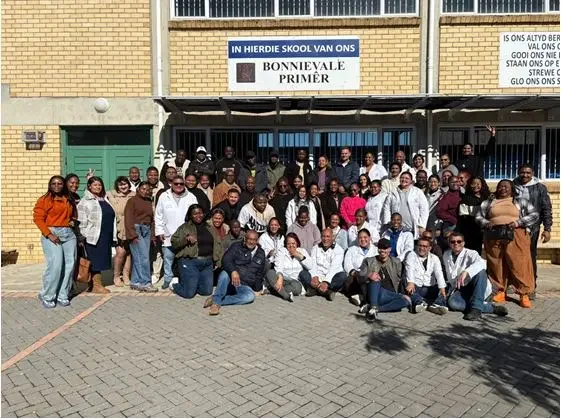
Advancing Knowledge Non-Profit Company (AK NPC), in partnership with the South African Democratic Teachers’ Union (SADTU) and the Curriculum Services of the Cape Winelands and Overberg Education Districts of the Western Cape Education Department (WCED), presented a science club training programme for Natural Sciences teachers and science club practitioners from schools across the two districts.
The initiative builds on the success of a similar programme conducted in the region in 2025. It seeks to promote science and technology education by making science more accessible and engaging through school science clubs. The training was designed to equip teachers with the knowledge and practical skills required to establish new science clubs or strengthen and expand existing ones.
THE 2026 TRAINING PROGRAMME
The 2026 training programme formed part of AK NPC’s partnership with the Garden Cities Archway Foundation and was held on 6 and 7 August 2026 at Bonnievale Primary School in Bonnievale. Fifty teachers representing 30 schools participated in the programme.
The training was opened by Professor Shaheed Hartley, Director of AK NPC, who outlined the objectives of the programme and provided practical guidance on establishing, sustaining and managing effective school science clubs. The specialist sessions were facilitated by AK NPC project team members: Robert Solomon (Physics), Mr Gert Marero (Chemistry) and Mark Ogilvie (Technology), Danie Burger, Analida Malies, Evelyn Johnson, Joanne Lindeboom, Abigail Joseph, Irene Robertson, Mira Snyman, Madre Cupido, Devon Espin and Recobin Conradie. AK NPC staff members Somila Dlakavu and Siphiwuthando Qeqe (Science Interns) and Melissa Petersen (Project Coordinator) also supported the programme. Science subject advisors, Ms Chantel Cupido and Mr Ziyaad Moerat, represented the education department at the training.
Most of the facilitators are teachers from schools within the Cape Winelands Education District with well-established science clubs. Their practical experience enabled them to share valuable insights into establishing and developing successful science clubs, overcoming common challenges and sustaining learner participation. Through demonstrations and examples drawn from their own experience, they showed participants how simple introductory activities can be developed into comprehensive science club programmes that promote inquiry, creativity and scientific thinking.** **
PRACTICAL AND EXPERIENTIAL LEARNING
Participants were divided into three groups that rotated through practical sessions in Chemistry, Physics and Technology over the two-day programme, ensuring that every teacher attended each of the three sessions. Participants were introduced to a progressive approach to planning and conducting science activities, beginning with simple experiments and investigations and gradually progressing to more complex demonstrations, exhibitions and projects. The objective is for teachers to transfer these skills to learners through their school science clubs and, ultimately, prepare them to participate successfully in science club competitions.
SPARKING CURIOSITY THROUGH CHEMISTRY
Experienced facilitators first demonstrated a range of hands-on activities before participants conducted the investigations themselves. This approach enabled teachers to gain the confidence and practical competence required to replicate and adapt the activities in their own school science clubs.
Particular emphasis was placed on safe laboratory practices and the safe conduct of science activities. Throughout the programme, teachers were introduced to practical science investigations using inexpensive and readily available household materials to demonstrate scientific concepts, principles and processes. This approach is particularly valuable for schools with limited resources, as it demonstrates that meaningful and engaging science activities can be conducted without relying on expensive equipment or specialised materials.
CHALLENGING MINDS THROUGH PHYSICS
The practical sessions generated considerable enthusiasm among participants. Teachers responded with excitement, cheering and applause as they observed demonstrations and participated in activities that challenged and expanded their scientific knowledge and understanding. The Chemistry session, in particular, featured controlled demonstrations involving loud bangs, explosions and coloured flames, while the Physics and Technology teams provided equally engaging activities, including water-rockets that participants struggled to retrieve from rooftops.
Beyond the excitement of the demonstrations, the programme provided teachers with a practical pathway for establishing a science club from scratch or renewing, strengthening and expanding an existing initiative. Participants were guided to begin with elementary experiments, investigations, exhibitions and activities and to progressively increase their level of difficulty and complexity. The training therefore emphasised both the development of practical scientific skills and the importance of creating sustained opportunities for learners to explore, question, investigate and apply scientific concepts.
CREATING, BUILDING AND INNOVATING WITH TECHNOLOGY
EXPECTED OUTCOMES AND NEXT STEPS
The knowledge and skills acquired during the training are intended to strengthen science clubs across the Cape Winelands and Overberg Education Districts. By transferring these skills to learners, participating teachers will be better positioned to develop active and sustainable science clubs that encourage scientific curiosity, creativity, inquiry and problem-solving.
The programme also serves as an important preparation opportunity for learners who will participate in the annual AK NPC Science Club Competition, scheduled to take place on 22 September 2026 in Worcester.
The 2026 training programme has therefore provided participating teachers with practical knowledge, resources and renewed confidence to establish, revitalise and advance school science clubs. Through continued implementation at school level, the programme aims to contribute to a stronger culture of science engagement and participation among learners across the two education districts.
EVALUATION OF THE TRAINING: KEY IMPACT AREAS
The evaluation feedback from participating teachers provides strong evidence that the science club training achieved more than the transfer of scientific knowledge and practical skills. The hands-on nature of the programme stimulated enthusiasm, challenged existing perceptions of science teaching, strengthened teachers’ confidence and equipped participants with practical ideas that they could take directly into their classrooms and science clubs.
The teacher feedback provide compelling qualitative evidence of the value of the 2026 science club training programme. The programme strengthened teachers’ practical competence while simultaneously influencing their attitudes, confidence and approach to science education.
Most importantly, participants were shown that science clubs do not have to begin with elaborate equipment or complicated projects. They can start with a simple question, an everyday object, an experiment and a teacher who is willing to explore alongside their learners.
The training has consequently laid a practical foundation for participating teachers to establish new science clubs, revitalise existing clubs and create more opportunities for learners to experience science through experimentation and discovery.
The enthusiasm expressed by participants and their stated intention to implement the activities at school level provide encouraging evidence that the programme can translate professional development into visible action, sustained learner engagement and a stronger culture of science inquiry within schools.
In this respect, the training was not simply a two-day professional development intervention; it served as a catalyst for renewed confidence, creative teaching and expanded opportunities for learners to engage meaningfully with science and technology.
PARTNER WITH US TO GROW THE NEXT GENERATION OF STEM TALENT
Organisations, corporates and other stakeholders that share a commitment to strengthening science education and expanding opportunities for learners in rural schools are invited to partner with AK NPC in this important initiative. Through strategic partnerships and support, AK NPC aims to empower and capacitate science club practitioners, strengthen school science clubs and build a critical mass of young people from rural schools who are inspired and equipped to pursue studies and careers in Science, Technology, Engineering and Mathematics (STEM).
Organisations interested in contributing to or partnering in this initiative are encouraged to contact: Prof Shaheed Hartley
Director: Advancing Knowledge Non-Profit Company (AK NPC)Email: shartley@skatt.co.za