[Today’s Iran war post launched more or less complete but I had to run out. That means if there is any new news, an updated version may post as late at 8:30 AM EDT. Please check comments for any notes from me about refreshing the page and re-skimming]
With the fabulously erratic Donald Trump in charge, the presumed trajectory of the Iran war could change radically on short notice. But the boundary conditions seem to limit that. The US does not and will never have the means to subdue Iran militarily. Karen Kwaitkowski on Judge Napolitano re-confirmed what has been reported elsewhere, that the US has lost every war game that simulated a war on or attempted invasion of Iran. The US armed services are in much sorrier shape than in our Cold War prime. Our army is much smaller. Our Navy is much smaller. As has been reported widely, not only are US weapons stockpiles depleted, with many years expected for replenishment, but they are overwhelmingly the wrong weapons, fit for big World War II style maneuver or whacking insurgencies. They are overwhelmingly high-cost, fussy antiques in a new world of vastly cheaper yet highly precise drones and missiles, along with increased integration of weapons-based surveillance into a more comprehensive view of battle spaces.
That is before getting to the fact that the Navy is already coming apart due to the unprecedented length of deployment on the USS Abraham Lincoln in theater, with no end in sight. How, pray tell, can sailors who are psychologically frayed and chronically perform in one of the roles hawks bruit about, in providing transport and support for a ground invasion?
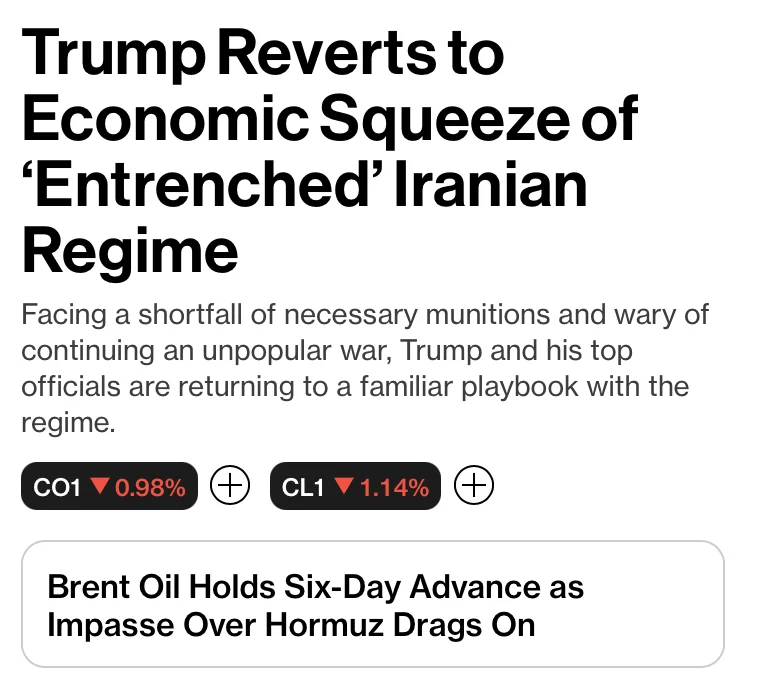
So the current clever US plan, as Administration sources told the Wall Street Journal, is that the US will keep up the economic war until Iran breaks. The Bloomberg lead article reconfirms that that is indeed the plan:
- The US military campaign against Iran has failed to force the regime to capitulate, so the Trump administration is relying on economic sanctions and a naval blockade to stifle oil exports.
- The approach, dubbed “Maximum Pressure”, is a return to a familiar playbook, with the administration arguing that it will be effective this time around despite having failed to bring about the desired result before 2020.
- The US has added numerous sanctions on Tehran, but analysts are skeptical that they will spark meaningful political change, with some arguing that the regime is entrenched and that sanctions are unlikely to convince them to give up their nuclear program.
As the summary suggests, given that the US has tried that for many many years, the prospects of that working out are not promising. We’ll soon turn to Brett Erickson, who argues that Iran is in much better shape (which does mean “good” shape) than is widely depicted in the West, particularly as far as government revenues are concerned.
By contrast, non-buyers of Iran and Russian oil (plus those who might get access by purchasing Chinese refined products) continued to suffer the effects of markedly lower transits of energy products and other essential commodities though the Strait of Hormuz. As we have pointed out, domestic growth in China is poor and a weak/recessionary world economy means exports won’t provide a boost.
The US short-term, by virtue of its domestic oil output, looks better situated than many countries. We have pointed out that Iran will have to shoot through much of the Global South economically harm the US. But that admittedly assumes that it is the energy/commodities strangulation and flagging global economy that drives the US into some sort of crisis. These factors may instead accelerate and intensify other train wrecks that seem likely to happen, such as bond market upheaval resulting from a currency crisis in Japan (recall oil shortages are increasing the harm done to Japan by a super cheap yen) or a private debt meltdown, or related implosions of AI equity and debt bubbles.
Now to Brett Erickson’s argument that Iran has more economic staying power than many assumed, even before getting to the fact that this conflict is existential for Iran and its citizens have already demonstrated that they have very high pain tolerance. Note I found Erickson to be uneven; some of his explanations did not make sense. Perhaps he is a TV newbie and was not as composed as he hoped to be.
From a lightly edited machine transcript:
Hussian: Who do you think has more stamina or more leeway in the situation? And how do you think that that siege strategy is likely to play out?
Erickson: So, I mean, one of the key flaws with the blockade is a lot of it is meant to cut off those oil revenues. The issue is in the first blockade, they Iran had about 120 to 140 million barrels of oil outside the blockade line and in May the average price of Brent was about $117 per barrel. Iranian oil was selling at just barely a discount, so they’re earning double what they had projected to earn at that time. As a result through this month they’re ahead of schedule on their projected oil revenues and that is definitely a huge aspect in their ability to weather this storm.
Then we signed the MOU and as a result during those 27 days Iran was able to export 80 million more barrels of oil which is about 175% their normal export rate. So while eventually the blockade will bite. We’re not seeing that in the rial. The rial has held better than it did prior to the war to the US dollar and Iran’s inflation rate has not meaningfully been impacted as a result of the blockade here. So we’re just not seeing from a data and numbers perspective, we’re not seeing much tocontribute to an imminent collapse of the Iranian economic infrastructure.
Grim: Just to clarify, Brett, if they were able to push 80 million barrels, export 80 million barrels. during the 20 days that the MOU was in in operation, how long will that will those ships be out at sea docking and unloading their cargo such that it continues to bring in revenue even as the even if the blockade is like 100% effective when it comes to new ships going out?
Erickson: Yeah. I mean, that’s a big question.
Grim: Are they all unloaded weeks, months? Like what are we talking?
Erickson: Yeah. So, I mean, Iran per their year 1405 budget bill is only planning to sell oil at $55 a barrel. Right now, Iranian oil is selling at, you know, 5-6-7 dollar discounts, but we’re trading at, you know, $85 to $90 per barrel. So, they’re earning significantly more than they have been budgeting for. Um, in addition, their average export rate is about generally 1.7 million barrels per day. So, between those two, I mean, at $55 a barrel, at 80 million barrels, you’re looking at 40 days. But when you’re talking about selling it at, you know, $80 per barrel, you’re looking at three months. Um, the other important aspect is generally for Iranian oil sales because of the need to launder those proceeds and evade sanctions, it can take one, two, or even three months for those revenues to hit the Iranian system so that they’re actually usable for trade.
So you’re looking at four, five, six months um before those revenues fully dry up. And that doesn’t even account for the roughly month and a half to two months ahead of budget that they are from being able to export and sell so much before the blockade was implemented. In fact, we even did a reverse blockade essentially by unsanctioning Iranian oil in March under a general licensed where they were able to sell free of sanctions.
So, they’re ahead of schedule and we just let them export 80 million more barrels that they’re going to be able to sell at higher than market prices or higher than budgeted prices. So, I mean, we’re looking well into 2027 before those oil revenues actually freeze up. And I mean, then then it only starts. I mean, then they’re only at budget for that timeline, not even catastrophically below.
Note that Iran’s very high inflation may also be given too much weight in the West. Many countries in Latin America have suffered from inflation at Iran levels for over a decade in their past. And for them, it was not the result of sanctions strangulation and war, as in intense and deliberate external pressure (ex Cuba). In fact, when I was a kid, Brazil was reported as having gotten good at inflation accounting, which somewhat reduced the effect of severe inflation normally making it impossible for businesses to know their financial condition (inputs, inventories, new investments and balance sheet items are inflating at different rates).
Erickson argues that Iran has chosen to implement a less than hard shutdown of the Strait of Hormuz for escalation control reasons, as opposed to lack of capability. He contends that Iran is choosing not to escalate more than it has to.
It could well be that Iran is choosing to hold back on how badly it strangles the world economy so as to reduce collateral damage. Here in Southeast Asia, we are seeing spotty effects (lower tourism, high diesel and palm oil prices but no generalized food, goods, or services inflation). And Thailand just announced a cut in electricity prices. And it is low in solar uptake. So increased US and Russian (and African) output, a leaky blockade, China making heavy use of its SPR have all led to less dire outcomes so far. But demand still exceeds output, so as some point the inventories situation will become more acute and demand destruction will kick in due to higher prices. And that’s before considering the crunch at refineries, which looks set to produce dislocations before crude shortages and grade mis-matches do.
It may also be that going much more aggressively after traffic in the Oman channel would have made negotiations with Oman even more difficult, and has led Iran to hold its fire.
Keep in mind vessels are still transiting the Strait of Hormuz, but at lower than pre-war levels. From Lloyd’s List in Tankers keep moving through Hormuz as diplomacy stalls:
- Tanker traffic through Hormuz continues despite US-Iran ceasefire collapse, with 30 mainstream transits recorded last week, including 19 VLCC movements
- Sinokor- and Adnoc-linked vessels persist trading even after ships associated with both operators were struck a month ago
- Diplomatic prospects remain dim as Iran insists strait will stay closed until Washington meets its conditions, while first Houthi-inflicted crew fatalities confirmed since war began
Nick Wade debunks optimistic takes on the latest inventory updates in A 17.4 Million-Barrel Crude Build is Not Evidence of a Glut:
US commercial inventories reported a massive crude build last week. This may be touted as evidence of a rebuild in supply and subsequent oil glut, yet once you look at the underlying numbers there is
limited evidence of this. The build consisted of SPR release (35%), identifiable market surplus (36%), transfers of other hydrocarbon liquids into crude supply (9%), and the EIA’s balancing adjustment (20%). The market surplus was fully driven by unusuallyhigh imports and low exports.Based on latest EIA data,
US refineries are already running hard, processing 17.2 mb/d, with utilisation at 96.2%.Crude imports jumpedby 1.14 mb/d to 7.3 mb/d, particularly because of increased arrivals from Canada and Venezuela, plus delayed Middle Eastern cargoes also began arriving. Meanwhileexports fellby 0.627 mb/d to only 3.06 mb/d, their lowest level since November 2025. Domestic production remained relatively steady at 13.8 mb/d.So the calculation for the
weekis:
Commercial build=million barrels17.42
Production + imports − refinery runs − exports = 6.35 million barrels
Transfers to crude-oil supply = 1.55
SPR release = 6.12
EIA adjustment/timing discrepancy = 3.406.35 + 1.55 + 6.12 + 3.40 = +
million barrels17.42On a
dailybasis, the calculation is:Production = 13.805 mb/d
Imports = 7.339
Exports = – 3.058
Refinery runs = – 17.179
= +0.907 mb/d(x 7 = 6.35 million barrels for the week)Transfers to crude-oil supply = 0.223 mb/d
SPR release = 0.874
EIA adjustment = 0.486Total commercial build = 0.907 + 0.223 + 0.874 + 0.486 = +
2.490 mb/d(× 7 = approximately 17.42 million barrels)The 1.56 million barrels of “
transfers to crude-oil supply” arenotnew crude production or barrels released from the SPR. They are other hydrocarbon liquids reclassified into the crude stream because they are blended with, or processed alongside, crude oil. For the week, they consisted of 38,000 b/d of Alaskan natural-gas liquids and 185,000 b/d of natural gasoline, condensate and unfinished oils. The EIA adds these barrels to crude supply and subtracts them from other petroleum supply, so thisdoes not represent additional supplyfor the petroleum system as a whole.A standout figure is the 3.4 million barrels for “
”. This is aEIA adjustment/timing discrepancybalancing item, not an identified physical flow, because the independently collected weekly figures do not balance.
Now to the increased intensity of the Ansar Allah-Saudi conflict. Keep in mind that Ansar Allah has been attacking both vessels (yesterday one killed crew members), port infrastructure, pipeline terminals, and refineries. Hitting ships lowers shipment levels due to fewer being willing to take the risk plus taking much longer routes, which ties up oil in inventories longer on tankers. Hitting energy assets can result in lasting, even permanent, output cuts.
But the Western press is oddly underplaying the latest escalation via ground operations. Some sightings on alternative media:
🔥🇾🇪 The Houthi escalation around Bab el-Mandeb is moving onshore too.
Ballistic missiles and drones have repeatedly struck Mocha, a strategic Red Sea port, damaging port infrastructure as the Houthis accuse Saudi backed forces of preparing military operations there.
The… pic.twitter.com/39llNJvSvp
— Jack Prandelli (@jackprandelli) August 12, 2026
YEMENI MILITARY SOURCE: NAVAL FORCES AND COAST GUARD DESTROY TWO HOUTHI BOATS OFF THE WESTERN COAST
— First Squawk (@FirstSquawk) August 13, 2026
See also at Janta Ka, starting at 10;45:
AlMayadeen reports, Nearly 3,000 casualties in Saudi attacks on Saada since de-escalation: “Yemen’s Saada Human Rights Office tells Al Mayadeen that Saudi attacks killed 356 people and wounded 2,632 during the de-escalation period.”
In a sign an information clampdown is underway, Aljazeera reports that Twitter suspended the account of Ansar Allah spokesman Yahya Saree, whose energetic delivery I find entertaining.
Some theories as to why:
X bans the official Houthi account after a series of successful strikes on Saudi-backed targets pic.twitter.com/shOR9FMfRH
— The Gulag (@WelcomeTheGulag) August 13, 2026
This healine, over the fold at the Bloomberg landing page, looks to be trying a bit too hard to depict the glass as half full. From Tanker Seen Loading at Key Saudi Hub for First Time in Weeks. From the story proper:
- A supertanker is moored at Saudi Arabia’s main oil export terminal inside the Persian Gulf, the first such sighting in almost a month.
- Saudi Arabia has diverted millions of barrels a day to its Red Sea port of Yanbu, but tracking those flows has become more complicated after Yemen’s Houthi militants said they would start attacking Saudi-linked ships.
- Satellite images show reduced levels of activity at the Yanbu export terminals compared to the period before Houthi rebels in Yemen threatened to attack ships calling at Saudi ports.
Finally, to the USS Abraham Lincoln suicide scandal. The Guardian broke the story USS Abraham Lincoln sailors tried to jump overboard amid extended deployment – reports:
Two leading specialist military papers, the Navy Times and Stars and Stripes, are reporting that there have been multiple attempts by sailors to jump overboard as poor conditions and mental stresses on the Lincoln reach the breaking point. The crew is in its ninth month at sea, and has spent 250 days consecutively without making land – a record for an aircraft carrier in modern times.
Worried families vented their anxieties about loved ones onboard the Lincoln at an emotional town hall meeting with navy leaders in San Diego last Thursday, Stars and Stripes reported. One spouse among the 200 or so family members said that her husband had texted her that day saying “he hopes he doesn’t wake up tomorrow”.
The families’ worries were expressed directly to navy leadership, represented at the town hall by the acting navy secretary, Hung Cao, and other top officials…
The Navy Times gave details of thwarted suicide attempts onboard the aircraft carrier during the current deployment. Annabelle Loma told the outlet that her husband had tried to jump overboard after his spell at sea kept being extended.
More from Larry Johnson in The US Navy is in Crisis and Pete Hegseth Does Not Give Damn:
The Guardian article elicited a response from a good friend who recently retired from the Army. Here is what he sent me:
And finally the truth. This is making the rounds. If the Lincoln has 5,000 people on it and it hasn’t seen land in 38 weeks… they are starving, no packages, rationing coffee, waiting to die from a fucking Iranian hypersonic. They say the number is 6 attempts. Nearly a year at sea no land, etc. the real number of attempts is likely 5-fold or 10-fold.
You have more attempts at suicide on a NORMAL carrier operation….
As an officer, like them, I have had to do a number of Army Regulation 15-6 Command Investigations on Soldiers committing suicide. All officers have, it’s a normal function. Suicide is a very real and stable number, too. And that’s while you are still in. They have no clue what’s waiting for them the first night they return home (or wherever)….Suicide is a part of daily life in the military.
Here’s another example: in the big units, such as 82nd Airborne, 101st Airborne…if the unit makes it 82 or 101 days without a DUI everyone gets a 4 day weekend. Well, they never got over 3 weeks without one, regularly. So they had to increase the denominator to…suicides. Everyone gets a long weekend if we make it to 82 days without a suicide in OUR OWN UNIT…..
Only 6 suicide attempts of 5,000 on an aircraft carrier that is a tinderbox of rage, frustration, and waiting on death? Multiple by 5, minimum. Eventually they end up just telling direct line supervisors if your sailor or soldier kills themself, it’s on YOU.
I also heard from the mother of a sailor who served on the USS Tripoli. She wrote:
I believe I told you I’ve been worried about the mental health of these sailors & marines aboard the navy ships at war. Why? Because they removed all chaplains off my sons ship, the USS TRIPOLI. They kicked them off in Diego Garcia, right before their last leg of trip to entering CENTCOM. This pisses me off. I called so many politicians and raised those alarm bells about their removals. I asked how many other chaplains were removed on other ships??? Again nobody would call me back or email me these answers. And here we are, sailors trying to commit suicide at war. Good GOD, Hegseth NEEDS TO BE FIRED! I guarantee you many military families aren’t aware that their loved ones chaplains were removed before going to war. This is a critical asset to have a chaplain while at war!!! ….Politicians need to demand his firing and immediately place chaplains back on every navy ship, especially at war..
An expert on Breaking Points stresses that being at sea for long periods, with no breaks on shore, is indeed crazy-making:
This tweet came before the Guardian story made the scandal hard to ignore:
It’s been a week since a dozen military families shared what their loved ones are enduring aboard the USS Abraham Lincoln.
Moldy showers, broken toilets, laundry down for weeks, long stretches with no hot water, a meal that came down to half a cup of rice and two tortillas.…
— Mike Levin (@MikeLevin) August 10, 2026
The Guardian report has goaded Congresscritters into action:
The Trump Admin must explain what they are doing to support sailors on the USS Abraham Lincoln who have been continuously at sea for nearly 7 months. Widespread reports of supply shortages, plumbing issues, deteriorating mental health & more demand immediate attention. pic.twitter.com/8eIdTHELfV
— Richard Blumenthal (@SenBlumenthal) August 12, 2026