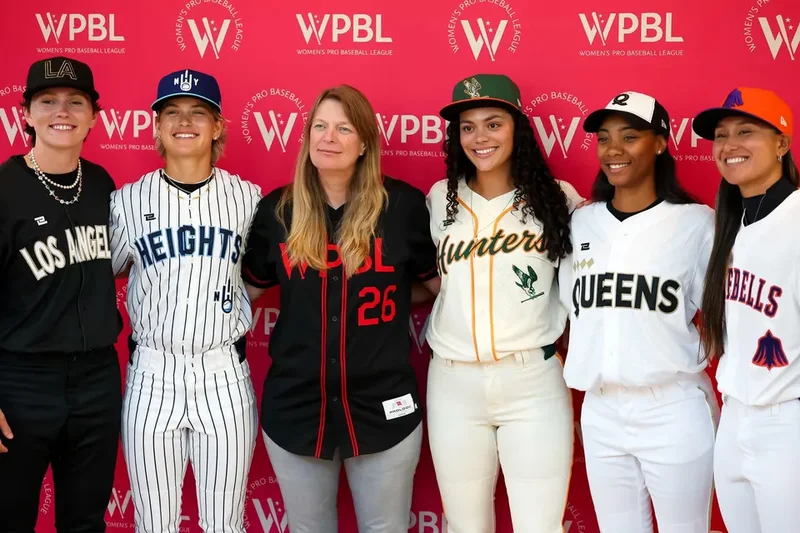
This month, the Women’s Pro Baseball League (WPBL) launched its inaugural season, marking the first time women's professional baseball is being played in the U.S. in 72 years. The league is led by co-founder and commissioner, Justine Siegal, who was the first woman to coach a professional men's team and throw batting practice for the MLB. The WPBL currently comprises four teams named after historical trailblazing women, including the New York Heights, San Francisco Firebells, Los Angeles Queens and Boston Hunters.
The WPBL's Launch Shows How the Business of Women's Sports Is Evolving
What’s more, the WPBL had sponsorship, apparel and media rights deals locked in before the first game. In July alone, Horace Mann was named as a founding partner, joining the league as the official multiline insurance and financial services partner and launching a season-long "Teacher & Educator Appreciation Night" program to honor educators every Wednesday. DICK's Sporting Goods also teamed up with PROLOOK to manufacture the WPBL's player jerseys, uniforms, practice apparel, and travel gear. And New Era supplied official team caps for the inaugural merchandise collection. Additionally, ESPN reached a media rights agreement with the league, with 36 games streaming on the channel for the inaugural season and 11 regular-season games simulcast on the Scripps Sports Network.
The immediate investments in the WPBL before its inaugural season began marks a significant step forward for women's sports. Historically, brand and media buy-in for women’s sports depended on proving an audience existed first. For instance, women's vert skateboarding was cut from the X Games in 2011, and pro skaters spent over a decade building followings on social media with no pay or broadcast support before the event returned in 2023.
Similarly, the WNBA played nearly three decades under media rights deals averaging about $43 million a year. After viewership records in 2024, Disney, NBCUniversal and Amazon committed $2.2 billion over 11 years. The league has since added Paramount, Scripps, USA Sports and NBA TV, bringing the package to $3.1 billion. This averages about $281 million annually, a roughly 550% increase over the previous deal.
The WPBL skipped that step, and recent research helps explain why. According to Deloitte's "Game changers: Unlocking the potential of women's sports" analysis of publicly available data across leagues, the global women's elite sports market is projected to reach at least $3 billion this year, a 340% increase since 2022. Brands and broadcasters are no longer waiting for proof that women’s sports leagues will succeed because the proof is already in the market.
Opportunities to Keep the Momentum Going in Women’s Sports
The WPBL's pre-launch deals are a promising start, and other leagues are showing what sustained investment looks like in practice. Rising league valuations, brand deals, new media commitments, and growing investment in player compensation are the areas where women's sports have gained the most ground, and where continued commitment can keep moving the needle.
Foremost, league valuations are rising sharply. According to Forbes' "NWSL's Most Valuable Teams 2026" list, a group led by Jimmy and Dee Haslam, owners of MLS's Columbus Crew and the NFL's Cleveland Browns, paid $205 million for the league's newest expansion franchise in Columbus, Ohio. Established NWSL teams are now worth an average of $200 million, up 49% year over year, and the lowest-valued team carries a $140 million price tag, twice what the bottom of the league reached in 2025.
Brands are committing to women's sports teams earlier, too. In February, Aflac signed a seven-year front-of-kit deal with the NWSL's Atlanta expansion team, which doesn't play its first game until 2028. Long-term commitments like these give new teams a financial baseline to build on, and the more owners and sponsors that move before opening day, the faster women's teams can get off the ground.
New media commitments are also expanding reach. In March, the PWHL landed its first national television deal through a partnership with Ally and Scripps Sports, giving the league consistent visibility in only its third season. That same season, it exceeded one million attendees for the first time, grew its partnership portfolio 35%, and increased merchandise sales by 50%. And through Nielsen Big Data reported by * Sports Business Journal*, the WNBA shows what expanded coverage can deliver, with TV viewership up 12% in the first year of its new media rights partnerships. Broadcasters and sponsors that commit to leagues, especially early on, help build the audiences that make larger rights deals possible down the line.
Additionally, increased investment in player compensation is starting to follow rising valuations and media rights deals. As previously reported, the WNBA's new collective bargaining agreement set this season's salary cap at $7 million and adjusts it annually based on team and league revenue growth. Meanwhile, the WPBL teams currently operate under a $95,000 cap for their full rosters in year one, covering living costs across the season plus a share of sponsorship revenue. Tying pay directly to league performance as the WNBA did could give leagues like the WPBL a model to grow into as their own revenues rise.
Nearly three quarters of a century passed between the end of one women's professional baseball league and the start of another. What makes the WPBL different from the league that came before is that the money arrived first. Sponsors, apparel partners, and broadcasters signed on before a single pitch was thrown, which is not how women's sports have typically been built up in recent history. Now, women’s sports valuations are climbing, brands are signing multiyear deals with teams that aren’t even playing yet, and media partners are backing leagues in their earliest seasons.
The appetite for women’s sports is alive and well, and progressively, investors, brands and broadcasters are becoming more willing to buy-in. Keeping that momentum going means more of them moving in quickly, even before the first seasons start, and leagues making sure the returns reach the women athletes generating them.