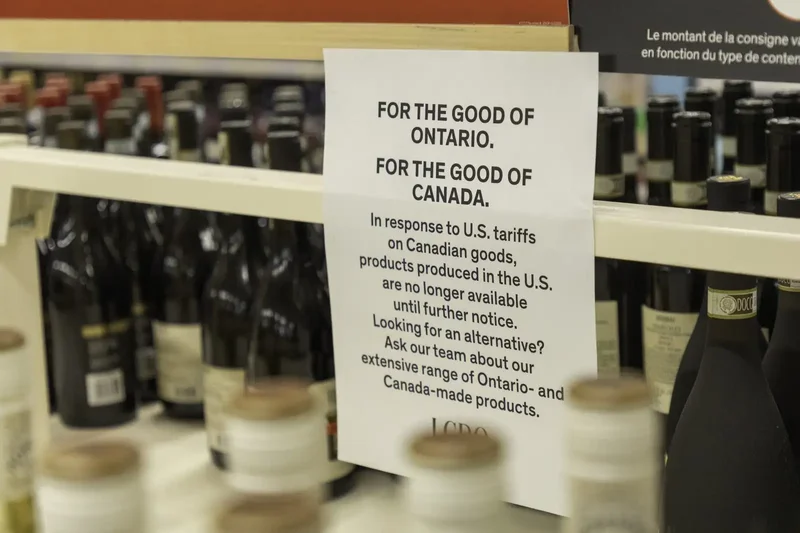
Wineries in both Ontario and the U.S. say they would welcome having American wines back on the shelves if it would help ease the trade war between Canada and the U.S.
“We get caught in these trade disputes that don’t really involve us,” Michael Kaiser, executive director of Wine America, told Global News.
Canadian provinces and territories began pulling American alcohol from their shelves in March 2025 as a retaliatory effort to the 25 per cent tariffs U.S. Donald Trump slapped on Canadian goods.
But as the deadline looms for a fresh round of 50 per cent tariffs, which Trump says are a response to “discriminatory” measures by Canada, some political leaders are considering making new space on liquor store shelves.
Earlier this week, Quebec Premier Christine Fréchette said she would be open to allowing U.S. wines back on the shelves if there are gains on the trade front, including reductions in tariff barriers for key sectors such as forestry, aluminum, and manufacturing.
As Prime Minister Mark Carney faces the August 19 tariff deadline, Conservative Leader Pierre Poilievre criticized Carney, saying he has already “backed down” to many of Trump’s demands, including splitting of net revenues from the Gordie Howe Bridge.
Poilievre urged Carney not to give any more concessions to the U.S., including pushing provinces and territories to put American booze back on store shelves.
Norman Beal, president of the Peninsula Ridge Estates Winery in Ontario, told Global News that if putting U.S. products back on the shelf would ease tariffs on other key sectors, that’s a price he’s willing to pay.
Get daily National news
“As much as it’s being a benefit to us, the damage to our overall economy is much worse,” he said.
Approximately two in five Canadian exporters say they currently export a product to the U.S. that would fall under the pending tariffs, according to a survey from the Canadian Federation of Independent Business.
Of those, more than three-quarters said they expect to lose revenue if the tariffs go ahead, with 35 per cent saying they stand to lose at least half of their revenues.
Eliminating U.S. products from liquor stores has also been a huge loss for American producers.
Kaiser, from Wine America, told Global News that Canada is the largest market for American wines outside of the U.S., especially for states like California, Oregon and Washington.
“We haven’t fully tabulated the numbers, but there’s millions in lost sales,” he said.
Unable to export wines across the northern border, Kaiser said there is also more competition between wineries to get their product on American shelves.
“If you lose that particular market but still have the same amount of wine that you need to sell, it’s a problem to try to figure out where to sell that,” he said. “So that has the ripple effect of the entire industry where now American wineries might be fighting for more American shelf space.”
Canadian producers have been anticipating the possibility of American wines making a return, Aaron Dobbin, president and CEO of Wine Growers Ontario, told Global News.
- Montreal tourism breaks previous record with numbers climbing exponentially
- Trump tariffs could see Canadian exporters lose half their revenue: survey
- City of Calgary, Rocky View County sign partnership to accelerate Prairie Economic Gateway
- Strategic oil stockpiles have hit a 40-year low amid the Iran war
“It’s not a matter of if, it’s just when,” he said.
But with American products off the shelves for a year and a half, he said Ontario and other Canadian producers have been able to appeal to the local consumer base.
“Ontarians have embraced buy local, buy Canadian, buy Ontario across all of their purchases, including wine,” he said. “I expect that that will have some lasting resonance with them and they will continue to look to support local.”
Sixty-nine per cent of Canadians in British Columbia, Ontario, Manitoba and the Maritimes said their provincial governments should keep the restrictions on American alcohol in place, according to a survey released by Abacus Data earlier this month.
That would spell good news for people like Beal.
Kaiser said that is a “serious” concern for American producers, that they may have lost their customer loyalty in Canadian markets.
“Consumers have either moved on to other products or they have a deep-seated dislike of our country’s leadership and, unfortunately, our products are what is getting impacted by it.”
Regardless, Kaiser said he is looking forward to the possibility of expanding back into the Canadian market, and hopes that could ease some of the animosity between the two countries.
“I think if we get our products back on their shelves, that could also be a step towards the goodwill being reestablished,” he said.
– With files from Ariel Rabinovitch and Uday Rana, Global News