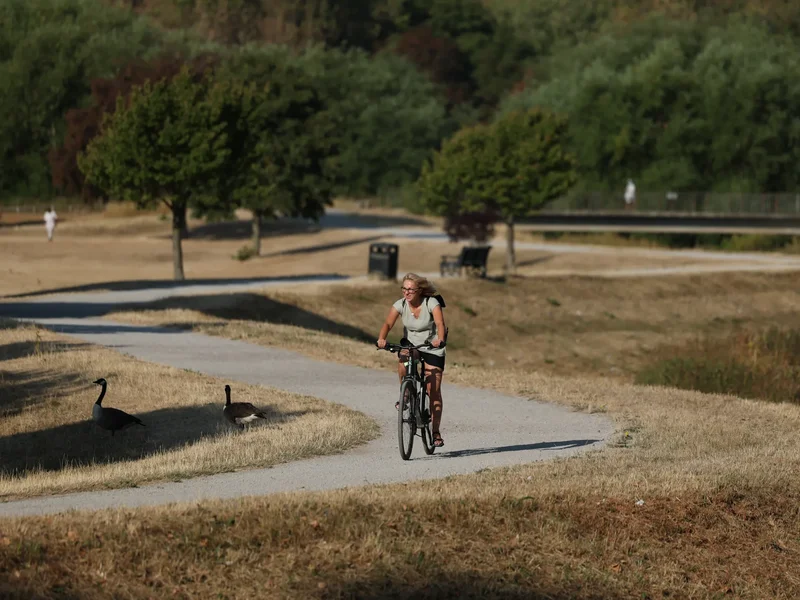
More than 135 million people across Europe, mostly in France, Italy, Spain and the United Kingdom, will face temperatures above 35 degrees Celsius (95 Fahrenheit) as the continent’s latest heatwave builds.
According to German weather service forecasts and 2025 population projections from the European Commission’s Joint Research Centre, nearly three in five Europeans, or about 340 million people, will feel temperatures surpassing 30C (86F) on Thursday. The figures line up with separate tracking from Austria’s Klimadashboard.
Recommended Stories
list of 3 items- list 1 of 3Central Europe sees record temperatures as heatwave continues
- list 2 of 3Wildfires in Albania and Spain cause hundreds to evacuate
- list 3 of 3Wildfires bear down on homes in Canada’s Okanagan region
The UK and France are set to experience their fifth heat wave of the summer. Forecasters predict temperatures could reach 38C (100F) in central and southeast England, possibly marking the hottest day of the year.
France may see temperatures as high as 40C (104F).
The highest temperature in the UK so far this year was recorded on June 26, when the temperature hit 38C in eastern England.
Britain’s Met Office said earlier this week that only average conditions were needed for the rest of August to beat last year’s record for the hottest ever year.
‘Impossible and inhumane’ conditions
The UK’s Royal College of Nursing (RCN) said on Thursday that extreme heat is making parts of the National Health Service (NHS) an “impossible and inhumane” place to work and receive care.
Calls to the RCN helpline report staff collapsing on shift, experiencing heat-related seizures, and pregnant nursing staff working in temperatures above 30C, the RCN said. Many staff reported that they were working without access to air conditioning, fans or even adequate ventilation.
Both France and the UK are also facing widespread drought, like much of Europe, as shrivelled crops and drained rivers strain water supplies for households, farms and the environment.
This has forced governments to seek both short and long-term fixes to slow down the effects of what is widely seen as human-caused climate change.