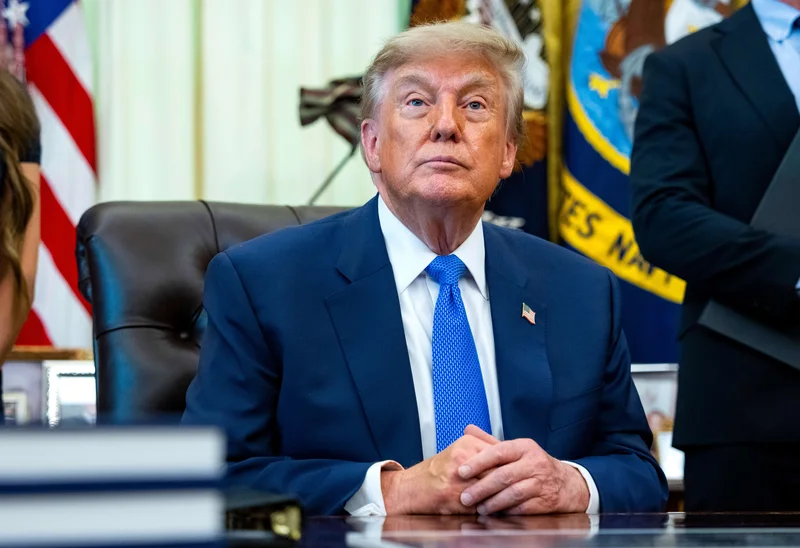
Two top Democratic lawmakers are pushing President Donald Trump for answers on the mountain of stock trades made in his name since he returned to the White House.
In a 17-page letter sent Wednesday and seen by CNBC, Sen. Elizabeth Warren of Massachusetts and Rep. Robert Garcia of California asked Trump to reveal the money managers he says are in charge of all his investment decisions.
They also pressed him to disclose his involvement in or awareness of numerous individual stock trades that have raised concerns due to their potential overlap with government policy, or their proximity to market-moving statements made by Trump himself.
"The appearance of numerous conflicts of interest from a President trading in individual stocks – including the potential for insider trading, market manipulation, and policy decisions that benefit the President's stock portfolio rather than the public interest – undermines public trust in government," Warren and Garcia wrote in the letter.
"The American people deserve to know that the President is not using his office to increase the value of his stock portfolios, rather than working to bring down the cost of groceries," they wrote.
The letter is the latest sign that Democrats are gearing up to aggressively investigate Trump if they win control of one or both chambers of Congress in the November midterms. Garcia is ranking member of the House Committee on Oversight and Government Reform.
The Democrats wrote that they sought the responses from Trump in order to inform their work on potential legislation to ban presidents from owning individual stocks. U.S. presidents are currently allowed to trade securities, but legally required to report their transactions.
"The American people deserve to know if the president is working for them or for his own stock portfolio," Warren said in a statement to CNBC. "It's past time we ban Members of Congress, the Vice President, and the President from owning and trading individual stocks."
The White House did not immediately respond to CNBC's request for comment on the letter.
Trump has defended the staggering number of trades made in his name — more than 21,000 in 2025 alone, according to an analysis of his 927-page annual financial disclosure — by insisting that he has no contact with the institutions that run his money.
CNBC previously linked JPMorgan Chase, Charles Schwab, UBS and Stephens Inc. to at least four of the eight investment accounts listed in Trump's 2025 disclosure. A full list has not been disclosed, and details about how outside firms handle Trump's portfolio — and how and when they make decisions about what to buy and sell — remain unclear.
"We have funds that run my money," Trump said in July. "They invest my money, and I don't talk to them. I never — I don't even speak to them."
Wednesday's letter from Warren and Garcia asked Trump to list "all third-party institutions and managers that direct your trades" and explain how they were selected, what mandate they were given and what investment processes they use, among other information.
The White House has flatly denied that Trump's financial disclosures, which by some estimates show he made more than $2.2 billion in revenue last year, raise any conflicts of interest.
Trump has placed much of his wealth in a revocable trust bearing his own name, with his eldest son Donald Trump Jr. named as the sole trustee. That arrangement gives Trump more control than if he were to set up a blind trust, as other recent presidents have done.
Eric Trump, another of the president's sons who serves as executive vice president of the Trump Organization alongside Trump Jr., has pushed back on criticism of his father's financial arrangement.
After Trump's disclosure covering the first three months of 2026, Eric Trump wrote on X that the president's holdings "are maintained exclusively in fully discretionary accounts managed by independent third-party financial institutions."
Trump's investments are allocated through "automated, model-based portfolios and direct indexing strategies" that neither he nor his family or its business are involved in, his son wrote.
Days earlier, Eric Trump wrote that "all of our assets are invested in a blind trust" in response to a post on X by Warren slamming Trump for disclosing Nvidia stock purchases after that company's CEO, Jensen Huang, joined the president on a trip to China.
"To suggest that individual stocks are being bought or sold, at the discretion of any member of the Trump family, would be a lie and blatantly false," Eric Trump replied to Warren, who wrote that the president's "corruption is a national security disaster."
The New York Times has reported there is no indication of the existence of a blind trust, which would require Trump to have no knowledge of what is in the portfolio.
Warren and Garcia in their letter this week also questioned Eric Trump's claim about a blind trust, writing to the president, "you yourself signed a financial disclosure certifying your awareness of thousands of individual stock transactions."
The lawmakers' letter focuses mainly on the more than 3,500 trades that Trump reported in the first three months of 2026.
"The sheer volume of stock trading by a sitting president is unprecedented," they wrote. "You—or the entities responsible for your accounts—made an average of approximately 50 trades every day markets were open during the first quarter of 2026."
They highlighted 15 instances of what they said were examples of Trump buying stock in a company prior to an official government announcement favorable to that company.
They include purchases of Nvidia and Advanced Micro Devices on Jan. 6, one week before the Trump administration announced loosened export controls that would "make it easier to sell AMD and NVIDIA chips to China," according to the lawmakers.
They also pointed to Trump's Feb. 10 purchase of between $1 million and $5 million of stock in Taser-maker Axon Enterprises, two weeks before Immigration and Customs Enforcement unveiled a $220 million Taser contract. Experts told CNBC in June that the contract appeared tailored to Axon's products.
The letter further questions certain sales of Microsoft and Meta stock.
The Democrats also cited examples in the filings of Trump purchasing a company's stock days before publicly praising the firm. A purchase of Dell stock on Feb. 10, for instance, came nine days before Trump said in a speech, "Go out and buy a Dell Computer," they wrote.
But the total list of Trump's questionable trades, Warren and Garcia argued, is nearly as long as the president's entire financial disclosures.
"The sheer volume of your trades, the amount of business conducted by the federal government, and your administration's specific actions and priorities, means that the value of virtually every one of those stocks that you have traded in is directly affected by your official actions," they wrote.
Warren and Garcia asked Trump to answer their questions by Aug. 28.