German court ruling on Israel-Nazi comparison is a step in the right direction
A German court this month decided that comparing Israel to Nazi Germany is protected legal speech, highlighting a growing conflict between constitutional protections and Berlin’s political commitment to Tel Aviv.
The regional court acquitted a woman convicted in a lower court over social media posts comparing Israel’s conduct in Gaza with the methods of the Nazi regime.
In recent years, Germany’s support for Israel has increasingly shaped policing, administrative decisions and criminal prosecutions.
After 7 October 2023, Germany banned Hamas and Samidoun, a Palestinian advocacy group, while increasingly using laws originally aimed at preventing a Nazi revival to crack down on criticism of Israel.
The recent court ruling, which found that the woman’s use of Nazi imagery in the context of Israel’s conduct in Gaza constituted protected political expression, rejected the prominent notion within German circles that such analogies are inherently criminal in nature.
Taking into account the ongoing discussion about Israel committing genocide in Gaza, alongside the International Criminal Court warrants against top Israeli politicians and the pending cases against Israel and Germany at the International Court of Justice, the German government is far from achieving public consensus.
Even before the events of 7 October 2023 and the war that followed, more than a third of Germans polled said they believed that what Israel was doing to the Palestinian people was “in principle the same thing the Nazis did to the Jews in the Third Reich”.
Public opinion has since soured further, with more than 60 percent of Germans now favouring European sanctions on Israel.
Moral reflection
Comparisons between Israel and Nazi Germany have been part of academic, philosophical and legal debates since the establishment of the state of Israel, founded in 1948 amid the brutal extermination and ethnic cleansing of the indigenous Palestinian population.
These comparisons have long appeared in discussions of Palestinian, Israeli and German memory, identity and moral reflection. Shoah and Nakba both mean “catastrophe”, and scholars such as Amos Goldberg and Bashir Bashir have examined them as interconnected national traumas.
They raise questions of historical responsibility and inherited guilt, especially regarding how the memory of one catastrophe shapes the interpretation of another.
The interconnection also remains visible in contemporary German discourse on Jewish memory: in 2023, Masha Gessen compared Gaza to Jewish ghettos under Nazi occupation, sparking controversy around the Hannah Arendt Prize.
The controversy reveals a particular German claim to authority over how Jewish memory may be invoked and how Palestinian suffering may be compared to it.
During the First Intifada, some Israeli soldiers described identifying with the Nazis while witnessing the persecution of Palestinians, with one revealing in a study on the 1987-93 uprising: “I felt like, like, like a Nazi … it looked exactly like we were actually the Nazis and they were the Jews.”
Criminal proceedings relating to Palestine have increasingly become symbolic struggles over national identity and historical memory
Yet over the past decade, Germany’s commitment to Israel’s security has evolved from a foreign policy principle into a broader framework shaping domestic governance.
Although this “reason of state” has no independent legal force, it has increasingly influenced decisions by ministries, universities, municipalities and law enforcement authorities. The recent court judgment, however, makes clear that such political commitments cannot replace constitutional standards when determining the legality of political speech.
Governments can pursue particular foreign policy objectives, but courts remain bound by constitutional principles rather than executive preferences. The decision thus implicitly rejects attempts to transform Germany’s “reason of state” into a quasi-constitutional construct capable of restricting political speech.
In doing so, it reasserts the autonomy of constitutional law against the growing influence of political doctrine.
Broader transformation
Remembering Germany’s Nazi past, and the role that lawmakers and the judicial system played in supporting the prosecution and torture of minorities, judges today have a moral obligation to refrain from considering government ideology as a justification for suppressing oppositional opinions - especially in light of Berlin’s support for an Israel that is ethnically cleansing Palestine and southern Lebanon.
The free-speech case reflects a broader transformation in contemporary Germany. Criminal proceedings relating to Palestine have increasingly become symbolic struggles over national identity and historical memory.
Such debates are rarely confined to the particulars of a single slogan or image, functioning instead as mechanisms through which the state seeks to reproduce a particular interpretation of Germany’s postwar responsibility. From this perspective, the courtroom becomes a place where differing interpretations of history, democracy and state legitimacy are negotiated.
The recent judgement does not establish an unrestricted right for dissenters to compare Israel with Nazi Germany, nor does it dismantle German laws against Holocaust denial or incitement. Rather, it insists that criminal law cannot become an instrument for enforcing political consensus.
Constitutional rights exist precisely to protect political expression, particularly where governmental interests favour its restriction.
Whether the ruling marks the beginning of a broader judicial shift remains uncertain. German courts continue to issue inconsistent decisions on Palestine-related speech, leaving activists, journalists and scholars uncertain about the limits of lawful expression.
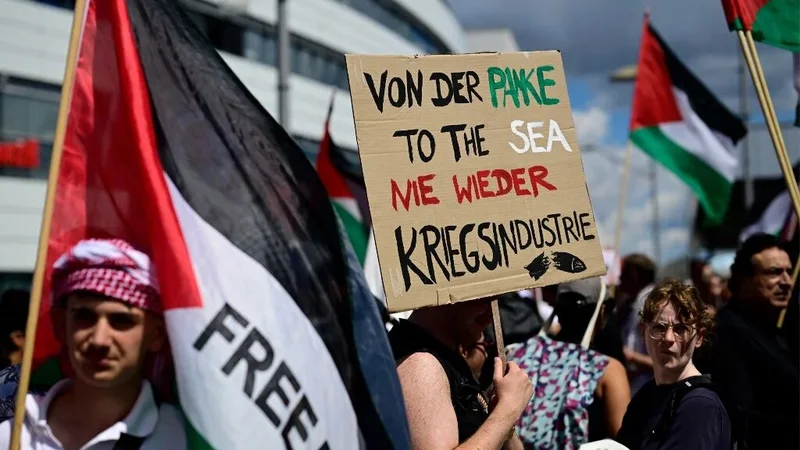
Counter-terrorism laws are being tightened, activists are being tried for membership of a criminal organisation, and court decisions are still unclear as to whether the slogan “from the river to the sea” is legally forbidden.
But given Germany’s own history of judicial complicity in legitimising state persecution, judges carry a particular constitutional responsibility to ensure that political commitments - however deeply rooted - do not override fundamental rights.
The views expressed in this article belong to the author and do not necessarily reflect the editorial policy of Middle East Eye.