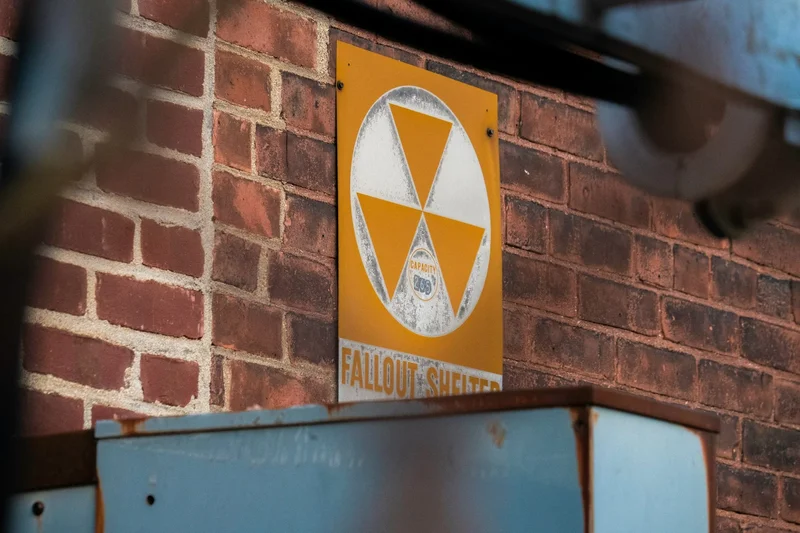
A telehealth startup is selling $345 emergency kits packed with medicine that it claims could help people survive nuclear disasters.
Amble Health’s “Oh Sh*T Kit” comes with iodine tablets, Prussian blue pills for removing radioactive cesium and thallium, and anti-nausea medication ondansetron, or Zofran. “If the unthinkable happens, whether from an accident, disaster, or other radiological event, having the right medications on hand can make a critical difference in the earliest hours. Because when radiation is involved panic is optional, but preparation isn’t,” the company’s website says. You’ll need a prescription to order it; Amble also does telehealth appointments with licensed healthcare providers who can issue prescriptions.
The fear of a radiological disaster isn’t unfounded. After decades of declining nuclear weapons stockpiles, America is building more and new kinds of nuclear weapons. The Trump administration’s nuclear deal with Saudi Arabia includes a provision to allow it to enrich its own uranium and, possibly, a path towards a nuclear bomb for the Middle Eastern Kingdom. Russia is modernizing its nuclear arsenal and field testing new types of nuclear-capable missiles in Ukraine.
If nuclear war doesn’t get you then a power plant meltdown might. The Trump administration has rewritten and outright cut safety regulations around the construction of nuclear power plants. Tech companies are investing billions in new and untested forms of nuclear power generation. Microsoft and others are using AI systems to speed through the lengthy safety processes.
According to Amble, the “Oh Sh*T Kit” is “primarily focused” on people exposed to radiation as part of their jobs, not the next nuclear war. “Millions of workers across medicine, construction, mining, shipping, agriculture, and power generation are routinely exposed to these hazards,” an Amble spokesperson told 404 Media.
“We created this kit to give people an actionable, reliable solution so they have peace of mind and know exactly what to do when the unexpected happens,” the spokesperson added. “Our clinicians (especially in a post pandemic world) identified a growing request-need-concern from their patients having medication available in a situation of emergency when a pharmacy would otherwise be unavailable.”
‘If you have been exposed to enough radiation that you are vomiting [...] you’re already in a lot of trouble.’
Should the worst happen, Amble’s “Oh Shi*t Kit” has promised to help for just $345. But experts told 404 Media that the kits might not actually be all that useful if you’re buying it for prepper reasons.
Amble is an online platform that “connects patients to licensed healthcare professionals in all 50 states, 100% online,” according to a description on its website. The site’s frontage advertises it as a place where people can get prescriptions for weight-loss drugs like GLP-1s and “anti-aging” drugs like NAD+ and Sermorelin.
It was founded by Joey Stiver, an entrepreneur with a felony conviction and a desire to “democratize healthcare,” according to his personal website. According to Stiver, he got a double-tear in his shoulder when he was 18 and didn’t want to have invasive surgery so he bought “healing peptides” online. He liked the product so much he began to sell medical items himself in an “illicit industry” which landed him a federal indictment and felony conviction. Now he’s a telehealth mogul.
GLP-1s are Amble’s big draw, but it also offers a number of “kits” for basic medical emergencies like a “Cold & Immunity Kit” that comes with a run of prescription antibiotics like Amoxicillin and Azithromycin. The “Oh ShT Kit” is part of this line of products. Alex Wellerstein, a nuclear war historian and professor at the Stevens Institute of Technology, told 404 Media that the “Oh ShT Kit” is “a ripoff at $345. Doomsday grifting at its best.” Iodine tablets, potentially the most useful part of the package, are available cheaply without a prescription. A bottle of 60 pills will run you around $13 at a GNC.
“Iodine tablets can be of some benefit if taken directly after some kind of release of fresh fission products (whether a nuclear power plant accident or a nuclear detonation),” Wellerstein said. “They max out the thyroid’s iodine levels and prevent it from greedily up-taking environmental iodine, which means [the thyroid] won’t grab any I-131 that has been produced by nuclear fission.”
I-131 is one of the principal radioactive substances present in the fallout that follows a nuclear disaster. It has a short half life and can wreak havoc on the body. “It is not the only fission product of worry, of course, it is just one that is particularly easy to avoid by taking potassium iodide [...] and a pernicious one as it is so quickly taken up by the body (and also, in turn, excreted relatively quickly, so you have the extra bonus of having radioactive sweat and excrement),” Wellerstein said. Potassium iodide is a medical compound made from iodine.
Medical-grade Prussian blue is a prescription substance that binds to heavy metals like cesium and thallium. According to the CDC, the medicine traps the heavy metals in the intestine and keeps them from being absorbed in the body until the afflicted can shit them out. “[Cesium] has a much longer half-life than I-131 (30 years), and is in the ‘worrisome chronic carcinogen’ category rather than the ‘will give you radiation poisoning’ that I-131 is in,” Wellerstein said. “I suspect it is the sort of thing that would be administered by a doctor, not taken by an individual, assuming there are doctors around after said ‘radiological event.’ It is not something that one should take without knowing exactly what dosages are required, I gather.”
Zofran will keep you from throwing up, but that will be cold comfort. It’s possible that in the aftermath of a nuclear disaster, there are things in your stomach that your body does not want to absorb. “If you have been exposed to enough radiation that you are vomiting (e.g., suffering from some form of acute radiation syndrome), you’re already in a lot of trouble,” Wellerestein said. “Anyway, that would be symptom management, a different category. It has its own possible adverse health effects.”
If you’re worried about nuclear disasters, you can do worse than buying some iodine tablets online. “I think the risk/reward tradeoff for potassium iodide is not terrible for people who worry about being exposed to radiological hazards,” Wellerstein said. “Which is to say, the risk of it happening is pretty low, and it is very cheap when bought on its own and not from grifters, and so if it brings you peace of mind to keep some around, I see no harm in that.” The rest, however, is probably not worth the money.