"On one hand I resent it," Tim Layana told a reporter from the South Florida Sun-Sentinel while watching a 44-year-old Steve Carlton throw a bullpen session at Yankees spring training in 1989. Layana, who was then 25 and had just reached Triple-A, would pitch in three big-league seasons for the Reds and Giants; Carlton was 44, had won four Cy Young Awards and 329 games. He was a veteran of 24 MLB seasons, an easy hall of famer, and identifiable as fully cooked from a hundred paces.
The Yankees hadn't invited Carlton to spring training, and neither had any other MLB team. Carlton had made it into four games with the Twins in 1988, allowing 20 hits, five homers, and 18 earned runs in 9.2 innings. Yankees manager Dallas Green let him throw at Yankees camp as he rehabbed an elbow surgery and auditioned for a job with whomever might need a pitcher who could do what he did. The story describes Carlton wearing cutoff uniform pants as shorts, and an "an observer" remarking to the Yankees VP for Player Development that Carlton was "not throwing hard." From that point forward, Tim Layana would be a better big-leaguer entirely by default; Carlton, whose agent had lost tens of millions of Carlton's dollars in bad investments, was trying to get one last job because he needed one, but would not pitch in MLB again.
"I guess guys like him and Tommy John and Ron Guidry still have the dream to pitch in the big leagues, like we do who’ve never been there," Layana said, before acknowledging and explaining the resentment he felt about that. "I mean, they’ve had their time, now step aside and give somebody else a chance. But I can understand their desire. If I could still throw at their age, I’d wanna be competitive and try to get people out, too."
In my opinion Tim Layana made some good points, there. Carlton's extenuating financial circumstances were by then a matter of public record; he'd sued his agent in 1983 for embezzlement. That he had nothing left as a pitcher was about equally clear. Between '86 and '88 Carlton had pitched, and mostly gotten torched, in Philadelphia, San Francisco, the South Side of Chicago, Cleveland, and Minnesota. After two decades as one of the very best left-handed pitchers in baseball history, Carlton had become the most marginal and fungible sort of major-leaguer: just a guy who sopped up some soggy innings for variously aimless teams. The Twins, who won the World Series in 1987, were an exception there, but they left Carlton off the postseason roster after he walked more batters than he struck out in nine appearances after coming over in a midseason deal for a player to be named later who would eventually top out in the Mexican League. Carlton did win his 329th and final MLB game for the Twins that August; in 2014, his Twins World Series ring went up for auction online.
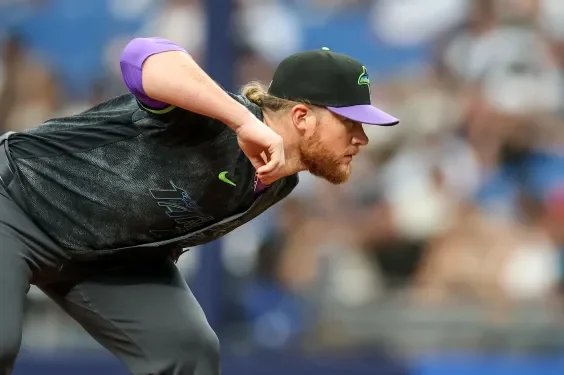
Comparing Craig Kimbrel to Steve Carlton both flatters Kimbrel and is in a narrow sense uncharitable to him. Kimbrel really was just about as dominant a closer as the game has seen during his peak, but Carlton was the best starting pitcher in the sport for a decade; those are different roles and different eras, but also those are just different things. Carlton's bleak endgame unfolded over three seasons at the end of a long and brilliant career; he pitched for six teams in all. Kimbrel's last great season came as the closer for the World Series champion Red Sox in 2018, and followed a 2017 season that was one of the most dominant relief campaigns in history; he has pitched for ten different teams in the eight seasons since then, and when he made his debut with the Royals on Wednesday night, who signed him earlier this week after first the Mets and then the Rays cut him loose, Kimbrel got an out for his third big-league team this year.
A great many baseball careers end like this, and that Kimbrel is still bouncing his way down this Plinko chute of an endgame is notable mostly because he has a decently viable case to join Carlton in Cooperstown. Starting pitchers are no longer used in the way Carlton was—Logan Webb's 207 innings pitched led the sport in 2025; Carlton cleared 250 a dozen times, and twice topped 300—and the closer role that Kimbrel once exemplified barely existed during Carlton's career. This is something that people with hall of fame votes will have to figure out, and they should absolutely do that on their own time.
What is interesting about Kimbrel's endgame, at least to me, has more to do with how he has chosen to ride it out. Kenley Jansen, who is third all-time in saves—Kimbrel is fifth, 50 behind Jansen's 490—was never quite as dominant as Kimbrel but has had a much more distinguished if also extremely itinerant late career serving as a moderately reliable closer for teams shopping in that particular aisle. Kimbrel was on a similar career track—decent enough to bank some saves for teams in the market for that kind of closer, diminished enough to lose the job at some point before the seasons changed to fall—until 2024, when an Orioles team that ostensibly saw itself as a World Series contender finally dropped him in late September. He saved 23 games that year, just as he had the year before with the Phillies, which was one more than he'd saved with the Dodgers the year before that. That could have been the end, and there is no apparent Carlton-style financial precarity or other extenuating circumstance that explains why it wasn't.
But it wasn't. Instead, Craig Kimbrel, who had been the most overpowering pitcher in the sport a decade earlier, instantly dominant at 22 and National League Rookie of the Year at 23 and seven times an All-Star at 30, became someone who was willing to spend his late 30s pitching in Round Rock and Syracuse and Gwinnett County. It was easy enough to understand why teams kept picking him up, and equally easy to understand why those same teams have been so comfortable letting him go. Beyond the fact that this was literally Craig Kimbrel, his pitches have continued to be weird and nasty in something like the ways they were when they were the weirdest and nastiest pitches in the sport. They're just slower, now, and more estranged from their author; the traits and attributes are there, but they don't cohere. "Stuff models still like what they see," his entry in the 2025 Baseball Prospectus Annual read, "but they don't worry about where the plate is."
Teams that pride themselves on identifying those sorts of promising traits and successfully rebuilding pitchers' approaches around them—the Mets have intermittently been able to do this; the Rays always have—have taken fliers on Kimbrel, and then moved on. The stuff still works well enough for even smart teams to dream on, but it also doesn't work like it used to, and there is less and less to wring out of it. That Kimbrel's 12th team is the Royals, who are just trying to get through a disastrous season, is mostly a matter of happenstance. But also that is where he is, now—catching on where he can catch on for as long as the catching-on is good, hanging out with Ron Villone and Matt Stairs and Mike Morgan in the club of Guys Who Have Played For 12 Big League Teams.
Again, it is hard to know the minds of hall of fame voters, and that vinegary juice is not necessarily worth the squeeze. It might be that Kenny Lofton's (extremely compelling, in my opinion) hall of fame case was hurt by the six seasons he spent bouncing from team to team at the end of his career. It might be that Kimbrel, whose case for enshrinement was always going to be vibe-heavy in the way that closer's cases tend to be, is arguing against himself every time he hits his familiar stance in a new uniform and issues a grueling nine-pitch walk. None of this is as interesting, ultimately, as the fact that he's still choosing to do it.
In the stories that get written every time Kimbrel joins a new bullpen, he comes off as both optimistic and realistic. "I’m not throwing 100, but my stuff’s still there," he told The Athletic in March of 2025, a season in which he would throw one inning for the Braves and 11 for the Astros. That is still true enough; it is also true that Kimbrel's ERA in 104 appearances since 2024 was 4.78 heading into Wednesday's game. Kimbrel spent much of the 2025 season in Triple-A at age 37, which is something that Carlton was unwilling to do even at the end. "It's been fun, actually," Kimbrel told MLB.com after signing with the Royals. "Getting to know the game in a little different light. Getting to talk to guys who are on their way up. Spent a lot of time in Triple-A last year. Getting to see the game through that lens."
This is the sort of thing a stand-up veteran is supposed to say, and everything Kimbrel has done suggests he really means it. But also Craig Kimbrel is different, and he knows he is different, and he surely remembers that fact as well as you or I do, even and especially as it recedes in the rearview. It is probably true, as Kimbrel has said every time he has changed teams, that he still enjoys the work and still believes in his stuff. It is also true that, having actually been Craig Kimbrel for as long as he has, his perspective is very different from those of us watching his numbers tick up from one desultory outing to the next. Kimbrel has been a star, and now he is this; he spent nearly as much time as a merciless godhead as he has being an increasingly disposable cog, but that doesn't mean the two experiences even out.
"To a great degree, he feels superhuman," Carlton's former catcher Tim McCarver told the Washington Post's Paul Domowitch in 1988. "He refuses to think like other mortals. It's not in his makeup to ever consider things in realistic, practical fashion. Everybody says, 'If I were in his shoes, I'd quit.' But if you're not in his shoes, you don't understand how he thinks. Part of the things that made him great are part of the things that are making him hang on. He may regret it 10 years from now. But I can't regret it for him now."