Sign in. It’s quick, free and it’s up to you.
An account is an optional way to support the work we do. Find out more.
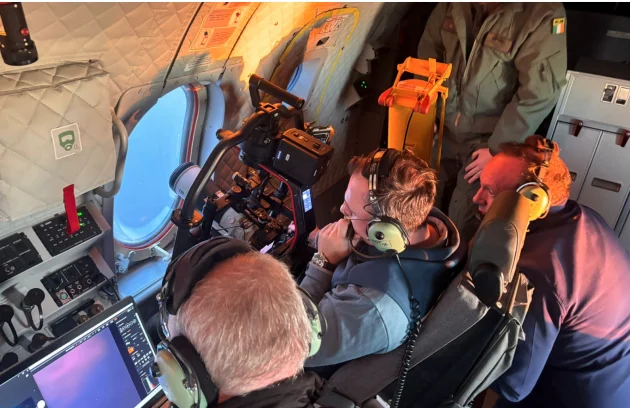
AS THE SOLAR eclipse took hold over the island, scientists took to the skies in what was called a flying observatory to get a closer look at the rare event.
Astrophysicist Dr Laura Hayes of the Dublin Institute for Advanced Studies (DIAS) was joined by colleague Dr Peter Gallagher on board the Aer Corps flight.
The team also included researchers from Trinity College Dublin and the Italian National Institute for Astrophysics (INAF).
For a few crucial moments, Hayes was placed in the path of totality, gaining a view of the full eclipse.
The mission, which took over a year to plan, would give the scientists a rare opportunity to examine the Sun’s outer atmosphere or corona and how the Sun’s magnetic field shapes and influences it.
During a total solar eclipse, the Moon blocks out the Sun’s bright disc, briefly revealing the faint, glowing corona around it.
Although it sits far above the visible surface of the Sun, the corona can reach temperatures of around two million degrees Celsius.
Scientists still do not fully understand why this happens, and an eclipse offers a valuable opportunity for further discovery.
Now back on the island, Hayes told The Journal that “it couldn’t have gone better”.
“These types of eclipse missions, weather is always a huge part, and we’re flying a plane, you know, at 10,000ft to a specific part of the Atlantic Ocean, and only have two minutes to catch data. So in reality, the risk of failure is quite high”, she said.
The level of visibility was a key concern for the team ahead of the expedition.
“It was just a matter of the weather playing its part. And we were a bit nervous the day before, looking at the forecast over the Atlantic. It wasn’t looking great”.
I don’t know if the gods were in our favour or something, but we actually really had a clear view most of the way out. And then, literally just before totality, when the moon goes 100% in front of the sun, we got a clear view,” Hayes told The Journal.
They opened up the window, depressurised the plane and took images of the sun with a solar filter, counting down to the eclipse.
“We could see the dark shadow coming over the Atlantic. And then, once we had those two minutes, we took our solar filter off and got our observation”, she said.
A new telescope, the E-CorMag, was developed for use during the critical mission.
As a result, scientists now have data from a specific line called Iron 14, which is important for studying the southern atmosphere.
It measures temperatures of around 2 million degrees. The telescope can then use polarisation measurements to determine the direction of the magnetic field.
“Our Nasa colleagues were flying a similar piece of equipment on a fighter jet from Iceland. So they were flying a little bit higher, a little bit faster, but they were taking the same measurements. So our plan then next week used to chat with them and compare data”, Hayes revealed.
She described the information gathered as significant, and the mission on the whole took a lot of planning and dedication.
“It was an amazing experience just as a person to be there, but as a scientist, I still can’t believe it happened, to be honest”.
To embed this post, copy the code below on your site